
How to Receive Money From Abroad in Colombia: Bancolombia, Nequi and More (2026)
Every way to receive money from abroad in Colombia: Bancolombia and other banks, Nequi, Daviplata, Western Union, PayPal, Payoneer and stablecoins, with costs, exchange codes and taxes.

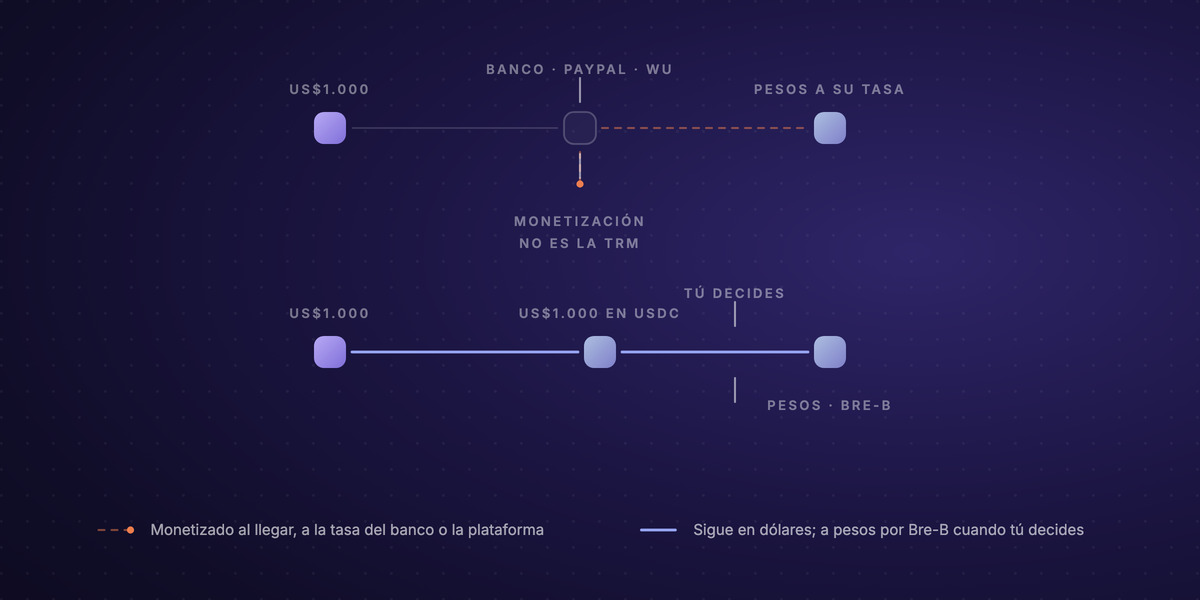
To receive money from abroad in Colombia you have seven routes: an international wire to your account at Bancolombia or another bank, a remittance network like Western Union, the Nequi and Daviplata apps, PayPal, Payoneer, Wise and stablecoins. All of them work. What separates them is a step almost nobody in Colombia gets to skip: a resident individual can't hold a dollar account at a Colombian bank, so the dollars are converted to pesos on arrival, at the rate the bank or platform sets rather than the TRM, the official rate of the day. That gap never shows up as a fee, but it comes out of your payment.
If you're waiting for money from a relative, the short answer is Nequi or Daviplata through a partner remittance company. If you're getting paid for your work, the choice matters more, and this guide compares every route with its published costs, explains which exchange code (numeral cambiario) to pick when the bank asks you to accept the transfer, answers the questions people search most (yes, it's legal; no, there's no legal cap and no tax on receiving) and ends with a way to get paid in dollars and move to pesos when you decide.
What makes Colombia different: the transfer is converted on arrival
Colombia received US$13.1 billion in remittances in 2025, a record, and almost half of it came from the United States (49%), followed by Spain (17%). On top of that comes money that isn't a remittance at all: freelancers, developers and consultants billing clients abroad. The infrastructure that gets this money to Colombia works well. The problem is the next step.
Under the Banco de la República's foreign exchange rules, resident individuals are not among those allowed to hold foreign-currency deposits at a Colombian bank. So when a dollar transfer reaches you, the bank doesn't keep it in dollars: it buys it from you. Colombian banks call this monetizing the transfer (monetizar el giro). When you accept it, you provide the "minimum data" of the operation, which legally serves as the exchange declaration (the old paper Formulario 5 no longer exists), and that data includes the exchange code (numeral cambiario) that says what the money is:
- 1840: business, professional and technical services. This covers consulting, software development and professional fees, and it's the one most freelancers use.
- 1809: workers' remittances, the money a relative working abroad sends home.
- 1810: donations and transfers with nothing given in return.
The code matters more than it looks: banks report every foreign exchange operation to DIAN, the tax authority, with no minimum amount, and the code is what tells DIAN whether that money is income from your work or family support.
Two practical consequences:
- The main cost is the rate, not the fee. Bancolombia, for example, doesn't charge to receive a transfer, but it pays you at its own rate of the day. On a US$2,000 payment, a few points of difference in the rate outweigh any fixed fee.
- Choosing a method means choosing who converts. The bank, the remittance company, PayPal and Payoneer all convert on arrival or on withdrawal, each with its own margin. Stablecoins are the only route where your dollars stay dollars until you decide to sell them.
With that in mind, the routes.
Every way to receive money from abroad in Colombia
| Method | What you receive | Typical cost | Timing |
|---|---|---|---|
| International wire (SWIFT) to your bank | Pesos, at the bank's rate | Bancolombia doesn't charge to receive; intermediary banks may deduct fees; the margin is in the rate | 1–3 business days |
| Western Union and remittance companies | Pesos in cash, in an account, or in Nequi and Daviplata | The sender pays the fee; your cost is in the rate | Minutes |
| Nequi and Daviplata | Pesos in the app, from partner remittance companies | Free for the recipient; monthly caps | Minutes |
| PayPal | Dollar balance, withdrawn in pesos | 5.40% + US$0.30 per international payment, 3.5% on conversion, COP 3,500 per withdrawal | Instant; withdrawal takes business days |
| Payoneer | Dollar balance, withdrawn in pesos | 1% (min. US$1) to receive in its USD account; 1.2% to 4% on withdrawals with conversion | Business days on withdrawal |
| Wise | Balance in dollars and other currencies, withdrawn in pesos | Conversion fee published by Wise | Varies by currency |
| Stablecoins (USDC/USDT) | Digital dollars in your wallet | A few cents in network fees; you move to pesos whenever you want | Minutes |
How to receive money from abroad at Bancolombia
This is the most searched question on the topic, and the route is simple. The sender needs three things: Bancolombia's SWIFT code, COLOCOBM, your full name as it appears at the bank, and your account number. When the transfer arrives, you have two options: turn on automatic crediting, or accept it yourself within 30 days in the Sucursal Virtual Personas (online banking), which handles up to US$249,999 per operation (larger amounts go through the bank's trading desk). When you accept, you see the exchange rate before the pesos are credited, and you choose the exchange code.
How much does Bancolombia charge to receive money from abroad? According to its own page, receiving is free, although banks along the way may deduct their own charges. The real cost is in the rate: Bancolombia buys your dollars at its price of the day, which isn't the TRM. To compare, check how many pesos you were credited against that day's TRM.
Bancolombia receives US dollars, euros, pounds, yen, Canadian dollars, Mexican pesos and Swiss francs. For clients who only pay through formal banking channels and for large amounts, it's the most direct route. For small, frequent invoices, intermediary deductions and the rate take a bigger bite.
Davivienda, Banco de Bogotá and other banks
Practically every Colombian bank receives international transfers; what changes is the channel, the cap and the rate. At Davivienda (SWIFT CAFECOBB) you receive in the app, under "Mis operaciones internacionales", transfers from US$35 to US$50,000, and remittances from partner companies up to US$7,500 a month. At Banco de Bogotá (SWIFT BBOGCOBB) remittances are free for the recipient, and above US$5,000 the bank asks for documents showing where the money comes from. Fees for incoming SWIFT transfers vary from bank to bank and aren't always published: ask your bank for the current fee before you give your details to a client.
Western Union and remittance companies
For money from family, remittance companies are still the most used route. With Western Union, the sender pays all the fees and shares the tracking number (MTCN) with you; you collect cash at any of its roughly 3,500 locations in Colombia with your ID, or receive the money in a peso account (Bancolombia, Davivienda, BBVA, Banco de Occidente, Scotiabank Colpatria) or in Nequi. Your cost is in the exchange rate the company sets. If you receive large or frequent transfers, Western Union's agent will ask you to register. Remitly, RIA, Viamericas and the rest work the same way: convenience and speed for family support, not for invoicing clients every month.
How to receive money from abroad with Nequi and Daviplata
Many people want to receive straight to their phone, and you can, with one condition: the money has to come through a partner remittance company. A client abroad can't send a SWIFT wire to Nequi.
Nequi works with 14 remittance companies: Western Union, Remitly, RIA, Viamericas, Paysend, BOSS Money, Zaswin, AFEX Chile, Banco Delbank, I-Transfer, Money Exchange, Monty, Kachin Ecuador and Echange. Receiving is free. The caps depend on the account type: a low-balance deposit account receives up to US$2,000 a month; a savings account up to US$5,000 a month and US$2,000 per transfer. You can receive up to three transfers with no extra steps; after that you complete your details in the app, under Servicios → Finanzas → "Traer plata del exterior". Wise and MoneyGram are not on Nequi's partner list.
Daviplata receives remittances from more than 15 partner companies, free of charge, and the money shows up in under an hour. If the amount exceeds Daviplata's caps, the transfer waits to be collected at a Davivienda branch.
Both apps work well for moderate family remittances. For income from work, the monthly caps run out fast.
PayPal
PayPal solves convenience: any client can pay you with your email address. Getting paid from Colombia is expensive, though. For an international commercial payment PayPal charges 5.40% plus US$0.30 (lower rates exist for high volumes, subject to approval), and when converting dollars to pesos it adds a 3.5% margin over its base exchange rate. Withdrawing to your Colombian bank account costs COP 3,500 per withdrawal. Run the numbers on a US$500 invoice and almost 9% is gone before the pesos reach your bank. It makes sense when the client only pays through PayPal, or for small payments.
Payoneer
This is the standard route for Upwork, Fiverr and the other marketplaces. Payoneer gives you a dollar receiving account in the US: your client pays by ACH as they would a local vendor, and receiving that way costs 1% (minimum US$1), because the dollar isn't your local currency; receiving from another Payoneer account is free. Card payments cost up to 3.99% + US$0.49. The cost shows up when you withdraw to your Colombian bank in pesos: Payoneer publishes a range of 1.2% to 4% for withdrawals with conversion, with no exact figure for Colombia. If you receive less than US$6,000 in 12 months, it also charges a US$29.95 annual fee. For people who live off platforms it's the lowest-friction route; for direct invoicing, compare the total cost of the withdrawal.
Wise
Colombia is on Wise's list of countries where you can hold balances in several currencies, and it isn't among the countries excluded from USD account details. In practice, that means you can receive dollars from a US client in Wise and convert them to pesos at Wise's published fee, which is usually lower than PayPal's. Check availability when you sign up, since Wise changes its country lists; the Wise card, for example, isn't available to Colombian residents.
Stablecoins: getting paid in digital dollars
Colombia is one of the largest crypto markets in Latin America, and one of the countries in the region where stablecoins make up the biggest share of volume. The mechanics: your client sends you USDC or USDT, digital dollars worth one US dollar each, and they arrive in minutes, any day, for a few cents in network fees. No intermediary bank and no forced conversion. Holding and selling stablecoins is legal for individuals in Colombia; there's no comprehensive crypto law, and from tax year 2026 crypto platforms report their users and transactions to DIAN, so this income gets declared like any other.
What stablecoins change is who controls the last step. Your dollars stay dollars in your wallet; when you need pesos, you convert the amount you want and receive it in your Colombian bank account: on a local exchange, peer to peer, or through an off-ramp that pays bank accounts directly. All three options, with costs and risks, are in how to convert USDC to COP.
Can you receive money from abroad through Bre-B?
No. Bre-B, the Banco de la República's instant payment system launched in October 2025, is domestic only: it moves pesos between Colombian accounts in seconds, around the clock, using a key (phone number, ID number or short code), and by its first anniversary it had passed 116 million registered keys. A client abroad can't pay you through Bre-B. Where it does help is the last leg: when you convert dollars or stablecoins to pesos, Bre-B gets those pesos into your account instantly.
How much money can you receive from abroad? Limits and requirements
There's no legal cap on receiving money from abroad in Colombia. The limits that exist belong to each channel: Nequi's and Daviplata's monthly caps, the per-operation maximum in Bancolombia's online banking, the documents Banco de Bogotá asks for above US$5,000. The basic requirements are an account in your name, your ID and the right exchange code when you accept the transfer; for large or frequent amounts, the bank may ask you to show where the money comes from, such as a contract or an invoice.
What doesn't exist is receiving without anyone knowing. Banks and exchange houses report every foreign exchange operation to DIAN, with no minimum amount, and remittances are also reported to the UIAF, Colombia's financial intelligence unit. That's not a problem if you declare what you receive; it's the reason to pick the exchange code carefully.
Taxes: what happens when you receive money from abroad
There's no specific tax on receiving money from abroad. What gets taxed is the income behind it:
- Payment for your work or services: it's income like any other. For individuals, the table in article 241 of the Tax Code runs from 0% (up to 1,090 UVT of taxable income) to 39%. With the 2026 UVT at COP 52,374, you must file for tax year 2026 if your gross income or your bank deposits exceed 1,400 UVT (COP 73,323,600). The SIMPLE regime is an alternative with its own rates for professionals.
- VAT: if you provide services to clients abroad, exported services are VAT-exempt (article 481, item c), provided you're registered as a services exporter in the RUT, issue an invoice, have the contract or purchase order, and the service is used exclusively outside Colombia.
- Family remittances: they're not taxed when received, but they count toward the thresholds that oblige you to file an income tax return.
- 4x1000: the GMF is charged on withdrawals and transfers out of your accounts, not on what you receive. You have an exemption of up to 350 UVT a month (COP 18,330,900 in 2026); if you receive in one account and pay from another, check with your bank how that exemption is set up.
How to receive money from abroad with Localbridge, step by step
Localbridge brings together the two halves that in Colombia almost always sit apart: getting paid in dollars as if you had a local US account, and moving to pesos only when you want to. A virtual account gives you local account details in USD, EUR, GBP, MXN, BRL and COP: your client in Miami pays by ACH, the one in Madrid by SEPA, and a Colombian client by local transfer. Every incoming payment converts automatically into USDC or USDT, so you get paid in digital dollars without anyone turning them into pesos on arrival.
From that balance you decide where each dollar goes. Need pesos for rent and taxes? Convert the amount you want with crypto-to-fiat conversion, at a rate you see before you confirm, and the pesos arrive by Bre-B or bank transfer in your own Colombian account, or a supplier's. Prefer to keep dollars? The balance stays in stablecoins, or you move it to your own wallet whenever you like. Localbridge is the technical layer: it isn't a bank or a custodian and never touches your money. That's why we work with regulated, closely supervised partners: conversion and accounts are run by Bridge, a Stripe company, and custodial wallets, where offered, are held by Bridge. Pesos always go to an external bank account and never sit on the platform, and the balance isn't a bank deposit and carries no deposit insurance.
Step by step:
- Open your account. Sign up and complete identity verification; it takes days, not weeks.
- Activate your payment details. Pick the currencies your clients pay in and share the details as you would any other bank account.
- Get paid like a local. Your US client pays by ACH, with no international wire; you invoice exactly as with any other method in this guide.
- Move to pesos when you decide. Keep the balance in USDC/USDT or send pesos to your Colombian bank account; the details are in how it works and the fees in pricing.
For the wider picture, see how to receive international payments, and the matching guides for Mexico, Argentina and Brazil.
FAQ
Is it legal to receive money from abroad in Colombia? Yes. You need no prior permission and there's no legal cap. Your obligations are to give the right exchange code when the bank converts the transfer and to declare the income on your tax return if it's payment for work or services.
How much does Bancolombia charge to receive money from abroad? According to Bancolombia, receiving transfers from abroad is free, although intermediary banks may deduct charges along the way. The cost you do pay is in the rate: Bancolombia buys your dollars at its own rate of the day, not the TRM.
How do I receive money from abroad at Bancolombia? Give the sender the SWIFT code COLOCOBM, your full name and your account number. When the transfer arrives, accept it in the Sucursal Virtual Personas within 30 days (or turn on automatic crediting), check the rate and choose the exchange code.
Which exchange code (numeral cambiario) should I use? For payments for professional services, consulting or software development, 1840. For money sent by a relative who works abroad, 1809. For donations with nothing given in return, 1810. If in doubt, ask your bank or your accountant before accepting.
How much money can I receive from abroad? The law sets no cap. The limits belong to each channel: Nequi allows up to US$5,000 a month in a savings account, Davivienda up to US$7,500 a month in partner remittances, and Bancolombia up to US$249,999 per operation in its online banking. Above certain amounts the bank will ask for documents on where the money comes from.
What's the best app to receive money from abroad? It depends on who's sending. For family remittances, Nequi or Daviplata with a partner remittance company. For getting paid by clients, a dollar receiving account (Payoneer, Wise, or a virtual account like Localbridge's) so they pay you by ACH and you decide when to move to pesos.
What's a good PayPal alternative for receiving payments from abroad? If your client can pay by bank transfer, a dollar receiving account is much cheaper: PayPal keeps almost 9% of a US$500 invoice between its fee and the conversion. Payoneer charges 1% to receive and again to convert, Wise charges when you convert, and with stablecoins receiving costs cents and you do the conversion yourself.
Can I have a dollar account in Colombia? At a Colombian bank, as a resident individual, no: the foreign exchange rules don't allow it. The alternatives are accounts abroad, such as Colombian banks' subsidiaries in Panama or Puerto Rico, receiving accounts like Payoneer or Wise, or a stablecoin balance.
How do I receive money from abroad through Western Union? The sender pays online or at a Western Union location and shares the tracking number (MTCN) with you. You collect cash with your ID at one of its locations, or receive it in your bank account or in Nequi. The sender pays the fee; your cost is in Western Union's exchange rate.