
How to Receive Payments From Abroad in Argentina: 2026 Guide
Every way to receive payments from abroad in Argentina in 2026: bank wire, Western Union, PayPal, Payoneer, Wise and stablecoins, with real costs and timelines after the end of the cepo.

To receive payments from abroad in Argentina today you have five routes: an international bank wire into your local dollar savings account, Western Union, platforms like PayPal, Payoneer or Wise, and stablecoins. And the context has changed completely: since April 2025 there are no currency controls for individuals, and since September 2025 you can collect service-export income with no amount cap and no forced conversion to pesos. The dollars arrive in your account and stay dollars.
That makes most guides you'll find obsolete. For years, the real question behind "how do I get paid from abroad" was "how do I dodge the official exchange rate". That question no longer exists: today the difference between a good route and a bad one isn't the exchange-rate gap, it's how much each intermediary keeps in fees and how long the money takes to become available. This guide compares every method with its real costs and timelines, covers the tax side, and ends with the setup that lets a client abroad pay you as if you were local to them.
What changed: you can now get paid in dollars, with no cap
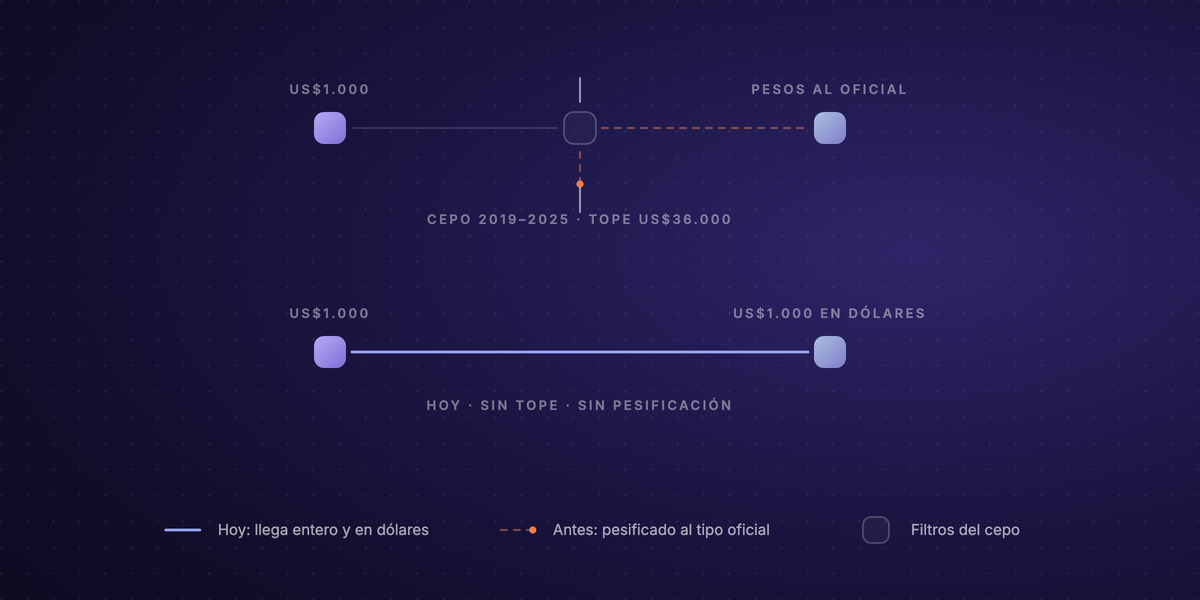
Two central-bank decisions redrew the map. In April 2025 Argentina lifted the cepo (currency controls) for individuals: monthly limits on buying dollars in the official market ended, along with the cross-restrictions against the financial dollar. Then on September 18, 2025, Communication A 8330 removed the last piece that hit people collecting money from abroad: the annual cap for service exporters, which had started at $12,000 in 2022 and reached $36,000 in January 2025, was eliminated entirely.
In practice, if you're a freelancer, developer, designer, translator or consultant invoicing clients abroad:
- You can collect without any amount limit and credit the dollars to a local foreign-currency account, with no obligation to sell them for pesos.
- Your bank cannot charge you a fee for receiving those service-export payments; it can only pass through documented charges from foreign banks.
- If a payment first lands in an account or platform outside the country, you have 20 business days to bring the funds into Argentina.
The consequence matters more than the fine print: choosing a method stopped being a defensive maneuver and became a cost decision. With that settled, the options.
Every way to receive money from abroad in Argentina
| Method | What you get | Typical cost | Timeline |
|---|---|---|---|
| Bank wire (SWIFT) | Dollars in your local USD savings account | $15–50 taken by intermediary banks; your own bank can't charge for service-export receipts | 1–5 business days |
| Western Union | Pesos (sometimes dollars) at WU's exchange rate | Margin built into the rate; the sender pays the transfer fee | Minutes to 2 days |
| PayPal | A dollar balance inside PayPal | Receiving fee (≈5.4% + fixed on international payments) + a bridge platform's cut to withdraw | Instant to PayPal; withdrawal takes days |
| Payoneer | A dollar balance; withdrawal to a local bank in USD or pesos | Up to 2% on withdrawal; payments between Payoneer accounts are free | Same day to 2 days |
| Wise | A multi-currency balance with local details in USD, EUR and GBP | Receiving via local details is free; landing the money in Argentina costs extra | Same day on local rails |
| Stablecoins (USDT/USDC) | Digital dollars in your wallet | Network fee in cents; converting to pesos is a separate step | Minutes |
International bank wire (SWIFT)
The classic route: your client sends an international transfer using your CBU, your bank's name and its SWIFT code, and the money lands in your dollar savings account, which most Argentine banks open and maintain for free. Since Communication A 8330 it arrives and stays in dollars, and your bank can't add its own fee when it's a service-export payment. What does survive is the cost of the journey: each correspondent bank can deduct $15 to $50 from the amount in transit, and the trip takes one to five business days. It suits large amounts and corporate clients who pay through formal banking channels; on small, frequent invoices the flat deductions hurt.
Western Union
The most accessible cash-out network in the country: you can collect in cash at thousands of locations, into your bank account, or in the app. The payout is ready in minutes when the sender pays online, and the sender covers the transfer fee. Your cost hides in the exchange rate: Western Union pays out in pesos at its own rate, usually close to the financial dollar but with a margin. It's a good route for small, occasional amounts or family remittances; it is not a tool for invoicing clients every month, and per-transfer amounts are capped.
PayPal
PayPal solves half the problem: any client in the world can pay you with just your email address, and the balance is in dollars instantly. The other half it complicates: the fee for receiving an international commercial payment runs around 5.4% plus a fixed charge, and PayPal doesn't allow withdrawals to Argentine bank accounts, so you need a local bridge platform to bring the money home, with its own fee (on the most-used ones, about $10 plus VAT for withdrawals up to $2,000) and a couple of days of waiting. It makes sense when the client insists on it, or for small payments where convenience outweighs the fee stack.
Payoneer
The marketplace standard: Upwork, Fiverr and dozens of platforms pay straight into your Payoneer balance, and payments between Payoneer accounts are free. From Argentina you can withdraw to your bank in pesos or, through Payoneer's arrangement with Santander, directly in dollars to an account at that bank, with a fee of up to 2% depending on the case. For someone living off freelance platforms it's the lowest-friction route; for invoicing clients directly, the card-payment receiving fees (around 3%) and the conversion on withdrawal deserve a look first.
Wise
Wise gives you what no Argentine bank does: local account details in the United States, Europe and the United Kingdom. Your US client pays you by ACH like a domestic supplier, no international wire involved, and receiving through those details is free. The account opens online with your national ID. The limitations for Argentine residents: the Wise card isn't available, and Wise doesn't convert to pesos or transfer to Argentine banks, so the balance sits in Wise until you move it on, for example as a dollar wire to your own local savings account. An excellent piece for collecting; incomplete for landing the money in the country.
Stablecoins: getting paid in digital dollars
In Argentina this stopped being a curiosity: stablecoins account for 94% of peso-denominated crypto volume, the highest share in the world, and roughly one in five Argentines uses crypto. The mechanics are simple: your client sends USDT or USDC, digital dollars that hold one-to-one with the dollar, and the payment arrives in minutes, any day, at any hour, for a network fee measured in cents. No intermediary bank can deduct anything on the way.
What stablecoins don't solve on their own is the last mile: turning them into pesos for rent or groceries. For that you sell on a local exchange at the crypto-dollar rate, or use an off-ramp that pays out to bank accounts. The structural advantage is that you take that step when you choose and for the amount you choose: the rest of the balance stays in digital dollars, something millions of Argentines already did as a defensive habit and keep doing now that inflation has cooled.
Can you receive money from abroad through Mercado Pago?
Not directly. Mercado Pago has no SWIFT code and doesn't accept incoming international transfers, so a client abroad can't send money to your Mercado Pago account, and the in-app option to buy financial dollars doesn't help with getting paid from outside either. The real routes are indirect: some remittance services (such as Remitly) pay out to Mercado Pago accounts from certain countries, or you receive through any method in this guide, land the money at your bank, and transfer it to Mercado Pago in pesos. If your goal is to collect from abroad and end up with a Mercado Pago balance, the shortest bridge usually runs through a bank.
Taxes: invoicing and declaring what you collect from abroad
Getting paid from abroad by the book has two layers. The first is invoicing: services to foreign clients are documented with Argentina's export invoice (factura E), and service exports are VAT-exempt. Under the simplified monotributo regime you can export services within your category's limits; above them, you move to the general regime and income tax enters the picture. The second layer is consistency: banks report incoming funds to ARCA, the tax agency, so what flows through your accounts should match what you invoice.
One point that confuses many people: the 30% surcharge you see on your card statement has nothing to do with receiving money. It's an income-tax advance applied when you pay for foreign-currency purchases with a card (a subscription, a purchase abroad), and you can claim it back from ARCA if it doesn't apply to you. Receiving dollars triggers no such surcharge.
Receiving payments from abroad with Localbridge, step by step
Localbridge applies to Argentina the pattern you saw with Wise and Payoneer, getting paid like a local, but with digital dollars as the engine. A virtual account gives you local receiving details in USD, EUR, GBP, MXN, BRL and COP: your New York client pays by ACH, the one in Berlin by SEPA, the one in São Paulo by Pix, with no international wires and no correspondent banks deducting along the way. Every incoming payment converts automatically into USDC or USDT, so you are paid, literally, in digital dollars: the outcome Argentine searchers compress into "cobrar en dólares".
From that balance you pay wherever the money needs to go: to your own bank account or to a supplier's or contractor's, in the supported currencies, with conversion to fiat at the moment of the operation. One honest note: Localbridge doesn't convert to Argentine pesos today; when you need pesos for local expenses, you move your USDT or USDC to a local app or exchange and sell at the crypto-dollar rate, a step that is routine in Argentina. The rest of the balance stays in digital dollars, independent of any foreign bank or regulatory cap.
The setup:
- Open an account. Sign up and complete identity verification.
- Activate your receiving details. Pick the currencies your clients pay in and share the details like any bank account.
- Invoice as a local. Your client pays over their domestic rail; you issue your factura E as with any other method in this guide.
- Decide where every dollar goes. Keep the balance in USDC/USDT, pay suppliers, or withdraw to a bank account; details on how it works and pricing.
FAQ
Is it legal to get paid in dollars in Argentina? Yes. Since September 2025, individuals exporting services can collect from abroad with no amount cap and keep the dollars in local foreign-currency accounts, with no obligation to sell them for pesos. The condition is operating by the book: invoicing the export and bringing the funds into the country within the current deadlines.
Is the $36,000 cap for freelancers still in force? No. The central bank's Communication A 8330 eliminated it on September 18, 2025. Before that date the regime had allowed $12,000 per year (2022), then $24,000 (July 2024), then $36,000 (January 2025); today there is no amount limit for individuals collecting service-export income.
If I pay in dollars with my card, do I get charged 30%? On foreign card spending, yes: a 30% income-tax advance applies, and you can recover it through ARCA if it doesn't correspond to your situation. The PAIS tax that used to stack on top of it ended in December 2024. None of this applies to receiving money: the surcharge taxes your payments, not your income.
How long does a transfer from abroad take to arrive? It depends on the rail, not the country: a SWIFT wire takes one to five business days; Western Union, minutes to two days; PayPal and Payoneer credit the balance almost instantly, but the withdrawal to a bank adds hours or days; stablecoins arrive in minutes at any hour.
Can I cash a foreign check in dollars? In practice, almost no Argentine bank accepts foreign checks anymore, and those that do process them as collection items: weeks of waiting and steep fees. Any method in this guide beats it; if your client only issues checks, a SWIFT wire is the natural replacement to ask for.
Do I have to invoice what I collect from abroad? Yes. Services provided to foreign clients are documented with the factura E export invoice, whether you're under monotributo or the general regime, and service exports are VAT-exempt. Clean invoicing is also what unlocks the favorable currency treatment: collecting without a cap and keeping the dollars.