
What Is a Stablecoin? A Plain-English Guide
What a stablecoin is in plain English: how it holds its dollar peg, the three types, whether stablecoins are safe and how they're regulated in 2026, and how to get paid in them.

A stablecoin is a type of cryptocurrency built to hold a steady value, almost always pegged 1:1 to a traditional currency like the US dollar. One dollar-pegged stablecoin is meant to always be worth one dollar, because real reserves or a built-in mechanism keep it there. Unlike Bitcoin, you don't hold a stablecoin hoping the price climbs. You hold it, send it from one wallet to another in seconds for a small fee, and convert it back to ordinary money when you want to.
That's the core idea. The rest of this guide covers how a stablecoin actually keeps its peg, the main types and which ones are worth trusting, whether stablecoins are safe and how they're regulated in 2026, what people use them for, and how a freelancer or business can get paid in stablecoins and turn them into local cash.
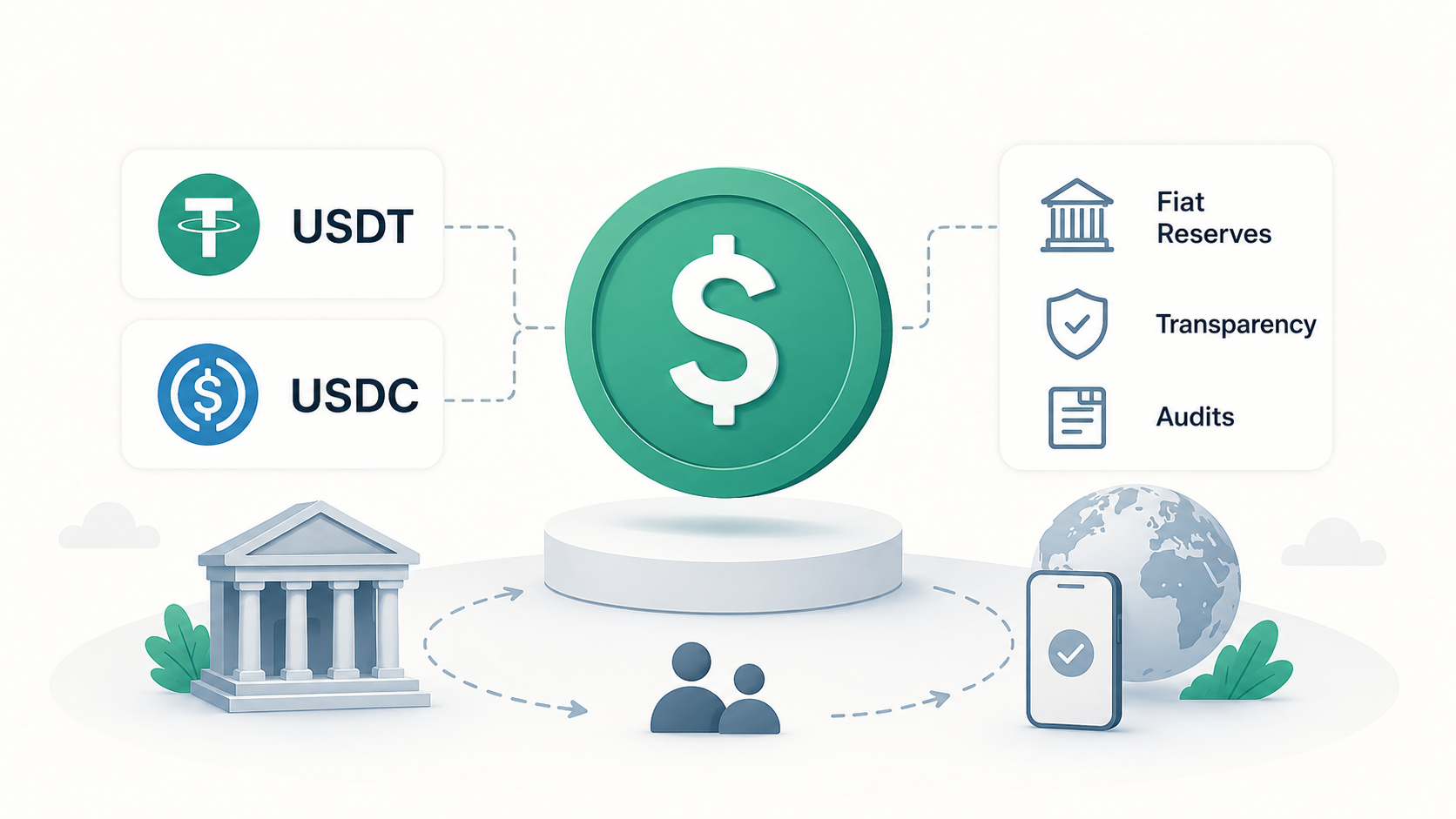
How a stablecoin works
A stablecoin is a digital token that runs on a blockchain, the same kind of network that carries Bitcoin or Ether. The difference is the goal. Bitcoin's price floats; a stablecoin's whole job is to not move. It tracks the value of something stable, usually the US dollar, so one token stays worth about one dollar whether you hold it for an hour or a year.
Two things make that possible: a peg and a way to defend it.
- The peg is the promise: one token equals one dollar (or euro, or another reference currency).
- The backing is what makes the promise credible. For the largest stablecoins, that's a pool of reserves, mostly cash and short-term US government debt, held so every token in circulation can be redeemed for a real dollar.
Sending one works like any crypto transfer. You enter a wallet address and an amount, pick a network, and the transfer confirms in seconds to a couple of minutes. The receiver gets the full amount; the sender pays a small network fee. Because the value doesn't swing, the number you agree on is the number that arrives. A $1,000 payment is $1,000 when it lands, not "$1,000 of crypto" that might be worth $920 an hour later.
The main types of stablecoins
Not all stablecoins keep their peg the same way, and the method matters a lot for how safe each one is. There are three broad types.
| Type | How it holds the peg | Examples | Track record |
|---|---|---|---|
| Fiat-backed | Backed 1:1 by reserves of cash and short-term government bonds | USDT, USDC | The mainstream choice; holds up in practice |
| Crypto-backed | Over-collateralized with other crypto locked in smart contracts | DAI | Works, but depends on the collateral's value |
| Algorithmic | Software and trading incentives, with little or no real reserves | (former) TerraUSD | Failed catastrophically; largely avoided now |
Fiat-backed stablecoins are what almost everyone means by "stablecoin." A company holds one dollar of safe reserves for every token it issues, so the token can always be redeemed for a dollar. USDT and USDC are the two giants here.
Crypto-backed stablecoins like DAI hold a peg by locking up more crypto than the tokens are worth (over-collateralization), which absorbs price swings in the collateral. They're more decentralized but more complex.
Algorithmic stablecoins tried to hold a peg with code and market incentives instead of real reserves. This is the category to be wary of. In May 2022, the algorithmic stablecoin TerraUSD lost its peg and collapsed, wiping out around $45 billion in a week. Regulators took note: the EU's rules now effectively ban the model.
Are stablecoins safe?
For everyday payments, the major fiat-backed stablecoins have a solid track record of holding their value. "Safe" still deserves a careful answer, because the risks are real and specific.
The backing is the thing to check. A fiat-backed stablecoin is only as good as its reserves. The two largest, USDC (issued by Circle) and USDT (issued by Tether), publish regular reports on what backs them, mostly cash and short-term US Treasuries. Circle publishes monthly attestations; Tether publishes quarterly. An attestation is a point-in-time confirmation by an accounting firm, not the same as a continuous full audit. That distinction is worth knowing before you park large sums.
Pegs can wobble. Even well-backed stablecoins have had scares. In March 2023, USDC briefly dropped to about $0.87 when part of its reserves was stuck at the collapsing Silicon Valley Bank, then returned to $1 within days once access was confirmed. It held, but it showed the peg isn't automatic.
Regulation arrived. This used to be the Wild West. Not anymore:
- In the US, the GENIUS Act, signed in July 2025, created a federal framework. Issuers must hold 1:1 reserves in cash and short-term Treasuries, honor redemptions, disclose reserve composition monthly, and submit to audited annual statements once they pass $50 billion outstanding.
- In the EU, MiCA has regulated stablecoins since mid-2024, with reserve and licensing requirements, and it effectively bans the algorithmic type.
The honest bottom line: a well-run, fiat-backed, regulated stablecoin behaves like reliable digital cash for payments. It is not a government-insured bank deposit, and issuer risk is never quite zero. For moving money and getting paid, that's a trade a lot of people happily make. For storing a life's savings, understand the model first.
What people use stablecoins for
Trading was the first use, and it's still large: stablecoins are how people sit in "dollars" on a crypto exchange without cashing out to a bank. But the fastest-growing use is plain payments, and that's where they matter for anyone earning across borders.
- Getting paid internationally. A client in the US or Europe can pay a contractor in Lagos, Buenos Aires, or Manila in minutes, without a chain of correspondent banks skimming fees and adding days.
- Remittances. Sending money home over stablecoin rails is often cheaper and faster than a traditional money-transfer service.
- Holding dollars. In countries with high inflation or hard-to-get dollars, a stablecoin is a way to hold value in dollars without a US bank account.
- Business settlement. This is a big reason the market is now north of $300 billion, with USDT and USDC alone making up more than 80% of it. Payment companies settle on these rails because they clear instantly, at any hour.
The step most explainers skip is the last one. A stablecoin is digital dollars, and at some point you usually want local currency in a real bank account to pay rent, staff, and suppliers. Turning stablecoin back into spendable local money is where a lot of people get stuck.
Getting paid in stablecoins and turning them into local money
If a client wants to pay in stablecoin, you have two jobs: receive it safely, and convert it to local currency without losing a chunk to fees. The bare-bones route is a personal crypto wallet plus an exchange. It works, but you manage wallets, networks, and a separate off-ramp yourself.
This is the part Localbridge is built for. With a Localbridge account, your balance is held as dollar stablecoins (USDC or USDT) under the hood, but you operate in plain dollars and other currencies the way you would with any account. You can receive stablecoin payments, hold a dollar balance, and pay out to a local bank account in 150+ countries, without touching a crypto exchange or learning which network is which. The off-ramp, stablecoin to local currency, is the product. If you want the mechanics end to end, here's how it works.
We're not a bank and don't pretend to be. The licensed rails, KYC/KYB, and compliance are handled by regulated infrastructure underneath. We handle the part you use: a multi-currency account, the day-to-day operations on it, and a real person on support.
FAQ
Is a stablecoin the same as real money? In value, a dollar stablecoin is designed to always equal one US dollar. Legally it's a token issued by a private company, not government-issued money or an insured bank deposit. For payments it behaves like a dollar; for safekeeping, the backing behind it matters.
Are stablecoins safe? The major fiat-backed ones (USDC, USDT) have a long track record of holding their peg and are now regulated in the US and EU. The risks are issuer risk (you're trusting the reserves), the occasional peg wobble, and user error like sending on the wrong network. Treat a well-run stablecoin as reliable digital cash, not as a guaranteed bank deposit.
What's the difference between a stablecoin and Bitcoin? Both are cryptocurrencies, but Bitcoin's price floats and can swing wildly, while a stablecoin is built to hold a steady value pegged to a currency like the dollar. You buy Bitcoin hoping it goes up; you hold a stablecoin because it won't.
Which stablecoin is the biggest? USDT (Tether) is the largest, at roughly $186 billion in circulation, followed by USDC (Circle) at around $75 billion. Together they're more than 80% of a stablecoin market worth over $300 billion.
Can I lose money with a stablecoin? Not from price swings in normal conditions, because the value is pegged. You can lose money if the issuer fails and reserves fall short, if you use an unbacked algorithmic coin, or through user error (wrong network, wrong address, or a bad exchange rate when you cash out). Sticking to a major regulated, fiat-backed stablecoin removes most of that risk.
How do I convert a stablecoin to my local currency? You off-ramp it to a bank account, either through a crypto exchange or through a service like Localbridge that pays out to local banks in 150+ countries. Watch the total cost: the exchange rate plus any withdrawal fee, not just the headline transfer fee.
This guide is the starting point for our stablecoin series. From here it's worth understanding what a virtual account is and how dollar balances actually reach your local bank.