
How to Convert USDC to COP: Getting Colombian Pesos in a Bank Account
Three ways to convert USDC to Colombian pesos: a local exchange, P2P, or an off-ramp that pays any Colombian bank account — plus what Bre-B changes and how the 4x1000 tax works.

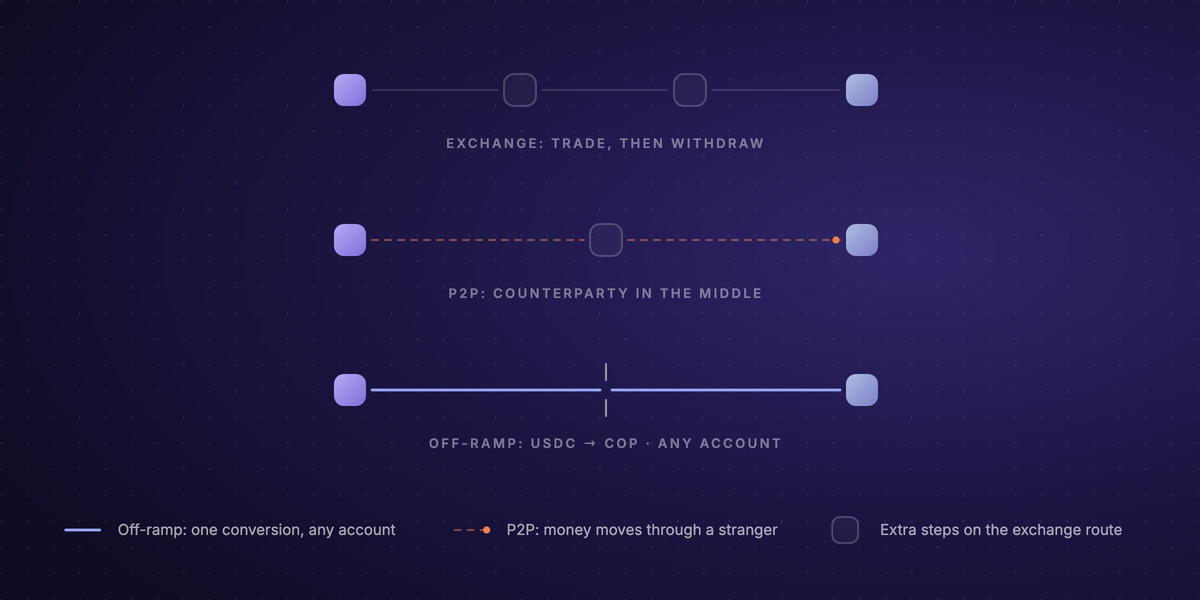
To convert USDC to Colombian pesos, you have three working routes: sell on an exchange that trades against COP and withdraw to your bank, trade peer-to-peer, or use an off-ramp service that converts USDC and pays pesos straight to any Colombian bank account. All three end the same way: COP landing in a bank account in Colombia. What changed recently is the delivery leg. Since Bre-B, Colombia's instant payment system, went live in late 2025, pesos can move between Colombian accounts in seconds, around the clock, which removes the old excuse for slow withdrawals. The route you pick decides the rate you get, the work you do, and who you have to trust along the way. One rule holds everywhere: convert USDC to pesos directly. Going USDC to dollars first and dollars to pesos second adds a second spread for no benefit.
Bre-B: the new rail your pesos ride
Bre-B is Colombia's interoperable instant payment system, run by Banco de la República and launched in October 2025, built openly on the model of Brazil's Pix. Accounts are addressed by a simple key (a llave: phone number, ID, or short code) instead of full account numbers, transfers settle in seconds, the system runs 24/7 including holidays, and transactions are free for end users until at least 2028. Adoption has been fast even by Pix standards: over 100 million keys were registered within six months of launch. Wherever your USDC-to-COP route ends, the last hop into a Colombian account is now instant more often than not; the legacy alternatives (ACH batches, or Transfiya between wallets) still exist but are no longer the ceiling.
Route 1: an exchange with a COP market
The standard path if you're comfortable trading:
- Deposit USDC to an exchange that supports Colombian pesos. Buda.com is the established local player with COP deposits and withdrawals through partner banks; Binance also serves Colombia, though there you typically convert USDC to COP inside the platform and then withdraw the pesos.
- Sell USDC for COP at the market rate. Watch the pair you're actually trading: on platforms without a direct USDC/COP book your order may route through USDT or USD, which is the double-conversion this article keeps warning about.
- Withdraw to your bank. Binance offers online-banking withdrawals that arrive quickly (its Transfiya option is near-immediate, ACH can take up to three business days); Buda pays out through its banking partners.
The frictions are structural: local KYC, funds parked on an exchange while you trade, manual steps every time, and the platform's operational moods, from maintenance windows to withdrawal reviews.
When it fits: you're in Colombia, cash out occasionally, and want the market rate.
Route 2: P2P marketplaces
Peer-to-peer platforms match you with a buyer who takes your USDC and sends pesos from their own bank account. P2P is popular in Colombia and rates can look attractive, but you're trading with an individual: the rate includes their margin, the flow is manual, and disputes, delays, and fraud risk are yours to manage. Bre-B actually cuts both ways here; the buyer can pay you in seconds, but instant, irreversible transfers also reward scammers who move faster than your release button. For a one-off conversion it's workable. As a monthly income routine, it's a lot of trust placed in strangers.
When it fits: occasional conversions where the exchange route isn't available to you.
Route 3: an off-ramp straight to any Colombian account
This is the route built for people whose USDC is income rather than a trading position: freelancers billing US or European clients, remote workers, businesses paying Colombian suppliers or salaries. An off-ramp doesn't ask you to trade. It converts stablecoins at the moment of the transaction and sends real pesos to an external bank account, yours or the account of whoever you need to pay.
With Localbridge it looks like this:
- Hold USDC in your account. Client payments arrive on-chain and sit as digital dollars until you need pesos, which also means your balance isn't parked in a depreciating local currency between invoices.
- Convert when a bill is due. USDC goes straight to COP at a transparent rate you see before you confirm. No USD leg in the middle.
- Pesos arrive as an ordinary local transfer to any Colombian bank account: your own, your accountant's, a supplier's. Nobody on the receiving end touches crypto.
If part of your USDC ends up paying Colombian rent, contractors, or suppliers anyway, converting and sending in one step beats cashing out to yourself first and forwarding the money in a second, taxed transfer (more on that tax below).
When it fits: recurring stablecoin income that needs to become pesos every month, or paying Colombian counterparties from a USDC balance.
What it costs, side by side
| Route | Conversion | Payout | Total picture |
|---|---|---|---|
| Exchange (Buda, Binance) | Market rate, trading fee varies by platform | Bank withdrawal, minutes to 3 days | Market rate, manual flow, local KYC |
| P2P | Counterparty's margin | Bank transfer, seconds on Bre-B | Rate roulette plus counterparty risk |
| Localbridge (off-ramp) | Transparent rate shown before you confirm | Local transfer to any Colombian account | One conversion, one transfer, works for third-party payments |
The number to compare is the all-in COP amount that lands per USDC, not any single advertised fee. A "zero-fee" route at a weak rate loses to a visible fee at a fair one.
The 4x1000 tax: plan which account receives
Colombia charges the GMF, universally known as the 4x1000, on movements out of bank accounts: 0.4% of every debit. It isn't a crypto tax, it applies to everyone, but it matters for how you structure the receiving side. Each person can mark one account as exempt for withdrawals up to 350 UVT per month (about COP 18.3 million in 2026; digital wallets like Nequi have a lower cap). Practical consequences:
- Receive your conversions into the account you've marked exempt, and the pesos you then spend don't lose 0.4% on the way out.
- If you're paying a third party from your USDC balance, one direct payment beats two hops: cash out to yourself and forward the money, and your outgoing transfer is a GMF-taxed debit if it exceeds your exemption.
Don't route through dollars
The old advice for getting money to Colombia was: convert to USD, wire the dollars, let the bank convert to pesos. That's the most expensive path available: an international wire fee, intermediary bank deductions, a retail FX spread on the USD-to-COP leg, and days of waiting. USDC already carries dollar value on-chain. The only conversion your money needs is dollar-value to pesos, once. Any route that converts twice charges you twice, and any route that adds a SWIFT wire adds the slowest, least transparent rail in this whole story.
FAQ
Is it legal to convert USDC to pesos in Colombia? Holding and selling crypto is legal for individuals. Colombia has no comprehensive crypto law yet: the central bank and the Financial Superintendence have made clear that crypto is not legal tender and banks can't hold it for you, but converting your own USDC to pesos is an ordinary, lawful transaction. Reporting obligations for platforms are tightening (large transactions become reportable to DIAN under rules issued for 2026), which formalizes the market rather than restricting users.
Do I pay tax on converting USDC to COP? DIAN treats crypto as an intangible asset: selling it for pesos is a taxable event, and gains are taxed as ordinary income at progressive rates. Since USDC tracks the dollar, the gain from holding the coin itself is usually small, but income you receive in USDC is taxable like any other income, and the peso-dollar rate moves the numbers. Talk to a Colombian accountant; this isn't tax advice.
How fast does the money arrive? Conversion is near-instant on every route. Delivery depends on the rail: Bre-B transfers settle in seconds around the clock, Transfiya is near-immediate, ACH batches can take up to three business days. Exchange withdrawal reviews can add hours on top. An off-ramp paying directly to a bank account is typically minutes end to end.
Can I pay someone else's Colombian account directly from USDC? With an off-ramp, yes: the pesos go to any Colombian bank account, so a supplier or landlord receives an ordinary local transfer with no crypto on their side. Exchanges generally require withdrawing to an account in your own name, so paying a third party takes two hops and, past your exemption, an extra 0.4% GMF on the second one.
Do I need a US bank account for any of this? No. None of the routes touch US banking, which is the point of converting directly. If what you actually need is dollars in a US account, that's a different how-to.
What about USDT instead of USDC? The routes are identical, and Colombian platforms trade both. The differences are about the coins themselves: reserves, issuers, and where each is licensed, which we cover in USDT vs USDC. For the peso side of the trip, nothing changes.