
How to Receive Money From the US in Mexico: 2026 Guide
Every way to receive money from the US and abroad in Mexico: bank wire, Directo a México, Western Union, PayPal, Payoneer and stablecoins, with fees, exchange rates and the tax rules.

To receive money from the US in Mexico you have six routes: an international wire to your bank account, the Banco de México's Directo a México service, a remittance network like Western Union, PayPal, Payoneer and stablecoins. All of them work. What separates them isn't whether the money arrives, but what happens to the dollars the moment it does: on most routes someone converts them to pesos for you, at an exchange rate that company sets, and that is where 1% to 5% of your payment quietly stays without ever showing up as a "fee".
That is the real question behind "how do I receive money from abroad" in Mexico. Unlike Argentina, there were never currency controls here; unlike Brazil, no law forces you to sell your dollars. But outside the northern border strip almost no bank opens a dollar account for an individual, so your dollars become pesos the moment they touch the banking system, and the intermediary you picked decides that day's exchange rate. This guide compares every method with its real costs, answers the tax questions people search most (yes, it's legal; no, there is no tax on receiving) and ends with the setup that lets you get paid in dollars and convert to pesos when you decide.
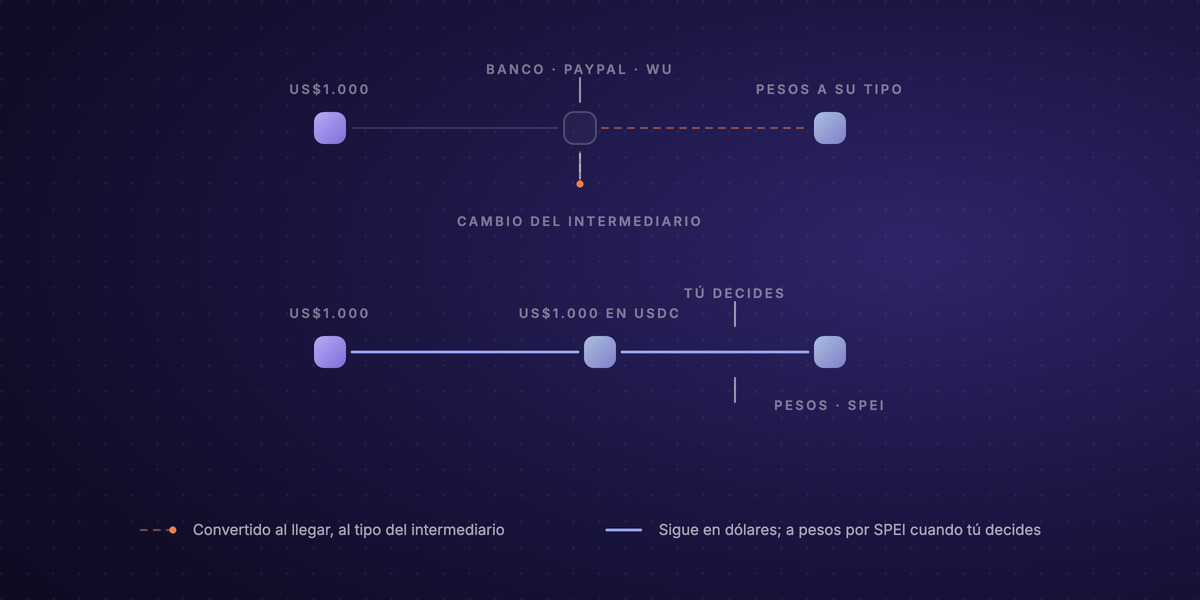
What makes Mexico different: dollars turn into pesos on arrival
Mexico received US$61.8 billion in remittances in 2025, the second-highest figure in the world, and more than 90% of it came by electronic transfer. Behind that volume is infrastructure that works very well at making money arrive: SPEI runs around the clock, remittance networks pay out in minutes, and every bank accepts international transfers. The problem sits one step earlier.
Under Banco de México rules, dollar accounts for individuals are limited, with narrow exceptions, to residents of the northern border strip, and cash deposits in dollars have monthly caps. Some banks open dollar accounts for individuals with documented foreign income, and companies can hold them, but for most freelancers and professionals in the interior the reality is this: the transfer arrives in dollars and is credited in pesos, at the bank's exchange rate for that day.
Two consequences:
- The main cost is the exchange rate, not the fee. A bank may charge US$17–30 plus VAT to receive a wire; the spread on a US$2,000 payment can cost you more than that, and you won't see it itemised.
- Choosing a method means choosing who converts. The bank, PayPal, Western Union and Payoneer convert on receipt or on withdrawal, each with its own margin. Stablecoins are the only route where dollars stay dollars until you decide to sell them.
With that clear, the routes.
Every way to receive money from abroad in Mexico
| Method | What lands | Typical cost | Timing |
|---|---|---|---|
| Bank wire (SWIFT) | Pesos in your account (dollars only if you hold a USD account) | US$17–30 + VAT to receive, plus intermediary banks and the bank's exchange rate | 1–3 business days |
| Directo a México | Pesos, at Banxico's FIX rate minus 0.21% | Flat fee paid by the sender; nothing on your side | 1 business day |
| Western Union and remittance networks | Pesos in cash, to an account or in an app | Sender pays the transfer fee; your cost is in the exchange rate | Minutes |
| PayPal | PayPal balance, converted to pesos | 3.95% + MX$4 to receive, +0.5% if the payer is outside Mexico, +3.5% on the exchange rate | Instant; standard withdrawal free, 1–3 days |
| Payoneer | Dollar balance; withdrawal to a bank in pesos | Free to receive via the USD receiving account; up to 2% to withdraw in pesos | Same day to 2 days |
| Stablecoins (USDC/USDT) | Digital dollars in your wallet | Network fee of cents; you convert to pesos whenever you want | Minutes |
International bank wire (SWIFT)
The route your corporate client knows: they request an international transfer with your CLABE, your bank's name and its SWIFT code. The big banks charge to receive it (BBVA around US$30 plus VAT, Banorte about US$17 plus VAT) and every intermediary bank along the way may take its cut. Without a dollar account, the bank credits pesos at its rate of the day, usually below Banxico's FIX. It suits large amounts and clients who only pay through formal banking channels; for invoices of a few hundred dollars, between fixed fees and the exchange rate, it is the most expensive route.
One detail that helps: ask your bank whether it opens dollar accounts for individuals with foreign income. Not all do and there are usually requirements, but if you get one, the wire stays in dollars and you decide when to convert.
Directo a México
Few people know it, and it is the best banking route for payments from the United States. Directo a México is a service of the Banco de México and the Federal Reserve: the sender uses their account at a participating US bank or credit union, pays a flat fee, and you receive pesos in any Mexican bank account at Banxico's FIX rate minus 0.21%, with no fee on your side. It's transparent and cheap; the limitation is that your client's bank has to offer it, and many don't. Worth asking.
Western Union and remittance networks
For money from family, Western Union, Remitly, Elektra and the other remittance networks rule: the transfer arrives in minutes, you can collect it in cash at thousands of locations, in your bank account or in apps like Banco Azteca, and the sender pays the fee. Your cost is hidden in the exchange rate, which each network sets below the interbank rate, and some pickup points add their own charge (OXXO, for example, about MX$17 per withdrawal). Since January 2026 the United States applies a 1% tax on remittances sent in cash; electronic transfers from an account or card are exempt. It is a route for family support and occasional amounts, not for invoicing services every month.
PayPal
PayPal solves convenience: any client can pay you with just your email address. The account is expensive for receiving from abroad. On a commercial payment you pay 3.95% plus MX$4, an extra 0.5% if the payer is outside Mexico, and because the payment arrives in dollars, PayPal converts to pesos with a 3.5% margin over its base exchange rate. Altogether, close to 8% of a US$500 invoice. A standard withdrawal to your bank is free (instant costs MX$40). It makes sense when the client insists, or for small payments where convenience outweighs the cost.
Payoneer
The standard for Upwork, Fiverr and the marketplaces. Payoneer gives you a USD receiving account in the United States: your client pays by ACH as they would a local supplier, and receiving that way is free. Payments between Payoneer accounts are also free; card payments cost up to 3.99%. The cost appears on withdrawal: to your Mexican bank in pesos, up to 2% plus Payoneer's exchange rate. For anyone living off platforms it is the lowest-friction route; for direct invoicing, compare the total cost of the withdrawal before deciding.
Wise
Wise is excellent in many countries, but in Mexico, at the time of writing, it only lets Mexican residents send pesos abroad: it doesn't give residents local USD account details or a multi-currency balance. If a client offers to "pay you through Wise", what they can do is send pesos to your Mexican bank account, with Wise doing the conversion at its mid-market rate plus its fee. That's a cheap way to receive, but not a way to get paid in dollars.
Stablecoins: getting paid in digital dollars
Mexico is one of the countries where this is already infrastructure rather than an experiment: Bitso processes around 10% of remittances between the United States and Mexico, and in 2026 stablecoins overtook bitcoin as the crypto asset its users buy most. The mechanics: your client sends you USDC or USDT, digital dollars worth one to one with the dollar, and they arrive in minutes, any day, with a network fee of cents. No intermediary bank and no forced conversion.
What stablecoins change is who controls the last step. The dollars stay dollars in your wallet; when you need pesos, you convert them yourself, for the amount you want, and receive MXN over SPEI to your CLABE: at a Mexican exchange, via P2P, or with an off-ramp that pays straight to bank accounts. All three options, with costs and timing, are in how to convert USDC to MXN. It is the only route where you choose the exchange rate, at the moment you choose.
Can I receive money from abroad through Mercado Pago?
Not by direct international transfer: Mercado Pago México has no SWIFT code, and a client abroad can't send money to your Mercado Pago account as if it were a bank. What does exist is an agreement with Western Union: the sender in the United States uses the Western Union app or a location, shares a ten-digit code with you, and you enter it in the "Receive money from abroad" section of Mercado Pago; the balance appears in seconds and the sender pays the fee. It works for family remittances. To get paid for your work, receive through any route in this guide and transfer pesos to Mercado Pago over SPEI.
Taxes: what happens if I receive money from abroad
It is legal to receive money from the United States or any other country; there is no tax on the act of receiving a transfer. What does exist is income tax on the income behind it: if the money is payment for work or a service, it is taxable income like any other, at the ISR rates for individuals (from 1.92% to 35% depending on your income level, or the reduced RESICO rate if you're in that regime). If it is help from a direct relative, a gift from parents, children or a spouse pays no ISR, but keep the proof.
The most-searched myth deserves a straight answer: "how much money can I receive from abroad without declaring it?" There is no threshold. The MX$15,000 a month that circulates online is the level at which banks report cash deposits to the SAT; the cash deposit tax (IDE) was repealed in 2014, and electronic transfers, domestic or international, don't enter that report. What the SAT can do is match what comes into your accounts against what you declare, so the practical rule is simple: invoice what you charge and declare it. If you provide services to foreign clients, the export of services carries a 0% VAT rate as long as it is used abroad, and you issue your CFDI as for any other sale.
How to receive money from the US with Localbridge, step by step
Localbridge brings together the two halves that are usually separate in Mexico: getting paid in dollars as if you were local in the United States, and converting to pesos over SPEI only when you want to. A virtual account gives you local account details in USD, EUR, GBP, MXN, BRL and COP: your client in Texas pays by ACH, the one in Madrid by SEPA, and a Mexican client by SPEI to your own CLABE. Every incoming payment converts automatically to USDC or USDT: you get paid, literally, in digital dollars, with no bank turning them into pesos on arrival.
From that balance you decide the destination of every dollar. Need pesos for rent and taxes? Convert the amount you want and receive it over SPEI in your Mexican bank account, the same CLABE as always, with conversion to fiat at a rate you see before confirming. Prefer to keep dollars? The rest of the balance stays in USDC, without depending on a dollar account your bank won't open. One honest note: Localbridge is not a bank and not a custodian; the regulated services are provided by Bridge, a Stripe company, and the balance is always a stablecoin, not pesos or dollars on deposit. Pesos go to your own bank account; they never sit on the platform.
Step by step:
- Open your account. Sign up and complete identity verification; it takes days, not weeks.
- Activate your receiving details. Choose the currencies your clients pay in and share the details as you would any other bank account.
- Get paid like a local. Your US client pays by ACH with no international transfer; you issue your CFDI as with any other method in this guide.
- Convert when you decide. Keep the balance in USDC/USDT or withdraw pesos over SPEI to your CLABE; the details are in how it works and pricing.
FAQ
Is it legal to receive money from abroad in Mexico? Yes, with no amount limit and no prior permission. The obligation is fiscal, not currency-related: if the money is income for work or a service, you declare it and pay ISR like any other income; if it is a gift from a direct relative, it is exempt.
How much money can I receive from abroad without declaring it? There is no tax-free amount. The MX$15,000 a month people talk about is the reporting threshold for cash deposits, and it doesn't apply to electronic transfers. All income from services is declared, whether US$100 or US$10,000; what matters is that what enters your accounts matches what you invoice.
What is the best way to receive money from the United States? It depends on who is sending. For a relative, Western Union or Directo a México if their bank offers it. For a client paying through banking channels, Directo a México first, then SWIFT. For getting paid for your work on a recurring basis, a USD receiving account (Payoneer, or a virtual account like Localbridge's) so they pay you by ACH, and you decide when to convert to pesos.
How much does PayPal charge to receive money from abroad? On a commercial payment from outside Mexico: 3.95% plus MX$4 base fee, an extra 0.5% for an international transaction, and a 3.5% margin on the exchange rate when converting to pesos. In practice, around 8% of a US$500 invoice. Receiving money from friends and family follows different rules.
Can I receive money from abroad with no fees? With no visible fee, yes: Directo a México charges the beneficiary nothing, Payoneer doesn't charge for receiving into its USD account, and with Western Union the sender pays. At no cost, no: on all of them the margin sits in the exchange rate. The only way to choose the exchange rate yourself is to receive dollars that stay dollars, in a USD account or as stablecoins, and convert when it suits you.
How do I receive money from abroad through Western Union? The sender pays online or at a Western Union location and shares the tracking number (MTCN) with you. You collect it in cash at any partner location with official ID, receive it in your bank account, or in apps like Banco Azteca or Mercado Pago. It arrives in minutes and you pay no fee, but the exchange rate is Western Union's.
What happens if I receive money from abroad and don't declare it? Nothing automatic: the bank doesn't withhold tax or block the money. But financial institutions report to the SAT, and if your deposits don't match your declared income, the SAT can ask you for the source and charge the omitted ISR with inflation adjustment and surcharges. Declaring it costs less than explaining it later.