
How to Receive Payments From Abroad in Brazil: 2026 Guide for Companies
Every way a Brazilian company can receive payments from abroad in 2026: SWIFT and the exchange contract, PayPal, Payoneer, Wise and stablecoins, with real costs and the central bank's new rulebook.

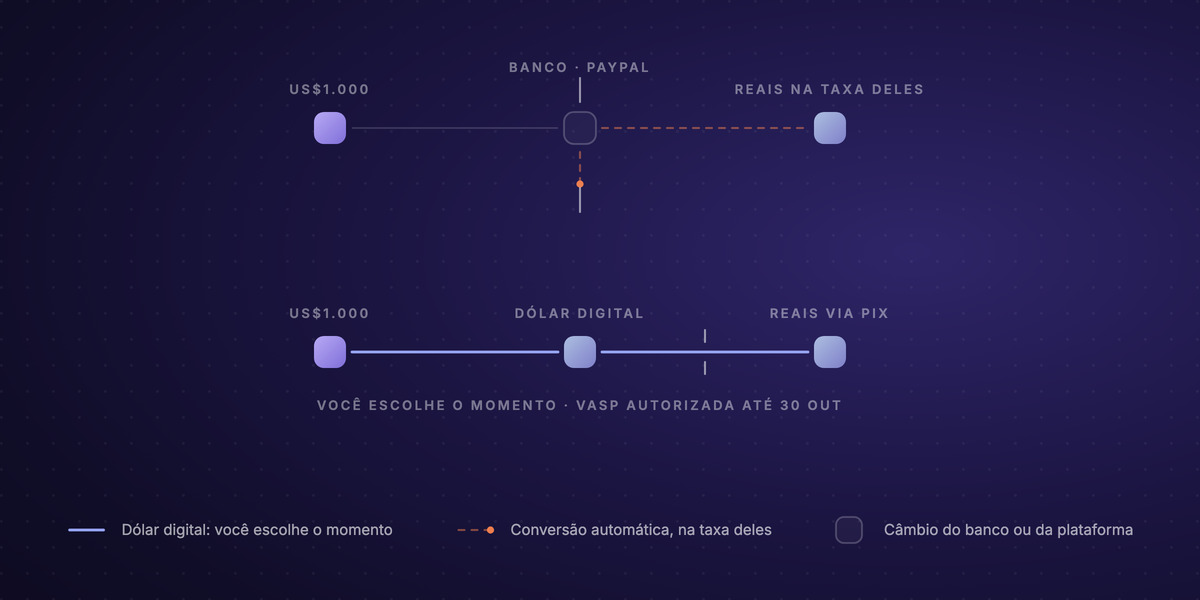
A Brazilian company has five routes for receiving payments from abroad: an international payment order settled through an exchange contract at the bank, PayPal, Payoneer, a global account like Wise, and stablecoins. All of them end in the same place, because in Brazil dollars cannot live in a local account: with narrow exceptions, every amount that enters through the banking system is converted into reais. The route you pick really decides three things: who performs that conversion, at what rate, and whether you get to choose its timing. And 2026 redrew the board: since February, the central bank treats stablecoin operations as foreign exchange, and the window for providers in that market to apply for authorization closes on October 30.
What makes Brazil different: dollars can't live here
The first thing a guide to getting paid from abroad should say is the thing most guides skip: in Brazil, foreign-currency accounts are prohibited for the vast majority of companies. Law 14,286 (the FX legal framework, in force since 2023) kept the general rule and left the central bank a list of who may hold a dollar account in the country, a short list that does not include the ordinary exporting business. The consequence: any amount arriving from abroad through the banking system goes through a foreign-exchange operation and becomes reais.
The same law, though, consolidated the escape valve that changes the game for exporters: export revenue may stay outside the country, in full, and be used from there to pay for imports, suppliers and expenses abroad. And the tax cost of bringing money in is lower than it looks: the IOF tax on inbound export revenue, goods and services alike, is zero, a rate the 2025 decrees, which raised IOF on general remittances to 3.5%, left untouched.
Those two facts set the strategy for this entire guide: the question is not "how do I bring the money home", it is where the dollar value should live and when to convert it into reais. With that settled, the routes.
Every way to receive payments from abroad
| Method | What you get | Typical cost | Timeline |
|---|---|---|---|
| Payment order (SWIFT) | Reais, after an exchange contract at your bank | Bank's flat fee + FX spread; intermediary banks deduct $15–50; zero IOF on export revenue | 1–5 business days |
| PayPal | Reais, converted automatically | ≈4.79% + fixed fee + international surcharge + conversion spread | Balance instantly; withdrawal 1–2 days |
| Payoneer | A dollar balance; withdrawal in reais | Withdrawal fee varies by account; payments between Payoneer accounts are free | Withdrawal in 2–5 business days |
| Wise | A multi-currency balance with local details in USD, EUR, GBP | Receiving via local details is free; converting to reais costs from ~0.78% + IOF | Same day on local rails |
| Stablecoins (USDT/USDC) | Digital dollars in your wallet | Network fee in cents; converting to reais is a separate step via an authorized provider | Minutes |
The international payment order (SWIFT) and the exchange contract
The classic route, and the one your corporate clients know: the payer sends an international transfer using your bank's SWIFT code, and the money arrives as a payment order. To credit it, the bank requires closing an exchange contract, with the operation documented (invoice, nature of the revenue), and that is where the real cost lives: on top of the flat fee each bank sets, there is the spread over the commercial rate, and every intermediary bank on the way can deduct $15 to $50. The IOF on export revenue is zero. It works well for large amounts and formal payers; on small, frequent invoices, the flat deductions and the exchange-contract ritual weigh heavily.
PayPal
PayPal solves the friction on your client's side, anyone in the world can pay an email address, and charges your side dearly for it. The international selling fee runs around 4.79% plus a fixed charge, with a surcharge of about 1.61% for international transactions, and conversion into reais is automatic and mandatory, with PayPal's own spread built into the rate: the balance does not stay in dollars, and withdrawals go to the bank account linked to your CPF or CNPJ. Stack the layers and it is the most expensive route in this guide. It makes sense when the client insists, or on small tickets where convenience outweighs the cost.
Payoneer
The marketplace standard: Upwork, Fiverr, Amazon and dozens of platforms pay straight into a Payoneer balance, and payments between Payoneer accounts are free. From Brazil, withdrawals go to your bank account in reais, with a fee that varies by account profile and a timeline of 2 to 5 business days. For a business living off platforms it is the lowest-friction route; for invoicing direct clients, the receiving fees and the withdrawal conversion deserve a careful calculation first.
Wise
Wise gives a Brazilian company what the local bank does not: local account details in the United States, Europe and the United Kingdom. Your American client pays by ACH as if you were a domestic supplier, no international wire involved, and receiving through those details is free. The business account opens with a CNPJ (including MEI), and the Brazilian side of the operation runs through an exchange broker authorized by the central bank. The balance sits in hard currency on the platform until you decide to bring it home, at which point the conversion fee and the operation's IOF apply. It is the banking version of the keep-it-abroad-and-convert-when-you-choose pattern, with the currencies limited to the platform's menu.
Stablecoins: getting paid in digital dollars
Brazil is one of the largest stablecoin markets in the world, with roughly 90% of the country's crypto volume in stable currencies, and since February 2026 that market has a rulebook: buying, selling or exchanging fiat-pegged stablecoins is formally a foreign-exchange operation, and whoever performs that conversion for you needs central bank authorization as a virtual asset service provider. The receiving mechanics stay simple: your client sends USDT or USDC, the money arrives in minutes, any day, at any hour, for a network fee measured in cents, with no intermediary bank deducting anything on the way.
What stablecoins do not solve on their own is the last mile: becoming reais for payroll and local suppliers. That step runs through an authorized provider, an off-ramp that converts and settles in reais over Pix, and that link is exactly what the 2026 regulation placed inside the central bank's perimeter. The structural advantage remains: the conversion happens at the moment and for the amount your company chooses, and the rest of the balance stays in digital dollars.
The regulatory clock: October 30, 2026
The central bank's package (Resolutions 517 to 521, covered in our guide to Brazil's stablecoin regulation) took effect on February 2, 2026 and reclassified the entire market: virtual asset service providers, including foreign platforms serving Brazilian residents, need authorization; cross-border crypto operations have been reportable to the central bank since May 4; and Resolution 561 closed international crypto settlement for the eFX channel from October 1, while keeping it open for authorized VASPs.
The date that matters to anyone receiving from abroad is October 30, 2026: that is when the transition window closes for providers already operating to apply for authorization. After it, a platform that did not join the queue cannot lawfully keep serving Brazil. If your company's receiving flow runs through a crypto exchange or fintech, there is exactly one question to ask them this month: have you applied? A vague answer is a migration notice with a date on it.
Taxes and paperwork: receiving from abroad by the book
Getting paid from abroad properly has two layers. The first is documentation: a service export is invoiced to the client, and when the money enters through bank FX it is classified as export revenue, with zero IOF. Service exports are, as a rule, outside ICMS and relieved of PIS/COFINS, and ISS depends on how the service and the municipality are classified, a question for an accountant, not a blog. The second layer is consistency: the exchange contract, the invoice and the books tell the same story, and crypto operations above the tax authority's thresholds go into the corresponding declarations.
If you receive in stablecoins, know that crypto taxation changed in 2025-2026: individuals moved to a flat 17.5% rate on gains, with the old monthly exemption gone, while companies follow their corporate tax regime. Since digital dollars track the dollar, the taxable gain between receiving and converting is usually the currency move over that period, not the whole amount, but that does not replace getting the classification right.
Receiving payments from abroad with Localbridge, step by step
Localbridge serves Brazilian companies and applies to Brazil the pattern you saw with Wise, getting paid like a local, with digital dollars as the engine. A virtual account gives your company local receiving details in USD, EUR, GBP, MXN, BRL and COP: the client in New York pays by ACH, the one in Berlin by SEPA, with no international wire and no intermediary banks deducting along the way. Every incoming payment converts automatically into USDC or USDT, and the balance lives in digital dollars, off any local bank's books, the same pattern Brazil's FX law already blesses for export revenue kept abroad: the value waits in dollars until your company needs it.
From that balance you pay what needs paying: a supplier abroad in stablecoins or their local currency, and bills in Brazil with conversion to reais settled over Pix into an external bank account, your company's own or that of whoever you need to pay, who receives an ordinary transfer without touching crypto. One honest note: a reais balance does not exist inside Localbridge; converting always means settling into a real bank account, and the rate is shown before you confirm.
The setup:
- Open an account. Sign up and complete the company's verification.
- Activate your receiving details. Pick the currencies your clients pay in and share the details as you would any bank account.
- Invoice as a local. Your client pays over their domestic rail; your export invoice works the same as on any route in this guide.
- Decide where every dollar goes. Keep the balance in USDC/USDT, pay suppliers, or convert to reais over Pix; details on how it works and pricing.
FAQ
Is it legal for a Brazilian company to receive payments from abroad in dollars? Receiving, yes; keeping dollars in a Brazilian account, as a rule, no. Money entering through the banking system is converted into reais under an exchange contract. What the law does allow is keeping export revenue outside the country and using it from there, or receiving in digital dollars and converting when needed, always with the operation documented.
Can a company hold a dollar account in Brazil? Under the general rule, no: Law 14,286 kept the prohibition and left the central bank a restricted list of authorized holders, which does not reach the ordinary company. The practical alternatives are a global account outside the country or a stablecoin balance, two ways of keeping the value in hard currency until the moment of conversion.
How much does it cost to receive an international payment order? Three layers: the flat fee your bank charges for the exchange operation, the spread over the commercial rate, and the $15–50 deductions from intermediary banks along the way. The IOF on inbound export revenue is zero. On large amounts the flat layers dilute; on small, frequent invoices they eat margin.
How do you receive a payment from abroad through PayPal? The client pays your registered email address, the money lands as a balance and is converted into reais automatically, with an international selling fee of about 4.79% plus a fixed charge, an international surcharge and the conversion spread. Withdrawals go to the bank account linked to your CPF or CNPJ. It is the most convenient route for the payer and the most expensive one for the receiver.
What happens on October 30, 2026? The window closes for virtual asset service providers already operating in Brazil to apply for central bank authorization. After that date, platforms outside the queue cannot lawfully keep serving Brazilian residents. If your operation depends on a crypto exchange or fintech, confirm its status before the deadline, not after.
Does international Pix exist? Not yet. Connecting Pix to other countries' systems is a long-term central bank project with no launch date. What exists today are providers that settle the Brazilian leg of an international payment over Pix, which is exactly how an off-ramp delivers reais in minutes.