
Brazil's New Stablecoin Rules: Digital Dollars Are Now Foreign Exchange
Brazil now treats stablecoin operations as foreign exchange: what Resolutions 521 and 561 change, the authorization deadline of October 30, and a checklist for companies paying across borders.

Since February 2, 2026, buying, selling, or exchanging a dollar-pegged stablecoin in Brazil is legally a foreign-exchange operation. That single reclassification, made by the central bank's Resolutions 517 to 521, is the most consequential stablecoin rulebook in Latin America: the firms converting your coins must now be authorized by the Banco Central as virtual asset service providers, cross-border crypto operations are reportable, and a follow-up rule, Resolution 561, decides which channels may settle internationally in stablecoins at all. Nothing here bans holding or using USDT or USDC. What Brazil regulated is the plumbing: who may stand between digital dollars and reais, and under whose license. For a Brazilian business that pays foreign suppliers or collects export revenue in stablecoins, the practical question for the rest of 2026 is simple and urgent: is your provider getting authorized before the window closes on October 30?
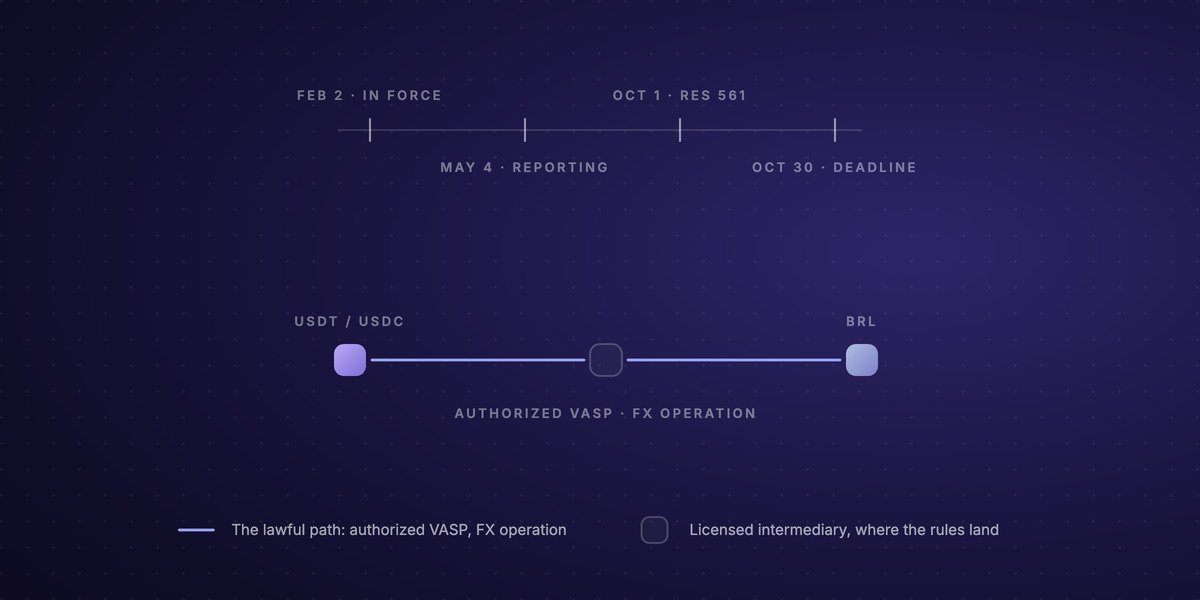
What actually changed in February
The package has four parts, and together they move crypto from a legal gray zone into the FX perimeter:
- Authorization. Exchanges, brokers, custodians, and other virtual asset service providers (VASPs) need a Banco Central license to serve Brazilian residents. That includes foreign platforms: serving Brazil from abroad without authorization stops being an option. Existing operators may keep working through a transition window while they apply; the window runs to the end of October 2026.
- Stablecoins are FX. Operations with fiat-pegged coins, purchase, sale, exchange, international transfer, are foreign-exchange operations, with the documentation and oversight that implies. Brazil's logic is straightforward: when roughly 90% of the country's crypto flows are stablecoins, the digital dollar is the FX market, so it gets FX rules.
- Reporting. Cross-border crypto operations became reportable to the central bank from May 4, 2026, the same visibility regulators have long had over wires.
- Self-custody meets KYC. When a transaction involving a VASP touches a self-custody wallet, the provider must identify the wallet's owner. Your MetaMask isn't banned; it's introduced to your exchange's compliance department.
If this arc sounds familiar, it should: the EU's MiCA and the US GENIUS Act follow the same blueprint of regulating issuers and intermediaries rather than holders. Brazil's twist is plugging stablecoins directly into its FX regime, which is stricter than either.
The second shoe: Resolution 561
In April 2026 the central bank added Resolution 561, which answers a narrower question: may regulated payment channels settle internationally in crypto? For eFX providers, the fintechs that handle small cross-border payments and remittances, the answer from October 1 is no: settlement with their overseas counterparties must run through traditional FX or non-resident BRL accounts, not stablecoins, with adaptation deadlines stretching into 2027.
The carve-out matters as much as the rule: authorized VASPs, including banks operating as VASPs, may still use stablecoins for cross-border payments under their own framework. Brazil isn't closing the stablecoin corridor; it's deciding that the corridor belongs to licensed VASPs rather than the eFX pipe. For businesses, that shifts the question from "can I pay abroad in stablecoins?" to "which licensed provider does it for me?"
What this means for an internationally operating company
Concretely, for a Brazilian business with foreign suppliers, clients, or contractors:
- Paying a supplier abroad in USDT/USDC is still possible, but it is now an FX operation executed through an authorized channel, with documentation to match. The informal route, buy coins on any platform, send them abroad, no paper trail, is exactly what the framework is built to end.
- Collecting export revenue in stablecoins works the same way in reverse: the conversion into reais happens at an authorized VASP, and the cross-border leg is reportable. Since stablecoin conversions now sit inside the FX perimeter, Brazil's IOF tax on FX operations is also in scope; the applicable rate depends on the operation type, which is a question for your accountant, not a blog post.
- Your provider's status is now your problem. After October 30, a platform that hasn't applied for authorization can't lawfully keep serving Brazilian residents. If your payment flows run through an exchange or fintech, ask them one question this month: have you applied? A provider that answers vaguely is telling you to migrate before they get switched off, taking your operational routine with them.
- Self-custody treasury still works, but expect the identification step whenever your wallet interacts with a licensed provider, and expect transfers to unidentified wallets to get harder.
The deeper shift is strategic. Brazil made the stablecoin corridor legible: reportable, licensed, taxed like FX. That removes the gray-zone discount, and it removes the gray-zone risk. Companies that treated stablecoins as a workaround will find the workaround closing; companies that treat them as a payment rail get, for the first time, a rulebook that says exactly how to use it lawfully.
This is the pattern everywhere, not just Brazil: regulators license the boundary between coins and bank money and leave the coins themselves alone. It's why, wherever you operate, the practical questions about a stablecoin off-ramp are always the same: who converts your money, under what license, at what rate you can see before confirming, and into which real bank account. Those questions now have official answers in Brazil, and any provider serving Brazilian businesses should be able to give them in writing.
The 2026 timeline
| Date | What happens |
|---|---|
| February 2, 2026 | Resolutions 517–521 take effect: VASP regime, stablecoins classified as FX |
| May 4, 2026 | Mandatory reporting of cross-border crypto operations begins |
| October 1, 2026 | Resolution 561: eFX providers must settle abroad via traditional FX, not crypto |
| October 30, 2026 | Authorization window closes for existing providers serving Brazil |
| Into 2027 | Adaptation deadlines for settlement arrangements under Resolution 561 |
FAQ
Are stablecoins banned in Brazil? No. Holding, receiving, and spending USDT or USDC remains legal, and Brazil is one of the world's largest stablecoin markets. What changed is who may convert them: providers need central bank authorization, and the operations are treated as foreign exchange.
Can a Brazilian company still pay foreign suppliers in USDT or USDC? Yes, through an authorized VASP, documented as an FX operation. What's ending is the informal version. Resolution 561 additionally blocks eFX providers from settling abroad in crypto from October 2026, but authorized VASPs keep their own stablecoin channel.
What's the difference between Resolution 521 and Resolution 561? 521 (with 517, 519, and 520) is the framework: who needs a license and what counts as FX. 561 is narrower: it forbids eFX payment providers from using crypto to settle with overseas counterparties, while leaving the VASP channel open. 521 licenses the market; 561 decides which pipe the cross-border settlement flows through.
Does the IOF tax now apply to stablecoin conversions? Stablecoin operations sit inside the FX perimeter, which is where IOF lives, and the rate depends on the type of operation. For anything beyond a general orientation, ask a Brazilian tax adviser; this isn't tax advice.
What happens after October 30, 2026? Providers that haven't applied for authorization can no longer lawfully serve Brazilian residents. For users the risk isn't fines; it's waking up to a platform that has cut off Brazil. Check your provider's status before the deadline, not after.
Is USDT treated differently from USDC? No. The rules are issuer-agnostic: any fiat-pegged token is FX when bought, sold, or exchanged. The coins differ in reserves and licensing elsewhere, which we cover in USDT vs USDC and Is USDT legal?; under Brazil's framework they ride the same rails. For the mechanics of actually converting to reais, see how to convert USDC to BRL.