
Is USDT Legal? Where Tether Stands Under GENIUS and MiCA in 2026
Whether USDT is legal to hold and use in 2026, country by country: the US 2028 compliance clock under the GENIUS Act, the EU delistings under MiCA, and what it means if you get paid in USDT.

Yes, holding and using USDT is legal almost everywhere, including the United States and the European Union. What changed in the last two years is not whether you may hold the coin, but where regulated platforms may offer it. In the US, USDT is available today and platforms can keep offering it until July 18, 2028, the GENIUS Act's cutoff for coins from non-permitted issuers. In the EU, USDT was never banned, but licensed exchanges delisted it because Tether didn't seek authorization under MiCA; holding it in your own wallet remains legal. In most emerging markets it's simply the dominant digital dollar. The question "is USDT legal" really unpacks into three different questions, and this post answers each: can you hold it, can platforms sell it to you, and how long will both stay true.
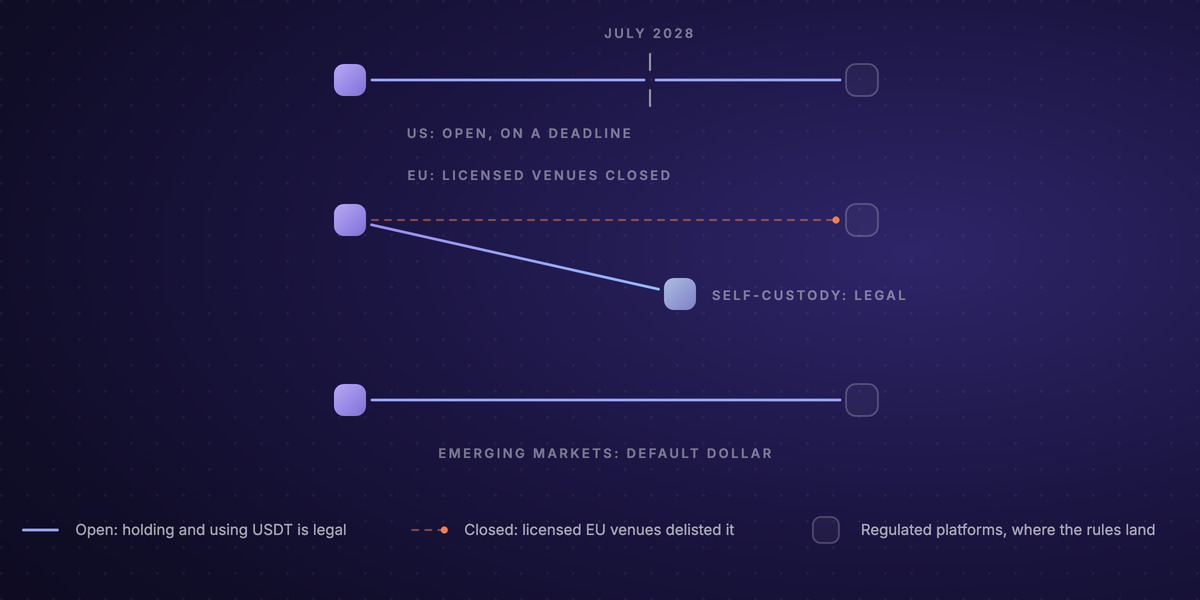
The short answer, by jurisdiction
| Where | Can you hold USDT? | Can regulated platforms offer it? |
|---|---|---|
| United States | Yes | Yes, until July 18, 2028, unless Tether qualifies as a compliant foreign issuer |
| European Union | Yes, self-custody is legal | No; licensed exchanges delisted it under MiCA |
| United Kingdom | Yes | Platform by platform; UK stablecoin rules are still being finalized |
| Brazil | Yes | Yes, via authorized providers; stablecoin trades count as FX operations since February 2026 |
| Most emerging markets | Yes | Yes; USDT is usually the most liquid coin available |
Nowhere on this list is it illegal for an individual or business to receive, hold, or spend USDT. The regulatory action is aimed at issuers and platforms, not holders.
The US: legal today, on a 2028 clock
The GENIUS Act, signed in July 2025, created a permitted-issuer regime for dollar stablecoins: full backing in cash and short-term Treasuries, monthly disclosures, and freeze-and-seize cooperation. US platforms may offer coins from issuers outside that regime only until July 18, 2028.
Tether's response was a fork, not a filing. In January 2026 it launched USAT, a separate US-compliant coin issued through Anchorage Digital Bank, while USDT itself, roughly $190 billion in circulation, stays offshore. For USDT to remain on US platforms past 2028, Tether needs to qualify as a compliant foreign issuer, which requires a reciprocity determination from the US Treasury that was still pending as of mid-2026. The reserve gap is the sticking point: by Tether's own Q1 2026 attestation, about a quarter of USDT's reserves sit in assets the US regime doesn't accept, including roughly $8 billion in gold and $7 billion in bitcoin.
So the honest US answer: fully legal to hold and use, freely available today, and carrying a visible deadline whose outcome depends on choices Tether hasn't finished making.
The EU: legal to hold, gone from licensed exchanges
MiCA requires stablecoin issuers to be authorized as e-money token issuers, and Tether never applied, objecting publicly to the rule that a large share of reserves must sit in EU bank deposits. The consequence arrived through the platforms: Coinbase, Kraken, Binance's EU entity, and Crypto.com delisted USDT for European users, mostly through 2025, and since the MiCA transition fully ended on July 1, 2026, a licensed venue offering an unauthorized stablecoin risks its own license.
None of that makes USDT illegal for you. Holding it in a self-custody wallet is lawful, moving it on-chain is lawful, and decentralized exchanges still trade it. What you've lost in the EU is convenience: no licensed on-ramp or off-ramp will touch it, so the practical route in and out of euros runs through MiCA-authorized coins like USDC and EURC.
Everywhere else: mostly business as usual
Outside the US and EU, USDT remains the workhorse. Across Latin America, Africa, and much of Asia it is the most liquid digital dollar and often the default way freelancers and traders hold value. Rules are formalizing rather than prohibiting: Brazil now treats stablecoin trades as foreign-exchange operations handled by authorized providers, and other jurisdictions are converging on the same pattern, regulate the ramp, not the wallet. The direction of travel worldwide is consistent: nobody is criminalizing holders; everybody is licensing intermediaries.
What this means if you get paid in USDT
For a business or freelancer invoicing in stablecoins, three practical conclusions follow.
Where you are matters more than the coin. In most of the world, accepting USDT stays straightforward. In the EU, converting USDT to euros through licensed channels is the hard part, so EU-based businesses increasingly invoice in USDC instead. In the US, nothing changes before 2028, but contracts and payment terms that outlive 2028 deserve a fallback clause.
Diversification is cheap insurance. USDT and USDC are interchangeable for day-to-day payments, and the differences between them are precisely about regulation and reserves. Accepting both, and being able to convert either to local currency, removes the single-issuer risk from your income.
The ramp is what regulators regulate. Every rule discussed above lands on the boundary between coins and bank money. Localbridge operates on that boundary deliberately: accounts run on both USDC and USDT rails (via Bridge, part of Stripe), conversion happens at a rate you see before confirming, and fiat always lands in a real bank account, yours or your counterparty's. If the coin mix of your income shifts, the off-ramp doesn't have to.
FAQ
Is USDT banned in the US? No. USDT is available on US platforms today and can remain so until July 18, 2028. After that, platforms may only offer coins from permitted issuers, unless Tether qualifies as a compliant foreign issuer before the deadline. USAT, Tether's separate US-regulated coin, exists precisely for that scenario.
Is USDT banned in Europe? No, but it's delisted. Licensed EU exchanges removed USDT because Tether didn't seek MiCA authorization. Holding USDT in self-custody is legal, and no one is confiscating it; you just can't buy or sell it through regulated European venues.
Can my USDT be frozen? Tether can and does freeze tokens at specific addresses, usually at law-enforcement request; that capability predates all of these laws. The GENIUS Act makes such cooperation a formal requirement for any issuer that wants US market access. Funds in self-custody are otherwise yours; freezing targets specific addresses, not the coin at large.
Is "legal" the same as "safe"? No. Legality is about whether you may hold and use the coin; safety is about whether the peg holds and reserves are real. USDT's reserves are attested quarterly but not audited to the standard the US regime demands, which is exactly why part of them doesn't qualify. For the safety question, see What is USDT.
Should I switch from USDT to USDC? If you're in the EU, or your off-ramp is an EU-licensed platform, practically yes. Elsewhere it's a preference: USDC offers cleaner regulatory standing, USDT offers deeper liquidity in emerging markets. Accepting both costs nothing and hedges the decision.
What is USAT? Tether's US-compliant stablecoin, launched in January 2026 and issued through Anchorage Digital Bank, a federally chartered crypto bank. It exists so Tether can serve the US market under the GENIUS Act without restructuring USDT's offshore reserves. Adoption so far is modest compared with USDT itself.