
How to Receive International Payments: Every Method Compared
SWIFT wires, PayPal, Wise, Payoneer, local rails, and stablecoins compared: what each costs to receive, how long money takes to arrive, and what actually lands in your account.

To receive an international payment you need two things: account details your client can actually pay to, and a route that doesn't quietly eat the money on the way. The main routes are a bank wire over SWIFT, a payment platform like PayPal, a multi-currency account with local receiving details (Wise, Payoneer, Localbridge), a local payment rail when both sides share one, and stablecoins. They differ enormously in what arrives: send $1,000 down each route and the amount that lands in your account ranges from roughly $920 to $1,000, and the arrival time from under a minute to five business days.
This guide is written from the receiving side, which most explainers skip. The sender picks the method, but you absorb most of the cost: deducted fees, conversion spreads, and the days of waiting all happen on your end. Below is every method with its real receiving cost, when each one makes sense, and the setup that lets a client abroad pay you as if they were paying a neighbor.
Why you receive less than the sender sent
Every method sits somewhere on the same trade-off: who touches the money between the sender and you, and what each touch costs.
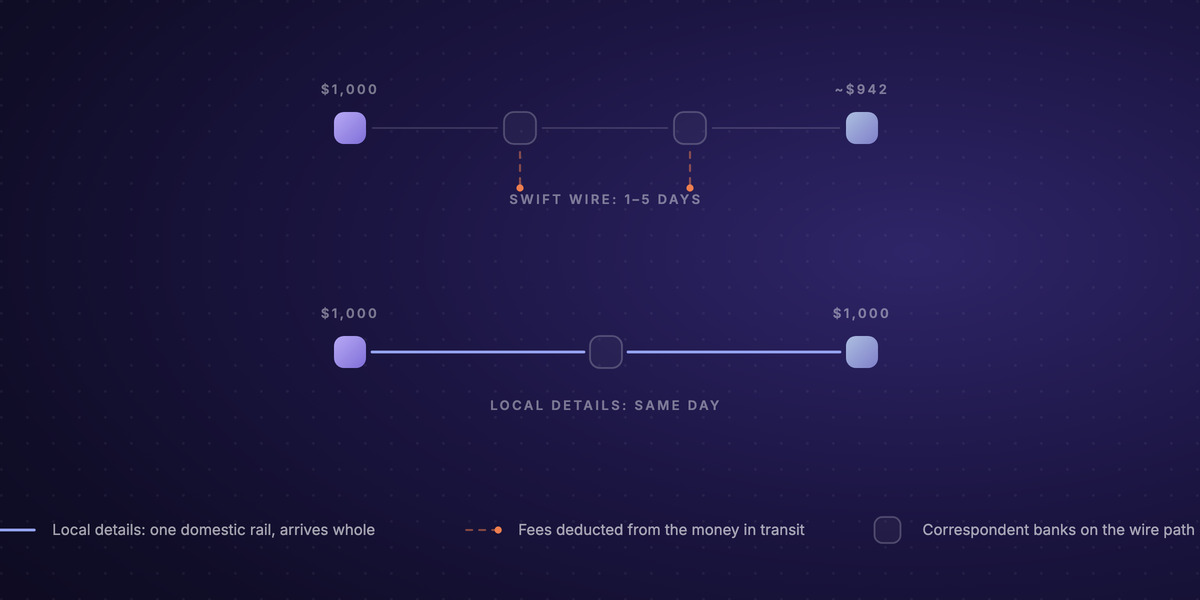
A classic international wire crosses the SWIFT network through one or more correspondent banks. Each intermediary can deduct a handling charge straight from the amount in transit, typically $15 to $50 per bank, and your own bank usually charges an incoming international wire fee of around $15 on top. None of this is visible when the sender initiates the payment; you find out what survived when it lands. That is why an invoice for $1,000 so often settles as $942 or $918, and why the exact number changes from one transfer to the next.
Platforms work differently: the path is short, but the platform prices the whole journey itself. PayPal charges the receiving business its standard rate (3.49% + $0.49 in the US) plus a cross-border fee of about 1.5% when the sender is in another country, and if the payment needs currency conversion, the spread above the mid-market rate is typically another 3 to 4%. The deductions are predictable, which is genuinely worth something, but they stack.
The third pattern removes the border from the payment entirely: you hold receiving details that are local to the sender. Their transfer travels a domestic rail (ACH in the US, SEPA in Europe, Faster Payments in the UK), which is cheap or free and fast. The border crossing happens later, inside your own account, on terms you can see before you agree to them. Multi-currency accounts and stablecoin-based accounts both use this pattern.
Every way to receive international payments
| Method | Typical cost to receive | Arrival time | Watch out for |
|---|---|---|---|
| Bank wire (SWIFT) | ~$15 incoming fee + $15–50 per intermediary | 1–5 business days | Deductions invisible until settlement |
| PayPal | 3.49% + $0.49 + ~1.5% cross-border + 3–4% conversion | Minutes to balance | Fees stack; withdrawal to bank is a separate step |
| Wise | Free via local details (US wires: $6.11) | Same day on local rails | Sender must use your local details, not a wire |
| Payoneer | Free from Payoneer users; up to 3.99% + $0.49 for card payments; conversion markup on withdrawal | Same day to 2 days | $29.95 annual fee below a volume threshold |
| Local rail (Pix, SPEI, SEPA) | Usually free | Seconds to one day | Only works when both sides are on the same rail |
| Stablecoins (USDC/USDT) | Network fee, cents to a few dollars | Minutes | You handle the conversion to local currency yourself |
Bank wire over SWIFT
The default your client's bank will offer, and the most expensive way to be on the receiving end. It works everywhere, needs nothing but your IBAN or account number plus a SWIFT/BIC code, and large sums travel it routinely. The problems are the opaque intermediary deductions described above and the timeline: two to five business days is normal, and neither side can see where the money is mid-journey. Use it when the amount is large enough that a $40 haircut doesn't matter, or when it is genuinely the only rail connecting the two banks.
PayPal
The easiest thing to ask a client for, and often the most expensive percentage-wise once cross-border and conversion fees stack on the base rate. On a $1,000 invoice from another country, the deductions commonly total $50 to $90 depending on whether conversion applies. PayPal also doesn't operate in every country (we've covered what that looks like in Nigeria), so availability on your side is worth checking before you put it on an invoice. It earns its keep for small amounts where convenience beats cost, and for clients who simply won't use anything else.
Multi-currency accounts: Wise and Payoneer
Both give you local receiving details in major currencies, which moves you into the "get paid like a local" pattern. Wise is free to receive money through those details on domestic rails (an incoming USD wire costs $6.11, so steer US clients toward ACH), and holds a real fiat balance you convert at a small transparent fee. Check first that Wise opens accounts for your country and entity type: residents of Mexico, Nigeria and Turkey are excluded, and Wise Business is closed to companies registered in Argentina, for example. Payoneer is free when the payer is another Payoneer user and convenient for marketplaces, but card payments cost up to 3.99% + $0.49, withdrawing to your local bank carries a conversion markup, and an annual fee of $29.95 applies below a receiving-volume threshold. For a freelancer invoicing US or EU clients from elsewhere, either is a large upgrade over wires and PayPal. We've compared the two head-to-head in Payoneer vs Wise.
Local payment rails
When you and the payer are in the same country, or your account gives you a presence on their rail, the payment stops being international at all. SEPA moves euros across Europe for free in a day; Pix settles in Brazil in seconds; SPEI does the same in Mexico. The receiving cost is usually zero. The limitation is obvious: someone has to give you a foothold on the sender's rail, which is exactly what virtual accounts and multi-currency accounts exist to do.
Stablecoins
A client who agrees to pay in USDC or USDT can send you digital dollars directly: the payment arrives in minutes, at any hour, for a network fee measured in cents to a few dollars, with no intermediary able to deduct anything. What stablecoins don't solve by themselves is the last step, turning digital dollars into money at your local bank; for that you need an off-ramp, and you'll want to understand what a stablecoin actually is before routing invoices through one. For payments between businesses that both operate internationally, this route is increasingly the fastest and cheapest of all.
Best app to receive money from abroad
There is no single best app, because the answer depends on who is paying you and where the money needs to end up. An honest short list:
- Wise, when you want a regulated fiat balance with local details in USD, EUR, GBP and other major currencies, and your clients pay by bank transfer.
- Payoneer, when your income comes through marketplaces and platforms that already integrate it.
- PayPal, when invoices are small and the client's convenience decides.
- Localbridge, when you want local receiving details for six currencies (USD, EUR, GBP, MXN, BRL, COP) with the balance held in digital dollars and payouts to bank accounts worldwide; the step-by-step is below.
Searches for an "international Venmo alternative" land here for a reason: Venmo only works between US-based users with US bank accounts and phone numbers, so for cross-border payments the alternative is any of the four above rather than a different Venmo.
How long does it take to receive payment from abroad
Depends entirely on the rail, not the countries:
- Stablecoins: minutes, around the clock, weekends included.
- Local rails: seconds (Pix, SPEI) to one business day (SEPA, Faster Payments); ACH typically one to two.
- PayPal: minutes to your PayPal balance; moving it to a bank adds one to three business days.
- SWIFT wire: one to five business days, with two to five being the honest expectation and no visibility in between.
A payment that is "late" on a domestic rail is usually a compliance review, not a routing delay; a wire that is late is often just a wire.
Receiving international payments with Localbridge
Localbridge applies the get-paid-like-a-local pattern with a different engine under it. A virtual account gives you receiving details in USD, EUR, GBP, MXN, BRL, or COP. Your client pays through their domestic rail, nothing international on their side. When the money arrives, it's converted into USDC or USDT automatically and held as digital dollars, so the balance doesn't lose value to a weakening local currency while it sits. From there you pay it out wherever it needs to go: to your own bank account, or straight to a supplier's or contractor's account in their local currency. Receiving fiat always ends in a real bank account, yours or your counterparty's.
The setup, step by step:
- Open an account. Sign up and pass verification; with a complete KYB pack this takes days, not weeks.
- Get your receiving details. Choose the currencies your clients pay in and share the details like any bank account.
- Invoice as a local. A US client sends ACH, a European client sends SEPA, a Brazilian client sends Pix. No wire forms, no SWIFT codes, no intermediary deductions.
- Hold digital dollars, pay out anywhere. The balance sits in USDC/USDT; payouts land in local bank accounts, with the conversion handled for you. Details on how it works and pricing.
FAQ
What's the cheapest way to receive money from abroad? Any route where the payment travels a domestic rail: local receiving details (via Wise, Payoneer, or Localbridge) or a shared local rail cost you at or near zero to receive. Stablecoins are comparably cheap once the sender agrees to them. SWIFT wires and PayPal are consistently the most expensive routes.
Is there an international alternative to Venmo? Venmo itself is US-only, both parties need US bank accounts. For cross-border payments the practical equivalents are Wise, Payoneer, PayPal, or a stablecoin-based account like Localbridge.
Can I receive international payments without a bank account in the sender's country? Yes. That is precisely what local receiving details solve: a virtual or multi-currency account gives you local details in the sender's currency without opening a bank account there. You do still need a real bank account (in your own country is fine) wherever you finally withdraw fiat.
Why did I receive less money than the sender sent? On a SWIFT wire, intermediary banks and your receiving bank deduct fees from the amount in transit. On platforms, receiving fees and conversion spreads come out of the payment. The invoice-to-received gap is a property of the route, so changing the route is how you close it.
Do I pay tax on money received from abroad? Income is generally taxable where you are resident regardless of which rail it arrives on; the payment method changes your fees, not your tax bill. Rules differ by country, so check locally. Nothing here is tax advice.
How long does an international bank transfer take to arrive? A SWIFT wire takes one to five business days. Payments over local rails arrive the same day, and stablecoin transfers in minutes. See the timing section above for the full breakdown.