
What a $100 Payout via Payoneer Really Costs (2026)
Payoneer's fees on a $100 payout, line by line: 1% to receive, 1.2–4% to withdraw, a $29.95 annual fee under $6,000 a year, and ATM charges. The arithmetic for Mexico, Colombia and Brazil.

A $100 payout sent through Payoneer reaches your bank account as roughly $94 to $98, and under $90 once the Payoneer card and an ATM are involved. The withdrawal fee is the part everyone sees: Payoneer's fee schedule puts it at 1.2% to 4% when the money converts into your local currency, built into the exchange rate. Three smaller lines do the rest of the damage on a small check: a 1% receiving fee (minimum $1) when a client pays by bank transfer, a $29.95 annual fee if you receive less than $6,000 in a year, and $3.15 plus a percentage every time the Payoneer card touches an ATM.
This article is for people who get paid by companies in amounts like $50, $100 or $250: affiliate commissions, data-labeling and tutoring payouts, small freelance invoices. On a $1,000 transfer the fixed costs disappear into the rounding. On a $100 payout they don't, and that is what this article is about. Every figure comes from Payoneer's published fee schedule (last updated 1 January 2026) and its own pages, as of October 2026.
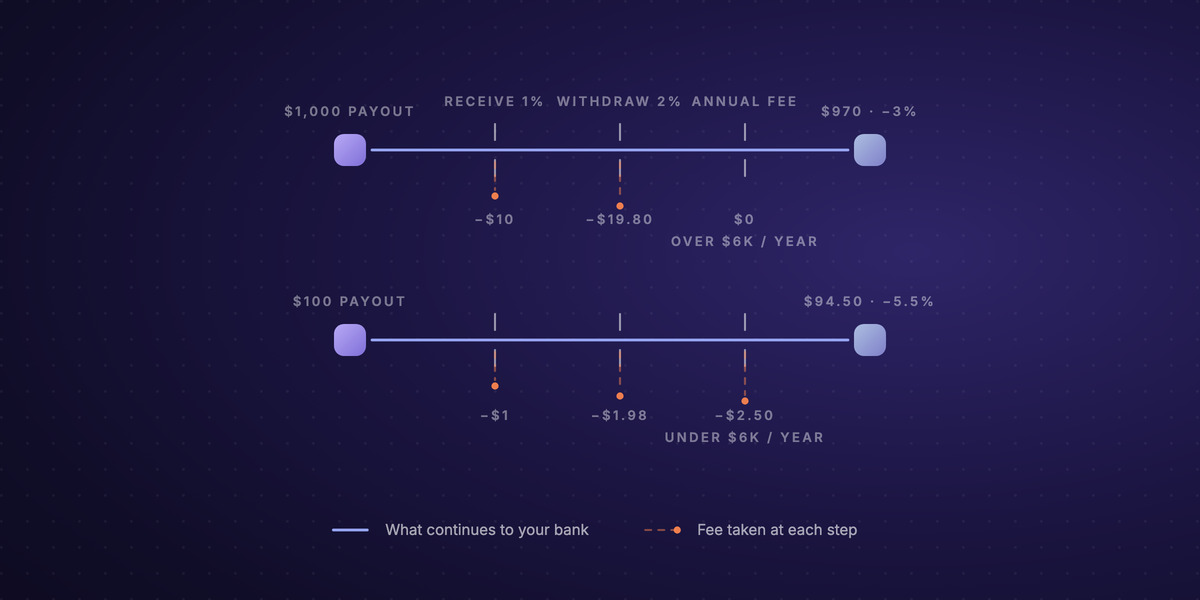
The four Payoneer fees that hit a $100 payout
Payoneer's pricing page lists dozens of lines. Four of them decide what a small payout actually costs.
Receiving fee: free or 1%, depending on how the company pays. If the company pays you from its own Payoneer balance, which is how most platforms and mass-payout senders work, receiving is free. If a client pays by bank transfer into your Payoneer receiving account in US dollars, and dollars aren't your local currency, Payoneer takes 1% with a minimum of $1. Marketplace payouts have their own rates set by each platform. Card payments from a client cost up to 3.99% + $0.49, which on $100 is $4.48 before anything else happens.
Withdrawal fee: 1.2% to 4%, hidden inside the exchange rate. When you withdraw to a bank account in pesos or reais, Payoneer converts at a rate "based on wholesale market rates" that already includes its fee. You never see the fee as a separate line, only the rate. The global schedule gives a range of 1.2% to 4% and warns that some countries carry a minimum fee of up to $20. Payoneer's own Argentina page says "up to 2%", and Brazilian coverage of its launch quoted up to 2% as well, so 2% is the working figure we use below. The only way to know your real number is to compare the rate on the confirmation screen with the mid-market rate at that moment.
Annual account fee: $29.95 if you receive less than $6,000 in 12 months. This is the fee that small-payout recipients forget. Someone paid $100 a month receives $1,200 a year, well under the threshold, so they pay it. Spread over twelve payouts, it adds $2.50 to each one, or 2.5%. Someone paid $500 a month clears the threshold and never sees it.
Card fees: $29.95 a year plus $3.15 and a percentage per ATM withdrawal. The Payoneer card has its own annual fee. Cash at an ATM in the card's currency costs $3.15 plus up to 1.8%; with a currency conversion, $3.15 plus up to 3.5%. Purchases abroad or in another currency add up to 3.5% too. On a $100 payout, a single ATM withdrawal in pesos is $6.65 before the card's annual fee.
The arithmetic: what reaches your bank from $100
Four realistic cases, all using 2% for the withdrawal (the middle of Payoneer's published range) and the fees above. Your confirmation screen shows the real figures; the point is the shape, not the cents.
| How you get paid and cash out | Receiving | Withdrawal | Annual fee per payout | What reaches you | Cost |
|---|---|---|---|---|---|
| Paid from the company's Payoneer balance, bank withdrawal, over $6,000 a year | $0 | $2.00 | $0 | $98.00 | 2% |
| Paid from the company's Payoneer balance, bank withdrawal, under $6,000 a year | $0 | $2.00 | $2.50 | $95.50 | 4.5% |
| Client pays by bank transfer to your USD receiving account, bank withdrawal, under $6,000 a year | $1.00 | $1.98 | $2.50 | $94.52 | 5.5% |
| Same, but you take the cash at an ATM in local currency with the Payoneer card | $1.00 | $6.62 | $2.50 + $2.50 card | $87.38 | 12.6% |
Two things stand out. First, the person who gets paid the same way as a $5,000-a-month agency pays more than double the rate, only because the annual fee doesn't shrink with the check. Second, the card looks convenient and is the most expensive exit by far: two fixed charges and two percentages stacked on one $100.
If the withdrawal fee in your country sits at the 4% end of the range, add $2 to every row. If your bank charges you for an incoming transfer, add that too; Payoneer doesn't control it and says so.
Why $100 payouts lose more than $1,000 ones
Payoneer's percentage fees are the same for everyone. Its fixed charges aren't, in effect: a $1 minimum, a $29.95 annual fee and a $3.15 ATM fee cost a small recipient a far larger share of each payout.
| $1,000 payout, over $6,000 a year | $100 payout, under $6,000 a year | |
|---|---|---|
| Receiving (1%, min $1) | $10.00 | $1.00 |
| Withdrawal (2%) | $19.80 | $1.98 |
| Annual fee per payout | $0 | $2.50 |
| Total | $29.80 (3%) | $5.48 (5.5%) |
The B2P economics behind this are simple. A company that pays a hundred contributors $100 each is sending $10,000, but each contributor is a small account on Payoneer's side, below the annual-fee threshold, often cashing out through the card. The platform's fee is low. The recipient's isn't.
Mexico, Colombia and Brazil: what changes on the bank side
The Payoneer fees are the same. The last mile differs.
- Mexico. Withdrawals in pesos go to a CLABE account by SPEI. Payoneer also offers a route into Bitso, which its own page prices at 2.9% all-in (Payoneer, Bitso and conversion), with a $10 minimum per transfer and a $6,000 monthly cap. Our guide to receiving money from the US in Mexico covers the rest of the options.
- Colombia. A resident can't hold dollars at a Colombian bank, so every Payoneer withdrawal converts to pesos at Payoneer's rate, not the official TRM. What that means for the exchange rate you actually get is in our guide to receiving money from abroad in Colombia.
- Brazil. Withdrawals in reais go to a Brazilian bank account, and Payoneer's help centre warns it may ask for documents to satisfy Brazilian bank rules before the first one. The routes side by side are in our guide to receiving payments from abroad in Brazil.
Argentina works differently, with dollar savings accounts, central-bank deadlines and a Santander route of its own; we covered it in Payoneer in Argentina.
How to pay less if you stay on Payoneer
- Ask the payer to send from its Payoneer balance. That makes receiving free and removes the $1 minimum. Most platforms already do; direct clients often don't know the difference.
- Withdraw less often. The withdrawal fee is a percentage, so batching doesn't reduce it, but any per-transfer minimum, and any fee your bank charges on incoming transfers, hits once instead of four times.
- Watch the $6,000 line. If you're close to it in a rolling 12 months, routing one more client through Payoneer saves you $29.95. If you're nowhere near it, the annual fee is a real 2 to 3% on your income and belongs in your comparison.
- Skip the card for cashing out. It's fine for paying for services in dollars. As a way to turn a $100 payout into pesos, it's the worst option on the list.
- Check the rate against mid-market before you confirm. The fee is in the rate, so that comparison is the only place it becomes visible.
The alternative: no fixed fee per incoming payment
This is the one block in the article about us. We built Localbridge for exactly the payouts described above: money that companies and platforms send to the people who work for them.
An individual account is made for payouts from companies: affiliate commissions, labeling or tutoring platform earnings, freelance income, salary from an employer abroad. A business account covers companies that invoice customers. Either way, a virtual account gives you local payment details in USD, EUR, GBP, MXN, BRL and COP, so the payer sends an ordinary domestic transfer. Each payment converts automatically into USDC or USDT, digital dollars you can keep, send to a bank account in Mexican pesos, Colombian pesos or Brazilian reais, or move to your own wallet. There's no fixed fee per incoming payment and no annual fee: you pay a percentage of what you convert, published on the pricing page, and nothing else. Localbridge never holds your funds; the accounts and the conversion run on regulated partner infrastructure, and payouts in local currency go to your own external bank account.
Two honest limits. The individual account doesn't take money from other individuals or let you invoice customers; that's what the business account is for. And the full loop in local currency exists today for Mexico, Colombia and Brazil; in Argentina you'd sell stablecoins on a local exchange for pesos.
FAQ
How much does Payoneer charge to withdraw to a bank account? Between 1.2% and 4% when the money converts into your local currency, according to Payoneer's fee schedule, with the fee built into the exchange rate rather than shown separately. Some countries carry a minimum of up to $20. Payoneer's Argentina page says up to 2%. Withdrawing US dollars to a US bank account costs a flat $1.50.
Does Payoneer charge a fee to receive money? Receiving from another Payoneer account is free. Receiving a bank transfer into a receiving account in a currency that isn't your local one, which is the case for a dollar account held by someone in Mexico, Colombia or Brazil, costs 1% with a $1 minimum. Card payments cost up to 3.99% + $0.49.
What is the Payoneer annual fee and how do I avoid it? $29.95 a year, charged only if your account receives less than $6,000 in any 12 consecutive months. You avoid it by receiving $6,000 or more in that window. For someone paid $100 a month it works out at $2.50 per payout.
Is Payoneer's exchange rate the mid-market rate? No. Payoneer converts at a rate based on wholesale market rates that includes its conversion fee. The fee isn't shown as a separate line, so comparing the rate on the confirmation screen with the mid-market rate is the only way to see what you're paying.
How much does it cost to take $100 out of Payoneer at an ATM? In the card's own currency, $3.15 plus up to 1.8%. With a currency conversion, for example dollars to pesos, $3.15 plus up to 3.5%, which is $6.65 on $100. The card itself costs $29.95 a year.
How long does a Payoneer withdrawal take? Payoneer says most withdrawals land the same day and some take up to two business days; its withdrawal guide gives a wider range of one to three. A rejected transfer can take up to 14 business days to come back.
Is there a cheaper way to receive small payouts from a company? Any route without fixed charges beats Payoneer on small amounts, because the $1 minimum, the $29.95 annual fee and the ATM fee are what push a 2% headline to 5% or more on $100. Localbridge charges a percentage per conversion and no fixed fee per incoming payment; the rate is on the pricing page.