
Payoneer in Argentina: How It Works and How to Withdraw Money (2026)
How to withdraw money from Payoneer in Argentina: pesos to a CBU or dollars to your USD savings account, what each step costs, what changed in 2026, and the BCRA rules that apply.

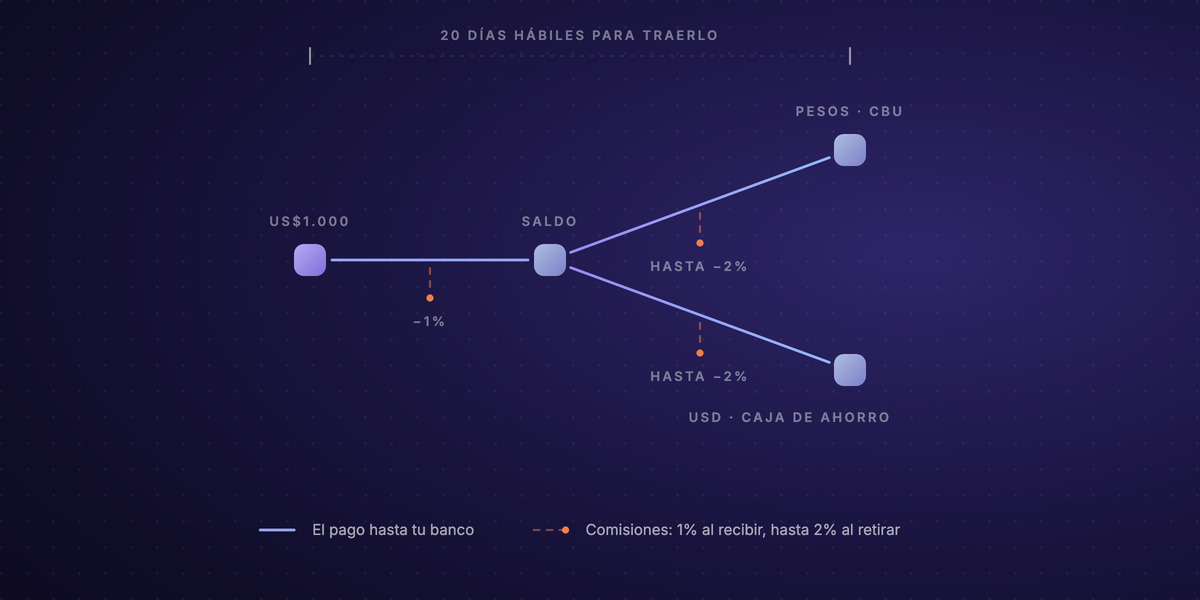
To withdraw money from Payoneer in Argentina you have two direct routes: pesos to any bank account with a CBU, or dollars to a US-dollar savings account (caja de ahorro en dólares), yours or someone else's. On both, Payoneer charges up to 2% and the money usually arrives within one or two business days. Before that comes a cost many guides leave out: receiving dollars into Payoneer's receiving account costs an Argentine user 1% (minimum US$1), because the dollar isn't their local currency.
Payoneer is one of the tools Argentine freelancers use most to get paid by Upwork, Fiverr and clients abroad, and unlike Wise, it's designed for that: its terms define it as a service for commercial activity, open to freelancers and companies. This guide explains how it works from Argentina, what each step costs at the rates in force in October 2026, how to withdraw to your bank in pesos or dollars, what changed this year, and which central-bank rules apply to the balance you keep abroad.
What Payoneer is and how it works in Argentina
Payoneer is a US payments company that gives freelancers and businesses receiving accounts in other countries: US dollar account details in the United States, plus euros, pounds and other currencies. Your client pays you like a local supplier, platforms like Upwork, Fiverr or Amazon pay straight into your balance, and from there you withdraw to your bank.
The detail that matters in Argentina is in its terms of use: Payoneer is a service for business purposes, not for personal, family or person-to-person payments. Both individuals with a commercial activity (freelancers, monotributistas) and companies can open an account. It's the mirror image of Wise in Argentina, which only offers the personal account.
To open one:
- As an individual: a photo of both sides of your ID and a questionnaire about your activity, with links to your marketplace profile or LinkedIn.
- As a company: the contact person's ID, an incorporation or tax registration document, and proof of the company's address from the last three months.
Payoneer usually reviews the account around the first payment, so open it before your first invoice is due.
What Payoneer costs in Argentina
Based on Payoneer's published pricing (updated January 2026) and its Argentina pages:
| Operation | Cost for an Argentine user |
|---|---|
| Receiving into the USD receiving account (ACH, bank transfer) | 1%, minimum US$1 |
| Receiving from another Payoneer account | Free |
| Charging a client by card | Up to 3.99% + US$0.49 |
| Payouts from Upwork, Fiverr and other marketplaces | Set by each platform |
| Withdrawing to your bank in pesos (CBU) | Up to 2% |
| Withdrawing to your US-dollar savings account | Up to 2% |
| Annual account fee | US$29.95 if you receive less than US$6,000 in 12 months |
| Payoneer card | Annual fee of about US$30; ATM, US$3.15 + up to 1.8% |
In numbers: if a client pays you US$1,000 by ACH, Payoneer takes US$10 on receipt and up to US$19.80 when you withdraw the remaining US$990. If you withdraw in pesos, add the gap between Payoneer's exchange rate and the one you could get yourself, since Payoneer builds the conversion cost into its rate and doesn't publish which quote it references.
The annual fee is new: it has applied in Argentina since 23 February 2026 and is charged only if you receive less than US$6,000 in any 12 consecutive months. If you use Payoneer for occasional payments, factor it in.
How to withdraw money from Payoneer in Argentina, step by step
- Add your bank account in the withdrawal section. The account holder's name must match your Payoneer account (unless you're paying a third party), and approving a new account can take up to three business days.
- Choose the currency: pesos to an account with a CBU, or dollars to a US-dollar savings account.
- Enter the amount and check the fee and, if you're withdrawing pesos, the exchange rate before you confirm. Per-transaction minimums and maximums are shown in the app.
- Wait for the credit: most withdrawals arrive the same day, some take up to two business days.
A warning Payoneer itself repeats: your bank may ask for documents before crediting dollars from abroad, such as the export invoice (factura E) for the service you were paid for. Have it ready before your first withdrawal.
Withdrawing pesos to a CBU
The simplest route, and it works with any bank. The fee is up to 2%, with the conversion built into Payoneer's rate. Payoneer doesn't list virtual wallets with a CVU, like Mercado Pago, as withdrawal destinations: if you want the pesos there, withdraw to your bank account and transfer afterwards. Payoneer does mention Prex as an option for instant withdrawals.
Withdrawing dollars to your US-dollar savings account
Since currency controls were lifted, this is the route many people prefer: the dollars arrive as dollars and you decide whether and when to sell them. Payoneer charges up to 2%, and you can withdraw to your own account or a third party's. On the bank's side, the central bank's Communication "A" 8330 (September 2025) bars banks from charging their own fees for crediting dollars from abroad to individuals' accounts; they can only pass through documented correspondent-bank costs, at cost.
About the Santander partnership, one figure keeps circulating, "3.3% end to end", and it isn't Payoneer's: it comes from another provider's comparison table. What Payoneer publishes is its 2% plus Santander's fee of US$20 + 0.125% per transfer, which adds up to about 4.1% on 1,000 dollars and about 3.1% on 2,000. Since that bank fee predates "A" 8330, ask your bank what it charges today before you pick the route.
Spending with the Payoneer card
In Argentina Payoneer offers a card in US dollars, euros, pounds or Canadian dollars, which you can also add to Google Wallet, Apple Pay or Mercado Pago. Availability depends on your account, the annual fee is about US$30, and ATM withdrawals cost US$3.15 plus up to 1.8%. It's useful for spending abroad or on services priced in dollars; for bringing money into Argentina, bank withdrawals are cheaper.
Rules and taxes that apply to your Payoneer balance
The 20-business-day rule. Under the central bank's Communication "A" 8481 (September 2026), payment for services you sell abroad has to be brought into Argentina within 20 business days of being credited to an account abroad, and your Payoneer balance is one. You don't have to sell the dollars: you can credit them to your own dollar account at an Argentine bank. This is our reading of the rule, not legal advice; check your case with your accountant.
The annual cap is gone. Some pages, including Payoneer's own page for Argentina, still mention the US$36,000-a-year limit of the "dólar tecno" regime. Communication "A" 8330 removed it in September 2025.
Factura E. Services sold abroad are documented with the export invoice (factura E), and that's what your bank will ask for to credit the dollars.
Bienes Personales and information exchange. Whatever sits in your Payoneer balance on 31 December is an asset abroad and must be declared. Payoneer says it isn't covered by the CRS automatic exchange-of-information standard, though it cooperates with regulators' requests. Don't take that as a reason not to declare: it's a statement about Payoneer's reporting obligation, not yours.
When Payoneer isn't the best option
Payoneer is hard to replace if you're paid by marketplaces that only pay there. For direct client invoices, the cost stacks up: 1% on the way in, up to 2% on the way out, and an annual fee if your volume is low. Other routes:
- A Swift wire to your US-dollar savings account. Under "A" 8330 your bank can't charge you to credit it; correspondent-bank costs remain. It's slow, but the dollars are already in the country.
- An account built for income from companies, with stablecoin settlement. That's what we built at Localbridge, and it's the one block in this article about us.
Localbridge opens business accounts and individual accounts for freelancers, made for income from companies: client invoices, salary from an employer abroad, platform payouts. A virtual account gives you local payment details in USD, EUR, GBP, MXN, BRL and COP, and each incoming payment converts automatically into USDC or USDT, digital dollars you can keep, send to suppliers' bank accounts in the supported currencies, or move to your own wallet. One honest limit: we don't pay out Argentine pesos today, so for pesos you sell your stablecoins on a local exchange, a routine step in Argentina. The 20-business-day rule applies to a Localbridge balance too, so plan the transfer home either way. Localbridge itself never holds your funds: accounts and conversion run on Bridge, a Stripe company, and custodial wallets, where offered, are held by Bridge. Fees are on the pricing page.
Every route for getting paid from Argentina, with costs and timings, is in our guide to receiving payments from abroad in Argentina.
FAQ
How do I withdraw money from Payoneer in Argentina? Add your bank account in the withdrawal section, choose pesos (to an account with a CBU) or dollars (to a US-dollar savings account), enter the amount and confirm. Payoneer charges up to 2% and the money usually arrives the same day or within two business days.
How much does Payoneer charge to withdraw to an Argentine bank? Up to 2%, in pesos or in dollars. If you withdraw pesos, the conversion cost is built into Payoneer's exchange rate. Separately, receiving into the dollar account costs 1% (minimum US$1).
Can I withdraw dollars from Payoneer to my dollar account? Yes, to a US-dollar savings account of your own or a third party's, for up to 2%. Since Communication "A" 8330, your bank can't charge its own fees to credit them, though it may ask for the factura E.
Can I withdraw from Payoneer to Mercado Pago? Payoneer doesn't list CVU accounts as withdrawal destinations. The practical route is to withdraw to your bank account with a CBU and transfer from there. What you can do is add your Payoneer card to Mercado Pago to pay with it.
How long does a Payoneer withdrawal take in Argentina? Most arrive the same day; some take up to two business days. If it's your first withdrawal to that account, its approval can add up to three business days.
Does Payoneer charge a maintenance fee? Since 23 February 2026 it charges US$29.95 a year, but only if you receive less than US$6,000 in 12 consecutive months. The card has its own annual fee.
Does Payoneer report to ARCA? Payoneer says it isn't covered by the CRS automatic exchange standard, though it cooperates with regulators' requests. Your obligation to declare the income and the balance abroad is the same either way.