
Deel Payments: How Contractors Get Paid and Withdraw Money (2026)
How Deel pays contractors: the invoice cycle, when money lands in your Deel balance, and every withdrawal method with its fee and timing, from free local bank transfers to 2.5% PayPal.

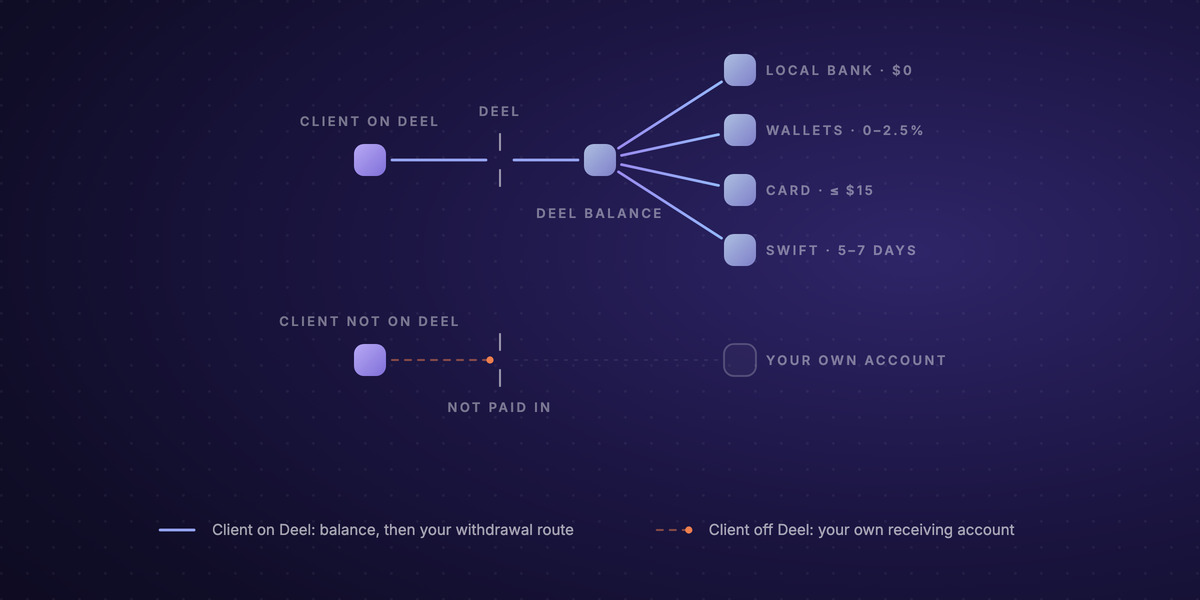
Deel pays contractors into a Deel balance, and from there you withdraw the money yourself. Your client approves the invoice and pays Deel; once Deel has the funds, they appear in your balance, and you move them out by the method you choose. A local bank transfer costs you nothing from Deel's side and takes one to five business days. Wise and Revolut carry no Deel fee, Payoneer costs 1%, Coinbase 1.5%, PayPal 2.5%, and an instant transfer to your debit card 2% capped at $15 outside the US. A SWIFT wire takes five to seven business days and loses an unpredictable slice to intermediary banks.
This article is for developers and small dev shops that get hired by a US or European company through Deel: what Deel is, who pays for it, how the payment cycle works, what every withdrawal route costs according to Deel's own pages, and where Deel stops being your answer. All figures come from deel.com as of October 2026.
What Deel is, and who pays for it
Deel is a platform companies use to hire and pay people in other countries: contractors, employees through an employer of record, and payroll. The company chooses Deel, signs the contract with you inside it, and pays Deel; Deel pays you. You don't pick Deel as a contractor. A client picks it for you, and you get an invitation to onboard.
The cost sits on the client's side. Deel's pricing page lists contractor management at $49 per contractor per month, and Contractor of Record, where Deel itself becomes the contracting party, at $325 per month. There's no subscription or onboarding fee for the contractor. What you pay is the withdrawal fee of the route you pick, plus whatever the destination charges, and that's the part this article is about.
Deel isn't a bank. Your Deel balance is money Deel owes you, held until you withdraw it. Deel's own disclaimer for its stablecoin wallet says the balance is not a bank deposit and isn't covered by deposit insurance such as the FDIC in the US or the FSCS in the UK. The practical consequence: treat the balance as a place money passes through, not a place to keep it.
How Deel payments work for contractors
Every payment starts from the contract type the client set up:
- Fixed: a set rate paid every cycle, weekly, every two weeks or monthly. Deel generates the invoice automatically on the cycle date written in the contract.
- Pay as you go: you submit hours or tasks, the client approves them, and the invoice follows. Bonuses, expenses and overtime can be added to each one.
- Milestone: payment tied to agreed stages of a project, with one-time or per-project payments and as many milestones as the contract defines.
Once the invoice exists, the sequence is the same: the client approves it, the client pays Deel, Deel credits your balance. The step that decides your waiting time is the middle one. Deel doesn't release the money before the client's payment has cleared to Deel, so a client that pays on net-30 terms or funds by SWIFT is slower than one that pays by card the day the invoice is approved. The payment date in your contract is the date the invoice is due, not a promise about when the cash arrives.
From the balance, you withdraw in the amount, currency and method you choose, or set a withdrawal method as automatic so each incoming payment leaves at once. Deel says it tries to pay out locally wherever it can and supports withdrawals in more than 150 local currencies.
Deel withdrawal methods, fees and timing
The table is Deel's own withdrawal table, from the contractor payment guide it last updated in July 2026. The destination's fees come on top.
| Withdrawal method | Deel's fee | Time | Currencies |
|---|---|---|---|
| Local bank transfer | None | 1–5 business days | 180+ |
| International wire (SWIFT) | $5, capped at $10, plus intermediary bank deductions | 5–7 business days | 180+ |
| Wise | None from Deel; Wise's conversion fees apply | Up to 1 business day | AUD, CAD, EUR, GBP, NZD, SGD, USD |
| Revolut | None | Up to 1 business day | USD |
| Payoneer | 1% | Up to 1 business day | USD |
| PayPal | 2.5%, minimum $0.25 | Up to 1 business day | USD |
| Coinbase | 1.5% (a flat $5 on USDC withdrawals under $300, then 1.6%) | Minutes, up to 1 business day | USDC, BTC, ETH, SOL, DASH |
| Instant card transfer | 2%, capped at $15, outside the US; 0.75%, capped at $25, in the US | Seconds; up to a few hours at some banks | Depends on country; minimum $5 |
| Deel Card | $5 for a virtual card, $10 for a physical one in some regions; 1.5% on non-USD purchases | Instant | USD balance |
| Stablecoin wallet (DLUSD) | None to move in or out | Instant to and from the balance | USD-pegged |
Deel changes these terms from time to time, and the figures above are the ones it published as of October 2026; the withdrawal screen in your account shows the fee and the delivery time that apply to you before you confirm. What does depend on you is where you are. The instant card transfer is open in about 80 countries, physical Deel Cards are issued in seven, the stablecoin wallet works in some 80 countries across Latin America, Africa, the Middle East and Asia-Pacific, and your withdrawal screen lists only the methods available in your country.
How to withdraw money from Deel, step by step
- Add a withdrawal method. In the Deel app, go to the finance section and the withdrawal methods tab. Pick the method, enter the account details and confirm. Bank accounts must be in your own name: Deel stopped withdrawals to third-party accounts in 2024, and a mismatch between the account holder and the Deel account is the most common reason a withdrawal is rejected.
- Pick it as the default, or turn on automatic withdrawal. With auto-withdraw on, every incoming payment leaves by that method without you logging in. With an instant card transfer set as the method, automatic payouts become instant too.
- Enter the amount and the currency. Deel shows the fee and the estimated delivery time before you confirm. If a currency conversion is involved, the rate is on the same screen.
- Confirm and wait. Local transfers take one to five business days; e-wallets up to one; SWIFT five to seven. Weekends and public holidays in your bank's country don't count.
If you're in a country where Deel asks for compliance documents before the first withdrawal, upload them when you onboard. Deel holds the balance until they're approved, and the first invoice is a bad moment to discover that.
Faster access: Deel Card, Advance and the stablecoin wallet
Deel sells three ways around the wait between invoice and bank.
Deel Card. A prepaid card funded from your balance and held in US dollars. The virtual card is available in more than 70 countries and costs $5 to activate; the physical one costs $10 in some regions and is issued in seven countries. Spending in dollars carries no fee; anything in another currency costs 1.5%. It works for paying for software, ads and travel in dollars straight from the balance. For bringing money home, a bank withdrawal is still the route.
Advance. A cash advance on earnings you haven't invoiced yet, for verified contractors with at least two months on a fixed or pay-as-you-go contract. Up to $50 per pay cycle is free; above that, a fixed fee with a $10 minimum. Deel repays itself from the next client payment. No credit check and no interest, in Deel's words, but it's still borrowing against money that's late, and the reason it's late is usually the client's payment terms.
Stablecoin wallet. Launched in 2026, this holds your balance as DLUSD, Deel's dollar-pegged digital balance, with optional rewards Deel calls promotional rather than yield. Moving money between the wallet and the Deel balance is free and instant. The disclaimer matters more than the rewards: DLUSD is redeemable for dollars inside Deel, isn't a bank deposit, and isn't insured. The rewards rate is variable and not guaranteed.
What a $2,000 Deel payout costs, route by route
Deel's fees on a $2,000 invoice, before the destination's own charges and any currency conversion:
| Route | Deel's fee on $2,000 | What reaches the destination |
|---|---|---|
| Local bank transfer | $0 | $2,000, converted at Deel's rate if your account isn't in dollars |
| Wise or Revolut | $0 | $2,000, then the wallet's own conversion fee |
| Instant card transfer outside the US | $15 (2% capped) | $1,985 |
| Payoneer | $20 | $1,980, then Payoneer's withdrawal fee of up to 2% |
| Coinbase (USDC) | $30 | $1,970 in USDC |
| PayPal | $50 | $1,950, then PayPal's withdrawal and conversion fees |
The shape is clear: the free routes are the ones where you accept Deel's exchange rate or a second provider's fees, and the paid routes are the ones that get you dollars quickly. For a dev shop paid a few thousand dollars a month, the conversion margin on the "free" local transfer is often the biggest line, and it's the one Deel doesn't print.
Where Deel stops: clients who aren't on it
Deel solves one client. If a US company hires you on Deel, you get a clean contract, an invoice on a schedule and a choice of withdrawal routes. The limit is that none of it carries over to the next client. A startup that pays by bank transfer, an agency that wants to wire euros from Germany, a second contract from a company that uses a different platform: for each of those, the question "where do you want the money sent?" comes back, and Deel isn't an answer, because it only pays what a client on Deel has paid into it.
For an individual developer, that means a receiving account in your own name alongside Deel. For a dev shop, it means a company account that can take payments from every client, on and off Deel, in the currencies they pay in. That's what we built at Localbridge, and it's the one block in this article about us.
Localbridge opens business accounts for companies and individual accounts for people whose income comes from companies: client invoices, platform payouts, salary from an employer abroad. A virtual account gives you local payment details in USD, EUR, GBP, MXN, BRL and COP, so a US client pays you by ACH and a European one by SEPA, with no SWIFT and no intermediary banks. Each incoming payment converts automatically into USDC or USDT, digital dollars you can keep, send to suppliers' bank accounts in the supported currencies, or move to your own wallet. The virtual account doesn't hold the fiat itself; fiat leaves only to an external bank account in a supported currency. Localbridge never holds your funds either: accounts and conversion run on Bridge, a Stripe company, and custodial wallets, where offered, are held by Bridge. Fees are on the pricing page.
If your other clients pay through Payoneer or Wise, the head-to-head is in Payoneer vs Wise, and the Argentine case of each is in Wise in Argentina and Payoneer in Argentina.
FAQ
How do I withdraw money from Deel? Add a withdrawal method in the finance section of the Deel app (a bank account in your name, Wise, Payoneer, PayPal, Revolut, Coinbase or a debit card for instant transfers), enter the amount and currency, check the fee Deel shows, and confirm. You can also set one method as automatic so every payment leaves on arrival.
How long does a Deel withdrawal take? A local bank transfer takes one to five business days, e-wallets like Wise, Payoneer and PayPal up to one business day, an instant card transfer seconds to a few hours, and a SWIFT wire five to seven business days. The clock starts when you withdraw, not when the client pays.
Does Deel charge contractors a fee? Not for using the platform; the client pays Deel's subscription. Contractors pay a withdrawal fee that depends on the method: none for a local bank transfer, Wise or Revolut, 1% for Payoneer, 1.5% for Coinbase, 2.5% for PayPal, and 2% capped at $15 for an instant card transfer outside the US.
What's the cheapest way to withdraw from Deel? A local bank transfer in your contract's currency has no Deel fee. If your bank account is in another currency, compare Deel's exchange rate on the withdrawal screen with Wise's, since Wise withdrawals also carry no Deel fee and Wise shows its conversion cost separately.
Can I withdraw from Deel to Payoneer or Wise? Yes. Payoneer costs 1% and pays out in US dollars; Wise has no Deel fee and supports AUD, CAD, EUR, GBP, NZD, SGD and USD. In both cases the wallet's own fees apply when you move the money to your bank.
Can I withdraw from Deel to someone else's bank account? No. Since 2024 the destination account has to be in the name of the Deel account holder. For a company contract, that's the company's account.
When does the money show up in my Deel balance? After the client has approved the invoice and their payment has cleared to Deel. On a fixed contract the invoice is generated on the cycle date automatically; on pay-as-you-go and milestone contracts it follows your submission and the client's approval.
Can a client pay me through Deel if they're not on Deel? No. Deel pays contractors from what a client on Deel has paid in. A client that isn't on the platform pays you some other way: a bank transfer to a receiving account in your name, or a payment platform you both use.