
What Is OUSD (Open USD)? The Stablecoin Issued by Bridge, Explained
What OUSD (Open USD) is, who is behind it, how it is minted and backed, how it differs from USDT and USDC, and how a business or freelancer can receive OUSD and turn it into local money.

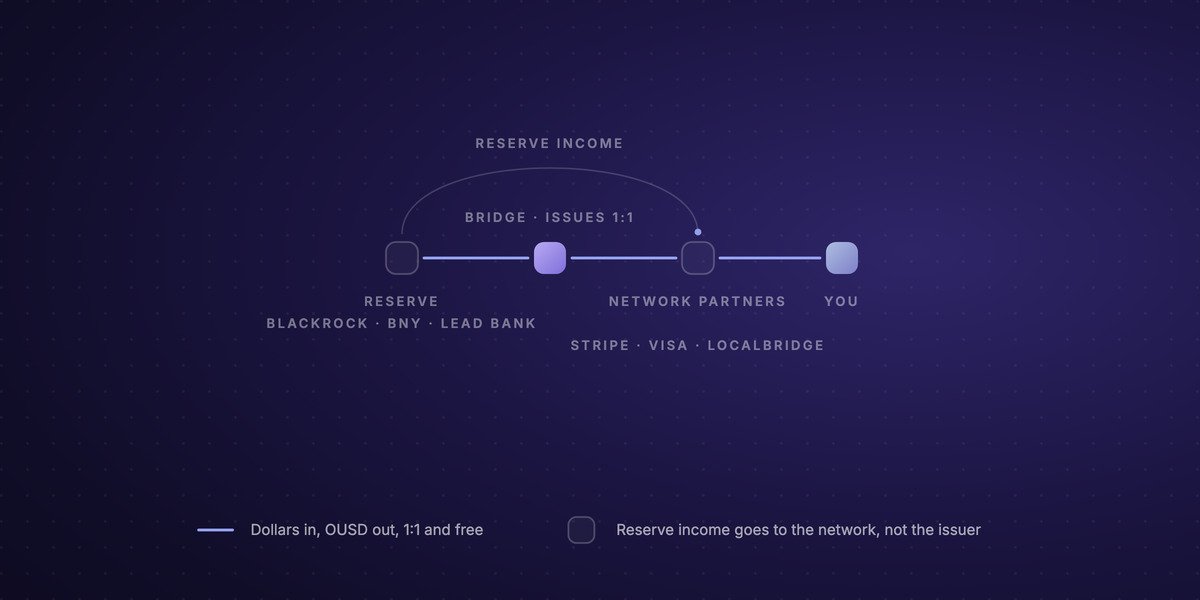
OUSD, or Open USD, is a stablecoin: a digital dollar pegged 1:1 to the US dollar, run by Open Standard, a company founded by Coinbase, Mastercard, Shopify, Stripe and Visa, and issued by Bridge, a Stripe company. One OUSD is meant to always be worth one dollar, because a dollar of cash and short-term US Treasuries sits in reserve for every token, held at BlackRock, BNY and Lead Bank. It went live on 30 September 2026 on Base, Ethereum, Solana and Tempo. What makes it unusual is the economics: creating or redeeming OUSD costs nothing, and the interest the reserves earn goes mostly to the companies that distribute the token rather than to the issuer.
That's the whole idea in one paragraph. The rest of this guide covers who is behind OUSD and who actually issues it, how a payment in OUSD works and which networks it runs on, what backs it and whether it is safe, how it compares with USDT and USDC, why a business or freelancer should care, and how to receive OUSD and turn it into money in your own bank account.
Who is behind OUSD
Two organisations, with different jobs.
Open Standard runs the network. It is an independent company announced on 30 June 2026 and led by Zach Abrams, who co-founded Bridge. Its founding members are Coinbase, Mastercard, Shopify, Stripe and Visa, and by launch more than 200 partners had joined, including American Express, BlackRock, BNY, Google, Standard Chartered and UBS. Open Standard sets the rules, decides who can mint and redeem, and distributes the economics. Every partner gets the same terms, and the company has said that most of its own equity will be handed out over time to the partners that grow the network.
Bridge issues the token. Bridge Building Inc., the stablecoin infrastructure company Stripe bought in 2025, is the legal issuer of OUSD. It mints OUSD when dollars come in, redeems it when they go out, holds the reserves with its custodians, and publishes the monthly attestations. Bridge had already issued more than $1 billion across dozens of stablecoins before OUSD, including branded dollars for companies such as Phantom and MetaMask. Bridge has received the OCC's conditional approval to establish Bridge National Trust Bank, but that entity is still being organised and does not issue OUSD; Bridge Building Inc. does.
The split matters when you read the news. "Stripe's stablecoin" is shorthand. Open Standard owns the standard; Bridge is the issuer; Stripe, Visa, Mastercard and Coinbase are the main doors through which businesses get in.
How an OUSD payment works
A payment in OUSD is the same as a payment in any stablecoin: a dollar-pegged token moves from one wallet to another over a blockchain, in seconds, for a small network fee. The sender enters your address and an amount, picks a network, and the OUSD lands in your wallet. The peg makes it useful for payments: a $2,000 invoice paid in OUSD is $2,000 when it arrives.
What's different sits one layer down, at the point where dollars become tokens and back:
- Minting and redeeming is 1:1 and free. A business sends dollars and receives the same number of OUSD, or sends OUSD and receives dollars, with no fee at any size. Bridge has committed in writing that it will not charge for minting or redeeming and will not impose liquidity restrictions that delay those transactions.
- The doors are the big payment companies. At launch, businesses could mint and redeem through Stripe, the Visa Stablecoin Platform and BVNK, the stablecoin company Mastercard owns. Coinbase opened its path on 1 October. OUSD also trades on Coinbase, Kraken and Uniswap.
- Liquidity was seeded on day one. The five founding members committed more than $1 billion to initial supply, so the token did not start empty.
OUSD networks
OUSD launched natively on four networks. As with every stablecoin, sender and receiver have to use the same one.
| Network | Typical fee | Speed | Notes |
|---|---|---|---|
| Base | A few cents | Seconds | Coinbase's network; the cheapest widely supported option |
| Solana | Under $0.01 | Seconds | Lowest fees, common for wallet-to-wallet payments |
| Ethereum | ~$2–30, varies with congestion | A few minutes | Largest transfers, longest track record |
| Tempo | Low, designed for payments | Seconds | Stripe's payments blockchain, built so fees can be paid in stablecoins |
What backs OUSD
Every OUSD is backed by a dollar held in reserve: cash and short-dated US Treasuries, the mix the GENIUS Act requires for a payment stablecoin. The reserves are held at three custodians, BlackRock, BNY and Lead Bank, and Bridge publishes a monthly attestation of them at reserves.bridge.xyz.
Three things to know before you treat it as cash:
- Attestations, not yet a track record. A monthly attestation confirms the reserve balance at a point in time; it is not a full audit. OUSD launched at the end of September 2026, so the first attestations are only now arriving. USDC has years of monthly reports behind it and USDT has years of quarterly ones. OUSD has the stronger institutional backing and the shorter history.
- It is built for the GENIUS Act. The GENIUS Act, signed in July 2025, requires US payment stablecoins to hold 1:1 reserves in cash and short-term Treasuries, publish monthly reserve reports, and give holders a redemption right. Open Standard says OUSD is designed to meet it. The law's rules take full effect by January 2027, and the implementing regulations are still being finalised, so "compliant" is the issuer's own claim today; no regulator has certified it yet. The background is in our stablecoin regulation guide.
- It is not a bank deposit. OUSD is a claim on the issuer's reserves. No deposit insurance applies, in the US or anywhere else. The quality of the reserves and the licences of the custodians are the protection.
OUSD vs USDC vs USDT
All three are dollar stablecoins: pegged one to one, sent wallet to wallet, not something you trade for a price. The differences are in who stands behind them and where the money goes.
| OUSD | USDC | USDT | |
|---|---|---|---|
| Issuer | Bridge (a Stripe company), for Open Standard | Circle | Tether |
| Launched | September 2026 | 2018 | 2014 |
| Size | New; $1 billion+ seeded at launch | About $75 billion | About $185 billion |
| Who earns the reserve interest | The network partners that distribute OUSD, less a management fee | Circle, with a share to Coinbase | Tether |
| Minting and redeeming | Free at any size, through Stripe, Visa, Mastercard and Coinbase | Free for most business customers via Circle Mint; fees on very large same-day redemptions | 0.1% fee, direct access from $100,000 |
| Reserve reporting | Monthly attestations, starting from launch | Monthly, attested by Deloitte, plus SEC filings as a public company | Quarterly attestations by BDO |
| Networks | Base, Ethereum, Solana, Tempo | 20+ | Tron, Ethereum, Solana and others |
| EU status under MiCA | Not notified as of October 2026; cannot be offered in the EEA yet | Compliant: issued in the EU by Circle's French e-money institution | Not compliant; delisted by EU exchanges |
| Where it is strongest | Stripe, Visa, Mastercard and Coinbase rails | US-regulated platforms and compliance-minded payers | Emerging markets, exchanges, Tron-based payments |
Two points from the table deserve a sentence each.
The economics are the real difference. Tether's business is keeping the interest on roughly $185 billion of Treasuries. Circle keeps most of USDC's and shares part with Coinbase. Open Standard hands nearly all of OUSD's reserve income to the companies that distribute it, and that is why Visa, Mastercard, Stripe and Coinbase, who all distribute dollars at scale, agreed to build on one token instead of four. Abrams described the contrast at launch as the difference between building a fund and building money.
Reach is still to be earned. USDT is accepted almost everywhere crypto is used, and USDC is the default for regulated platforms. OUSD starts with the largest distribution in payments, but distribution agreements are not the same as wallets holding the token. Paxos's Global Dollar launched in 2024 with similar partner economics and reached a few billion dollars, not tens. Whether OUSD does better is the open question of the next year.
Our USDT vs USDC guide has the full comparison of the two incumbents.
Why a business or freelancer cares
If you get paid from abroad, you may never choose OUSD, but you are likely to meet it. Stripe, Shopify and Coinbase sit in front of millions of businesses, and Visa and Mastercard settle with banks on stablecoin rails already. A client who pays through any of them may soon be sending you OUSD without thinking about it, the way clients send USDC today.
Two things change in your favour over time:
- Cheaper conversion. The cost of turning dollars into a stablecoin and back is one of the hidden fees in cross-border payments. With OUSD that step is free at the issuer, and the companies in the middle earn the reserve income, which gives them room to compete on what they charge you.
- A more normal dollar. A token whose issuer is a Stripe company, whose reserves are at BlackRock and BNY, and whose network is run by the card schemes, is an easier conversation with an accountant or a bank than "it's a crypto thing".
Most "what is OUSD" explainers stop there. The step they skip is the last one: OUSD is digital dollars, and at some point you want local currency in a real bank account to pay rent, staff and suppliers. That conversion is where people lose money to spreads and withdrawal limits, and it is the part worth getting right.
How to use OUSD with Localbridge
Localbridge runs on Bridge's infrastructure, and Bridge is the issuer of OUSD, so the token reaches a Localbridge account from the issuer directly, with no exchange or liquidity provider in between. We are adding OUSD alongside USDC and USDT; the launch details are in OUSD is coming to Localbridge accounts.
Once it is switched on, OUSD works like the other dollar stablecoins on your account:
- Receive it. A client sends OUSD to your wallet on Base, Ethereum or Solana. You see a dollar balance.
- Hold it, if you want to. Clients who keep a balance can hold OUSD in a custodial wallet held by Bridge, next to USDC, USDT or EURC. By default nothing is held: a payment arrives, converts and lands in your own account.
- Pay it out. OUSD pays out directly to a local bank account in 150+ countries through the off-ramp, at the percentage fee on our pricing page, with no conversion to USDC or USDT in between. There is no separate fee for OUSD. Converting OUSD to USDC or USDT is also possible, as an ordinary stablecoin conversion, if you ever need it.
Two boundaries, stated plainly. OUSD is not offered to clients resident in the European Economic Area: under MiCA, a dollar stablecoin can be offered in the EEA only once its issuer has notified a white paper for that token, and as of October 2026 no white paper for OUSD is in the MiCA register. Bridge's Luxembourg entity is an authorised e-money token issuer, so this may change; until then EEA clients hold USDC and EURC only. And Localbridge clients do not earn interest on OUSD: the reserve income goes to the network's distributors, and a GENIUS-compliant issuer cannot pay yield to holders.
We're not a bank and don't pretend to be. The licensed rails, custody and compliance are Bridge's, which is exactly why we built on them. We handle the part you use: a multi-currency account, the day-to-day operations on it, and a real person on support.
FAQ
What does OUSD stand for? Open USD. It is the dollar stablecoin of Open Standard, a company founded by Coinbase, Mastercard, Shopify, Stripe and Visa, and it is issued by Bridge, a Stripe company.
Is OUSD safe? It is fully backed by cash and short-term US Treasuries held at BlackRock, BNY and Lead Bank, with monthly attestations, and it is built to meet the GENIUS Act. It is also new, so it has institutional backing and a short history. The risks are the usual ones: issuer risk, and user error such as sending on the wrong network. It is not an insured bank deposit.
Is OUSD the same as USDC? Both are dollar stablecoins pegged one to one. They differ in issuer (Bridge versus Circle), governance (a consortium versus a single company) and economics (reserve income to the network's distributors versus to the issuer). On a Localbridge account, a dollar of either is worth the same and pays out the same way.
Do I earn interest on OUSD? No. The reserve income goes to the companies that distribute OUSD and provide services to the Open Standard network, not to holders. Under the GENIUS Act an issuer cannot pay yield to holders of a payment stablecoin.
Is OUSD available in the EU? Not yet. Under MiCA a dollar stablecoin can be offered in the EEA only after its issuer notifies a white paper for it, and as of October 2026 none has been notified for OUSD. Bridge's Luxembourg entity holds the e-money token issuer authorisation that would allow it.
Which networks is OUSD on? Base, Ethereum, Solana and Tempo at launch. Sender and receiver must use the same network.
What is Open Standard? An independent company that runs the OUSD network: it sets the rules, decides who can mint and redeem, and distributes the reserve income to its partners. It was founded by Coinbase, Mastercard, Shopify, Stripe and Visa and counts more than 200 partners.
Can I convert OUSD to my local currency? Yes. Through a service like Localbridge, OUSD converts and pays out to a local bank account in 150+ countries, or you can sell it on an exchange that lists it. Watch the total cost: the exchange rate plus any withdrawal fee, not just the headline transfer fee.
This guide is part of our stablecoin series. Related reading: what is a stablecoin, what is USDC, what is USDT, and USDT vs USDC.