
OUSD Is Live, Issued by Bridge, and It's Coming to Localbridge Accounts
Open USD (OUSD), the stablecoin behind Stripe, Visa, Mastercard, Coinbase and Shopify, went live on 30 September. Bridge issues it, Localbridge runs on Bridge, and OUSD is coming to our accounts.

OUSD, or Open USD, is a new US-dollar stablecoin that went live on 30 September 2026. It is run by Open Standard, a company founded by Coinbase, Mastercard, Shopify, Stripe and Visa, and it is issued by Bridge, the Stripe company whose infrastructure Localbridge runs on. We are adding OUSD to Localbridge accounts alongside USDC and USDT. You will be able to receive it, hold it, and pay it out to a local bank account the same way you do with the dollar stablecoins you use today.
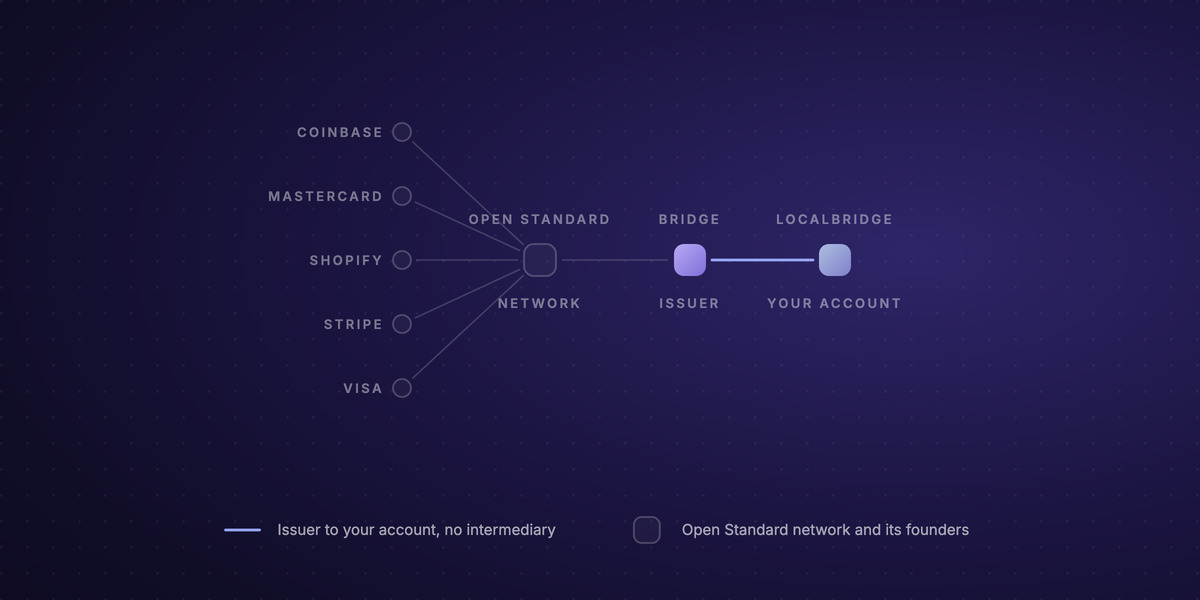
We're writing about this the week it launched because the detail most coverage skips is the one that matters to our clients: the company that issues OUSD is the company our accounts run on. Three things set the token apart: who stands behind it, who issues it, and where the money a stablecoin earns ends up. Below: what launched, why Bridge being the issuer matters to our clients specifically, what changes on your account, and what doesn't.
What launched on 30 September
Open Standard announced Open USD on 30 June 2026 with about 140 partners. On 30 September it went live with more than 200, on four blockchains: Base, Ethereum, Solana and Tempo, the payments chain built by Stripe. The five founding members committed more than $1 billion to seed liquidity on day one.
The mechanics are deliberately plain. Any business can mint and redeem OUSD one to one for dollars, with no fee, through Stripe, the Visa Stablecoin Platform and BVNK, the stablecoin company Mastercard owns; Coinbase opened its path on 1 October. The reserves sit at BlackRock, BNY and Lead Bank, and Bridge publishes monthly attestations of them. Open Standard says the token is built to meet the GENIUS Act, the US law for payment stablecoins that we covered in GENIUS Act and CLARITY Act explained.
The part that is actually new is the economics. With USDT and USDC, the interest earned on the reserves mostly stays with the issuer. Tether keeps it; Circle shares a slice with Coinbase. Open Standard passes nearly all of it to the companies that distribute OUSD and move volume on it, less a management fee, and every partner gets the same terms. Zach Abrams, Open Standard's founding CEO and a co-founder of Bridge, put it bluntly at launch: other stablecoins are building a fund, Open Standard is building money.
Bridge is not a participant. It is the issuer.
Most coverage lists Bridge as one of Stripe's assets in the story. Read Bridge's own announcement and the role is more specific: Open USD is "issued by Bridge". Open Standard runs the network, sets the rules and distributes the economics. Bridge Building Inc. is the legal issuer, the entity that mints OUSD when dollars come in, redeems it when they go out, and stands behind the reserves. Bridge has issued more than $1 billion across dozens of stablecoins before this one, including the branded dollars of companies like Phantom and MetaMask.
One honest footnote from the same announcement: Bridge has the OCC's conditional approval to establish Bridge National Trust Bank, but that entity is still being organised, is not operational, and does not issue OUSD today. Bridge Building Inc. does.
Here is why that matters if you hold a Localbridge account. Localbridge is built on Bridge. Every account, wallet and conversion you use runs on Bridge's licensed rails, which is the reason we chose them in the first place, as we explained in Is my money safe with Localbridge?. So when OUSD reaches your account, it comes from the issuer directly. No exchange in the middle, no third-party liquidity desk, no extra hop that adds a spread or a delay. For most stablecoins a service like ours is at least two steps away from whoever issues the token. For OUSD we are one.
Bridge has also committed, in writing, that it "will not charge fees for minting or redeeming or impose liquidity restrictions that delay those transactions." That is the issuer's promise to the businesses it serves. We are one of those businesses, and it is the reason we can bring OUSD to you without a new line on the price list.
What changes on your Localbridge account
OUSD joins the stablecoins your account can already hold. In practice:
- Receive OUSD on-chain. A client who pays in OUSD can send it to your wallet on Base, Ethereum or Solana, the same way clients send you USDC today.
- Hold it. Clients who keep a balance can hold OUSD in a custodial wallet, held by Bridge as custodian, next to USDC, USDT or EURC.
- Settle into it. If you prefer, an incoming dollar payment to your USD account details can settle as OUSD instead of USDC.
- Pay it out. OUSD pays out directly to a local bank account in 150+ countries through the same off-ramp, at the same percentage fee you see on our pricing page. Dollars in OUSD go out as local currency in one step, with no conversion to USDC or USDT in between, and there is no separate OUSD fee. If you ever want USDC or USDT instead, that is an ordinary stablecoin conversion, the same as between USDC and USDT today.
We are integrating it now. When OUSD is switched on for your account you will see it in the app, and we will update this post with the date.
One limit applies from the start, and it comes from EU law, not from us: OUSD is not available to clients resident in the European Economic Area. Under MiCA, a dollar stablecoin can be offered in the EEA only once its issuer has notified a white paper for that specific token, and as of 1 October 2026 no white paper for OUSD is in the MiCA register. Bridge's Luxembourg entity is a MiCA-authorised e-money token issuer and already issues a euro token under it, so this can change if Bridge notifies one. Until then, EEA clients hold USDC and EURC only, as today.
What doesn't change
You still operate in dollars. OUSD is one more thing under the hood, and you do not have to use it. USDC stays the default settlement asset, and nothing moves out of it unless you ask. If a client never mentions OUSD, you will never see it. If one does, you can accept it without opening an exchange account or learning a new network.
The custody picture doesn't change either. Localbridge is not a custodian and never holds your money. Flow-through payments land in your own bank account or wallet; a balance you choose to keep sits with Bridge under Bridge's terms. That was true for USDC and USDT, and it is true for OUSD.
The honest part
OUSD is days old. The $1 billion in liquidity is seeded, not yet proven across a market cycle, and the first monthly reserve attestation has not been published yet. Open Standard's claim that OUSD meets the GENIUS Act is its own claim; the Act's rules take full effect by January 2027, and the regulators' implementing rules are still being finalised. A stablecoin is a claim on its issuer's reserves, not a bank deposit, and deposit insurance does not apply to any of the tokens on your account.
And the rewards go to the network, not to holders. The reserve income flows to the companies that distribute OUSD and provide services to the network. Localbridge clients do not earn interest on an OUSD balance, and a GENIUS-compliant issuer cannot pay yield to holders in any case. What you get is a dollar that costs nothing to create or redeem at the issuer, backed by the companies that run global card payments, delivered to you by the issuer's own infrastructure.
FAQ
What is OUSD? OUSD, or Open USD, is a US-dollar stablecoin launched on 30 September 2026 by Open Standard, a company founded by Coinbase, Mastercard, Shopify, Stripe and Visa. It is issued by Bridge, a Stripe company, and backed one to one by reserves held at BlackRock, BNY and Lead Bank.
Who issues OUSD? Bridge Building Inc., the Stripe-owned stablecoin infrastructure company. Open Standard runs the network and governance; Bridge mints, redeems and holds the reserves. Localbridge runs on Bridge's infrastructure, so OUSD reaches our clients from the issuer directly.
Is OUSD the same as USDC? Both are dollar stablecoins pegged one to one and backed by cash and short-term US Treasuries. They differ in who issues them (Bridge versus Circle), who governs them (a consortium versus a single company) and where the reserve income goes (network partners versus the issuer). On your Localbridge account a dollar in OUSD and a dollar in USDC are worth the same and pay out the same way.
Is OUSD safe? It has the strongest institutional backing of any new stablecoin, full reserves at three major custodians, and monthly attestations. It is also new: the first attestation is still to come and liquidity has not been tested in a stressed market. The risks are the same as for any stablecoin: issuer risk and user error such as sending on the wrong network.
Do I earn rewards on OUSD? No. The reserve income goes to the companies that distribute OUSD and provide services to the Open Standard network, not to holders. Localbridge clients do not earn interest on an OUSD balance.
Is OUSD available in the EU? Not at the moment. No white paper for OUSD has been notified under MiCA, so it cannot be offered to clients resident in the European Economic Area. EEA clients keep USDC and EURC. If Bridge's Luxembourg entity notifies an OUSD white paper, we will update this post.
Do I have to switch to OUSD? No. USDC stays the default on Localbridge accounts. OUSD is an additional option for clients who receive it or prefer to hold it.
When will OUSD be available on Localbridge? We are integrating it now. The date will appear in the app and in an update to this post.