
Is My Money Safe with Localbridge? Who Holds It, and Why We Chose Them
Localbridge never touches your money. It sits with the most scrutinised partners in the business: Bridge, a Stripe company, and Circle. Here is who holds what, and why we built it this way.

Your money is never in our hands, and that is by design. Localbridge is the interface: the account you log into, the workflow, and the people who answer when something looks off. The money itself moves on infrastructure run by Bridge, a Stripe company, and by default it doesn't stop anywhere. A payment arrives, converts, and lands in your own bank account or your own wallet. If you'd rather keep a balance, it sits in a custodial wallet held by Bridge, a regulated custodian, and for that wallet you're Bridge's client directly.
We're a technical intermediary, not a bank, and we say so in our Terms. But "we don't hold your money" is only half of an honest answer. The other half is that we care very much about who does, which is why we built on the most scrutinised partners in the business rather than on the cheapest. Below: who holds what, why we chose them, what your balance is made of, and the boundaries we'd rather you hear from us.
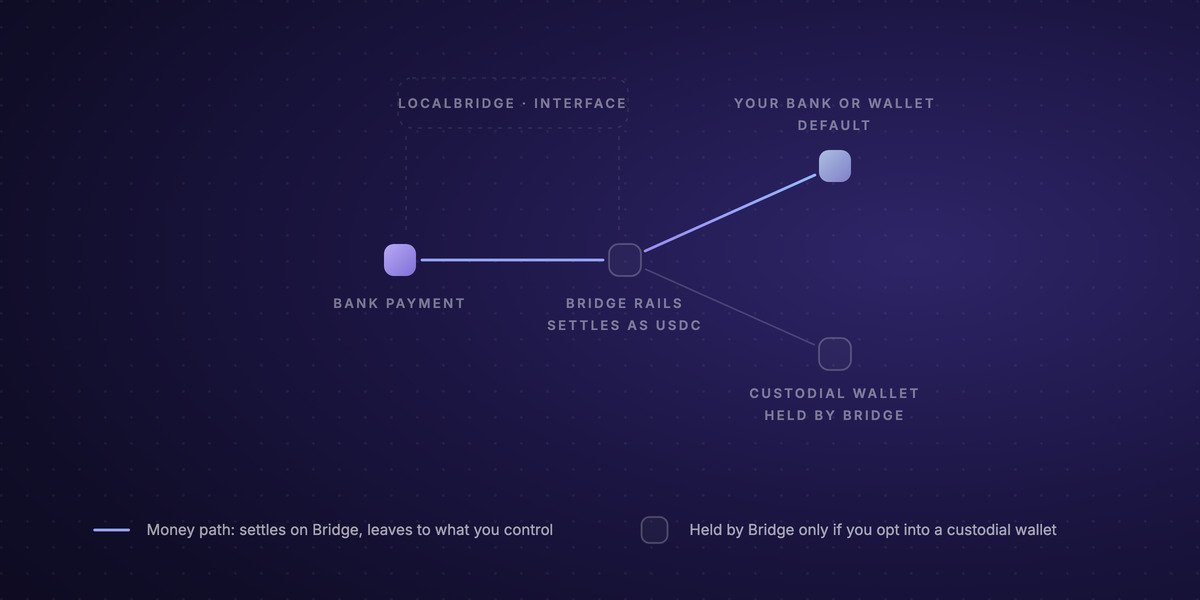
Who holds your money
Localbridge is not a custodian. Local Bridge Inc. does not open, hold, control or take custody of client funds, keys or crypto-assets at any time (Terms §2). Your money is in one of two places, and you choose which:
- Your own account or wallet, by default. A client pays your USD, EUR or GBP account details by ordinary domestic transfer. The payment lands on Bridge's regulated banking rails, settles as a stablecoin, and is paid out to an external bank account in your name or to a wallet whose keys you hold. Nobody keeps a balance for you, and a virtual account never holds fiat.
- A custodial wallet held by Bridge, if you want a balance. Eligible clients can keep USDC, USDT or EURC in a wallet opened, held and managed by Bridge as custodian, under Bridge's own terms. Custodial wallets are not currently offered to clients resident in the EEA.
Self-custody delivery, straight to a wallet only you control, is a standard option, not a workaround. Our stablecoin wallets guide explains the trade-offs between holding keys yourself and letting a custodian do it.
Why we built on Bridge and Stripe
A service that never holds money has exactly one way to keep it safe: choosing who does. We picked Bridge because it is the most heavily regulated stablecoin infrastructure available, and it has been part of Stripe since February 2025.
- In the United States, Bridge Building Inc. holds money transmitter licences in more than thirty states, listed on Bridge's licences page.
- In the European Union, Bridge Building S.A. holds a Crypto-Asset Service Provider authorisation under MiCA and an electronic money institution licence in Luxembourg, announced in July 2026 and valid across all 27 member states. MiCA brings capital, custody and operational requirements that a licensed custodian has to meet, and the register entry lists custody and administration of crypto-assets among Bridge's authorised services.
The same logic decided the conversion layer. Rates come from Bridge, with the spread published in the account terms and the executed rate on your receipt, and Localbridge charges the single on/off-ramp fee on our pricing page and nothing else.
What your balance is made of
Between arrival and payout, and in a custodial wallet, what you own is a stablecoin. Here too we chose the issuers with the most transparent reserves.
- USDC and EURC are issued by Circle. Circle publishes monthly reserve reports attested by Deloitte; as of its March 2026 filing, about 86% of USDC reserves sat in the Circle Reserve Fund, a government money market fund of short-dated US Treasuries, overnight Treasury repo and cash, with the rest in cash at banks. More in our USDC guide.
- USDT is issued by Tether, which publishes quarterly attestations prepared by BDO showing reserves led by US Treasury bills. Its mix is broader than Circle's, so clients who prefer Treasuries and cash choose USDC. USDT isn't available to our European clients.
US law is now catching up with this standard: the GENIUS Act, signed in July 2025, requires payment stablecoins to be backed at least 1:1 by cash, insured deposits and short-term Treasuries, with monthly audited reserve reports, and takes full effect by January 2027. We explained it in GENIUS Act and CLARITY Act explained.
What we do ourselves
Not holding money doesn't mean standing back. Access to your account and certain transactions require Strong Customer Authentication with two independent factors. Compliance decisions that affect you come with a route to a human: if your access is ever restricted, business@localbridge.com gets you a review, including human review of any automated decision, and a restriction on our side never freezes assets held by Bridge as custodian. And a person on support answers in a language that works for you, which matters most on the day a payment looks late.
The boundaries, in plain words
Fair means telling you what this setup doesn't do. Nothing you hold through Localbridge is a bank deposit, so neither FDIC insurance nor an EU deposit guarantee scheme applies; protection comes from the issuer's reserves and the custodian's licence obligations instead. A stablecoin is a claim on its issuer, and a loss of the peg is unlikely with reserves of this quality, not impossible. For a custodial wallet, our Terms say plainly that you bear Bridge's credit and insolvency risk for the assets in it (§6). The simplest way to keep all three small is the default mode: let payments flow through to your own account, and hold a balance only when you need one.
FAQ
Is Localbridge a bank? No. Local Bridge Inc. is a US technology company, not a bank or a regulated financial institution. Banking rails, conversion and custody are provided by Bridge, a Stripe company, under its own licences.
Is my money insured? Not by deposit insurance. A stablecoin balance is backed by the issuer's reserves, and a custodial wallet by Bridge's obligations as a licensed custodian. Neither is a bank deposit.
What happens to my money if Localbridge shuts down? Nothing sits with Localbridge. Flow-through payments are already in your bank account or wallet, and a custodial wallet balance stays with Bridge, as Bridge's direct client, under Bridge's terms.
Can I keep the keys myself? Yes. Delivery to your own external wallet is a standard option. You hold the keys and nobody can freeze the balance; securing them is then your responsibility.
Are custodial wallets available in the EU? Not at the moment. Custodial wallets and related crypto-asset services are not offered to clients resident in the EEA. EEA clients use the default mode: a payment arrives, converts and is delivered to their own bank account or wallet.