
Euro Bank Account for a Business Outside the EEA: How to Get Paid by EU Clients
A business outside the EEA rarely gets an EU bank account, and doesn't need one. What works: a euro IBAN on SEPA, a client briefed on the new name check, and a plan for the euros once they land.

A business based outside the EEA can rarely open a euro bank account at an EU bank, and for getting paid by European clients it doesn't need one. What it needs is a euro IBAN that clients can pay over SEPA, the EU's standard bank-transfer network, like any local supplier. A provider can issue one online, with no EU address and no branch visit. Two details decide whether the first payment goes through cleanly: the name your client types next to that IBAN, and what happens to the euros after they arrive.
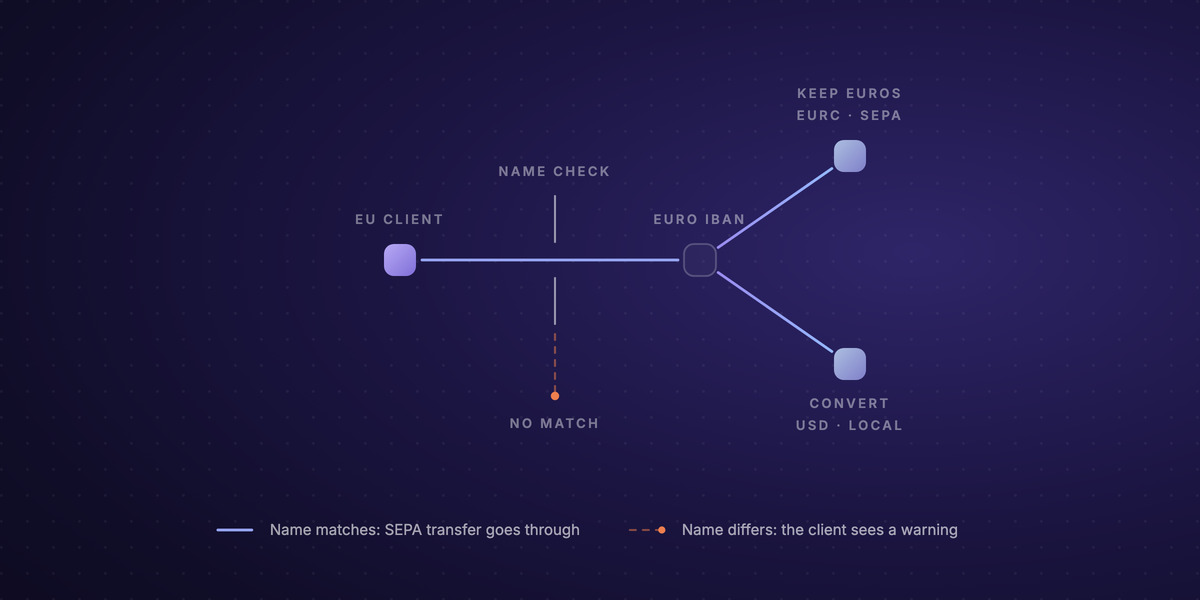
That second half is where most guides stop too early. Since October 2025, every bank in the euro area checks the payee's name against the IBAN before a transfer leaves. If the name your client enters doesn't match the one registered to the IBAN, their screen shows a warning, and a careful finance team won't press "pay anyway." Below: why the bank route is slow, what replaces it, how to get through the name check, and where your euros go once they land.
Why opening a bank account in Europe is hard from outside the EEA
The EEA is the 27 EU countries plus Iceland, Liechtenstein and Norway. Its banks work under some of the strictest anti-money-laundering rules anywhere, and their business accounts are built for companies with a real local footprint. When a company registered in Buenos Aires, Bogotá or Bangalore tries opening a bank account in Europe, the same requirements come up:
- An EU address. A registered office, a lease, a utility bill in the country of the bank.
- A local entity or resident director. A foreign company with foreign directors is the hardest file a compliance team gets.
- An in-person step. Some banks still want a director at a branch to verify identity.
- A long manual review. Weeks of questions about your clients, your ownership and your source of funds, often ending in a decline without a reason.
So the honest answer to how can I open a bank account in Europe as a non-EEA company is: set up an EU entity first, or accept a slow process with an uncertain result. For a studio that just signed one German client, neither makes sense.
What you need instead: a euro IBAN on SEPA
Your client doesn't care where your company is registered. Their accounts-payable system needs three things: a euro IBAN, a BIC and a beneficiary name. With those, they pay you over SEPA, the same rail they use for every European supplier. A SEPA Instant transfer arrives in seconds, and since October 2025 banks in the euro area must offer instant sends at no more than the price of a standard transfer.
A virtual account gives you exactly that. The provider issues a real euro IBAN on regulated payments infrastructure, and incoming SEPA payments are credited to you. You can open a euro account of this kind from anywhere the provider serves, with online KYB and no EU paperwork.
The name check your client's bank now runs
Verification of Payee (VoP) became mandatory for euro-area banks on October 9, 2025. Before a SEPA transfer goes out, the payer's bank sends the IBAN and the name the client typed to the bank that holds the IBAN, and gets one of four answers back: match, close match, no match, or check not possible. On anything short of a match, the client sees a warning. They can still send the payment, but if the money goes astray after they ignored the warning, the loss is theirs. Most corporate finance teams read that as "stop and ask the supplier."
This is where virtual IBANs trip people up. The name registered to a virtual IBAN isn't always your company's. With many providers it's the provider's own licensed entity, and your client needs to type that name, character for character, to get a clean match. If they type your trading name from the contract instead, the check can fail.
Three things prevent a stalled first invoice:
- Copy the beneficiary name from your account details, exactly as shown, into your invoice template next to the IBAN and BIC.
- Tell the client in one line why the beneficiary name may differ from your company name: the IBAN is issued through a licensed payment provider. A sentence on the invoice saves a week of emails.
- Send a small test payment first on a new client relationship, and let their finance team see a clean check before the big invoice.
Where your euros go after they arrive
This part decides how useful the account is, so ask it before you sign up with anyone. A high-street bank keeps a euro balance for you. A virtual account usually doesn't hold fiat at all. The receiving details are an inbound door, and the money moves on from there. What it moves into differs by provider: some convert everything to your home currency on arrival, some hold a multi-currency balance, some settle into a stablecoin.
Questions worth asking:
- Can I keep euros as euros? If you pay EU contractors or tools, forced conversion to dollars and back costs you two spreads.
- Where can I pay out? To any euro bank account over SEPA, to your own account at home, to a supplier?
- Who holds the money in between, and under which licence? That answer should name a regulated entity, not a marketing claim.
- What does conversion cost? A published spread or fee, shown before you confirm. A rate you only see on the receipt is a warning sign.
What a euro IBAN doesn't replace
A virtual euro account covers receiving, converting and paying out. It is not a full current account at an EU bank:
- No cash deposits and no branch.
- No overdraft, credit line or business loan.
- No deposit guarantee. The EU's €100,000 protection covers deposits at banks; money held through payment and e-money providers is protected differently, through safeguarding or custody rules, so read which one applies.
- Some public tenders and regulated contracts require an account at an EU-licensed bank. A virtual IBAN won't meet that requirement.
For a business whose European problem is "clients want to pay me in euros, and I want the money without losing a week and a slice of the payment on the way," those limits rarely matter.
How this works with Localbridge
Localbridge gives a business outside the EEA euro receiving details on SEPA and SEPA Instant, next to USD, GBP, MXN, BRL and COP details in the same account. Businesses and individuals can pay into your euro details. Onboarding is online; you won't need an EU address.
When euros arrive, they settle as a stablecoin. Choose EURC, a euro stablecoin, and the amount stays in euros with no conversion spread; you can later pay it out to any euro bank account over SEPA. Choose USDC and it converts to dollars at a rate shown before you confirm. Either way, you pay out to a bank account, yours or a supplier's, in any of the six currencies. The receiving details themselves never hold a fiat balance. Localbridge is not a custodian: the regulated services, and custodial wallets where they're offered, are provided by our infrastructure partner Bridge, part of Stripe. The fees for your plan are on the pricing page, and the full rules per currency are in the business account terms.
For your invoices, copy the beneficiary name from your EUR details exactly as it appears in your account.
FAQ
Can a company outside the EEA open a euro bank account? An account at an EU bank is possible but usually requires an EU entity or resident director, a local address and a long review. A euro IBAN from a virtual account provider is the practical route: online KYB, no EU address, and SEPA payments from your clients.
How can I open a bank account in Europe without travelling there? Traditional EU banks often want an in-person identity check. Payment providers that issue euro IBANs verify your business online, so the whole process happens from your home country.
Will an EU client accept an IBAN from a different EU country? They should. Regulation 260/2012 bans "IBAN discrimination": a payer in the EU can't refuse a valid euro IBAN because it was issued in another member state.
Why does my client's bank show a "name doesn't match" warning? That's Verification of Payee, mandatory in the euro area since October 9, 2025. The client typed a name that differs from the one registered to your IBAN. Send them the beneficiary name exactly as it appears in your account details.
Is a virtual euro IBAN the same as a bank account in Europe? No. It receives and sends euros on SEPA like a bank account, but it doesn't offer cash, credit or deposit insurance, and some public tenders won't accept it.
Start with what a virtual account is, or see how businesses receive international payments across currencies. Getting paid in pounds too? Read how non-residents get UK account details.