
CLARITY Act Fails in the Senate: What It Means If You Get Paid in Stablecoins
The CLARITY Act failed in the US Senate on September 15, 2026. Why the market was waiting for it, why it fell, and why a business paid in USDC or USDT loses less than the headlines suggest.

The CLARITY Act, the US bill that was meant to set the rules for crypto exchanges, brokers and custodians, failed in the Senate on September 15, 2026, and is unlikely to return before the next Congress in 2027. For a business that gets paid in USDC or USDT, the practical damage is smaller than the headlines suggest. The law that governs the coins themselves, the GENIUS Act, passed last year and is unaffected. What failed was the law for the market around them.
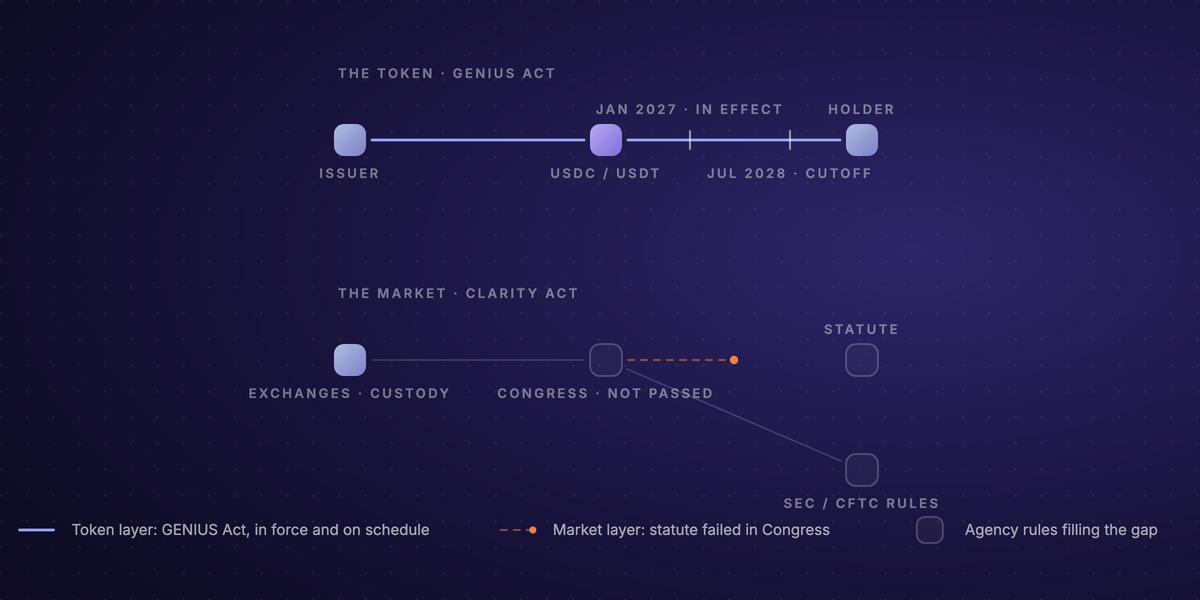
Why the market was waiting for it
US crypto law has two layers. The GENIUS Act, signed in July 2025, covers the token: who may issue a payment stablecoin, what backs it, and how you redeem it. The CLARITY Act was meant to cover the market: which digital assets count as commodities and which as securities, which regulator watches each, and how exchanges, brokers and custodians register. The House passed it in July 2025. The Senate then sat on it for more than a year.
Without it, the venues that hold and trade stablecoins operate under a patchwork of agency exemptions, no-action letters, court rulings and state licenses. Every platform decides for itself what it may list and for whom. One statute would have replaced that guesswork with one rulebook, and the industry had treated its passage as a matter of when, not if.
Why it didn't pass
On the core of the bill, how to split oversight between the securities and commodities regulators and how platforms register, both parties had largely agreed. It fell on two side issues.
- Ethics rules for officials who hold crypto. One side wanted binding limits on senior government officials profiting from digital assets while shaping the rules for them. The concessions offered in the final days were judged too weak, and no deal was reached.
- Rewards on stablecoin balances. The GENIUS Act bars issuers from paying interest on their coins but says nothing about exchanges, which is why some platforms pay rewards on USDC balances today. Banks lobbied for a total ban on any yield-like reward; the crypto side wanted to keep rewards tied to real activity such as payments or transfers. The compromise on the table satisfied neither camp and cost the bill votes on both sides.
With midterm elections in November and Congress leaving town in October, the negotiations ran out of calendar before they ran out of arguments.
What it means for stablecoins
Nothing changes for the coins you hold. The rules that matter live in the GENIUS Act, and it is on schedule:
- Only licensed issuers may issue payment stablecoins, backed 1:1 by cash and short-term Treasuries, with monthly reserve reports and a legal duty to redeem at par.
- The regime takes effect by January 18, 2027 at the latest, or earlier if final rules land sooner. Regulators are still in the proposal stage, so plan around the January date.
- From July 18, 2028, US platforms may only offer stablecoins from permitted issuers. That deadline is behind Circle's positioning of USDC and Tether's launch of a separate US coin, and it stands. Our post on whether USDT is legal walks through what it means country by country.
- The issuer yield ban stands. What stays open is the intermediary question: whether an exchange may keep paying rewards on your balance. For now it may.
In short: the token layer is finished. The market layer lost its statute.
What it means for business
If your clients pay you in USDC or USDT, three things follow.
Your coins are exactly as safe as they were before the vote. Reserve rules, redemption rights and the permitted-issuer deadline are all in the GENIUS Act. Who regulates exchanges has no bearing on which coins are backed and by what.
Expect platform terms to keep changing. For at least another year, exchanges and custodians will run on agency exemptions, with no statute behind them. Read the terms of the venue you use, and prefer one that is already licensed somewhere over one waiting for clarity that isn't coming.
Treat rewards on balances as a bonus, not a plan. Any yield an exchange pays on a stablecoin balance is one rulemaking away from being restricted. Banks lost this round by blocking the bill, not by losing the argument. A stablecoin is a settlement rail, not a savings account, a conclusion the BIS reached from a different direction.
What it means for Localbridge
The rules that exist today concentrate at the boundary between tokens and bank money: licensed issuers, KYC, sanctions screening, licensed money transmission. That boundary is where a compliant off-ramp lives, and it is governed by the law that passed, not the one that failed.
What's next
- Regulators fill the gap. Within days of the vote, the SEC issued a five-year conditional exemption that lets qualifying platforms trade tokenized securities without registering as an exchange, and the CFTC sent draft crypto-market rules to the White House for review. Expect more of this. An exemption can be withdrawn by the next agency chair, and no agency can draw the border between the SEC and the CFTC that only Congress can draw, so this is a stopgap.
- The GENIUS Act rollout continues. Final rules from the banking regulators and Treasury are the next milestones. They fix the exact date in early 2027 when the issuer regime takes effect.
- A new attempt in 2027. Anything not passed by January 3, 2027 restarts from scratch in the next Congress. A revival this year is possible on paper but unlikely in practice, and the ethics and rewards disputes will be back on the table whenever the bill returns.
Our guide to stablecoin regulation tracks where the US, the EU and the major Asian and Latin American regimes stand as they change.
FAQ
Did the CLARITY Act pass? No. It failed a Senate vote on September 15, 2026 and never reached final passage. It is unlikely to return before the next Congress convenes in January 2027.
Why did the CLARITY Act fail? Two disputes outside the core market rules: ethics limits on government officials who hold crypto, and whether exchanges may keep paying rewards on stablecoin balances. Time ran out before the November elections.
Does the failed vote affect the GENIUS Act? No. The GENIUS Act, which regulates stablecoin issuers, reserves and redemption, has been law since July 2025 and takes effect by January 18, 2027 at the latest. The July 18, 2028 permitted-issuer deadline is unchanged.
What happens to USDT and USDC after the vote? Nothing changes for either coin. Both remain available on US platforms, and the 2028 permitted-issuer cutoff still decides which coins platforms may offer after that date.
Can I still earn rewards on stablecoin balances? Under current law, issuers may not pay interest for holding their coin, but exchanges may pay rewards. The CLARITY Act would have restricted that. Its failure leaves the practice legal for now, while banks push regulators and the next Congress to end it.
Who regulates crypto exchanges in the US now? The same split as before: the SEC for securities, the CFTC for commodities, state licensing on top, with agency exemptions covering the gaps. The statutory border between the two agencies remains undrawn.