
Brazil's Stablecoin Deadline: What Changed on October 30
Brazil's crypto-provider authorization window closed on October 30, 2026. Who filed, what the central bank's list means for a company paying in USDT or USDC, and the three dates that now matter.

Brazil's authorization window for crypto providers closed on October 30, 2026, and the central bank has since published who made it through the door: 120 companies filed, 119 are under review, one was refused, and 24 banks and brokers that already held a license have notified that they will serve the virtual-asset market too. For a business that pays suppliers or collects revenue in USDT or USDC, the deadline changed one thing and left the rest where it was. Stablecoins remain legal to hold and use. What you can no longer do is run them through a provider that is on neither list: since November 6, Brazilian banks and payment institutions may not process virtual-asset operations for a provider outside the authorized or transition perimeter, and companies that did not file had until November 29 to stop offering the service. The licenses themselves are a 2027 story: the Banco Central gave itself up to 360 days for the first phase of review.
This is the follow-up to our September explainer, written when October 30 was still a date on the horizon. Here is what actually happened, what switched on alongside it, and what a company should check now. The list is public on the central bank's site, and the last section shows how to check a provider against it. Every fact below comes from the central bank's own acts and from that list; where we cite a date, we name the article.
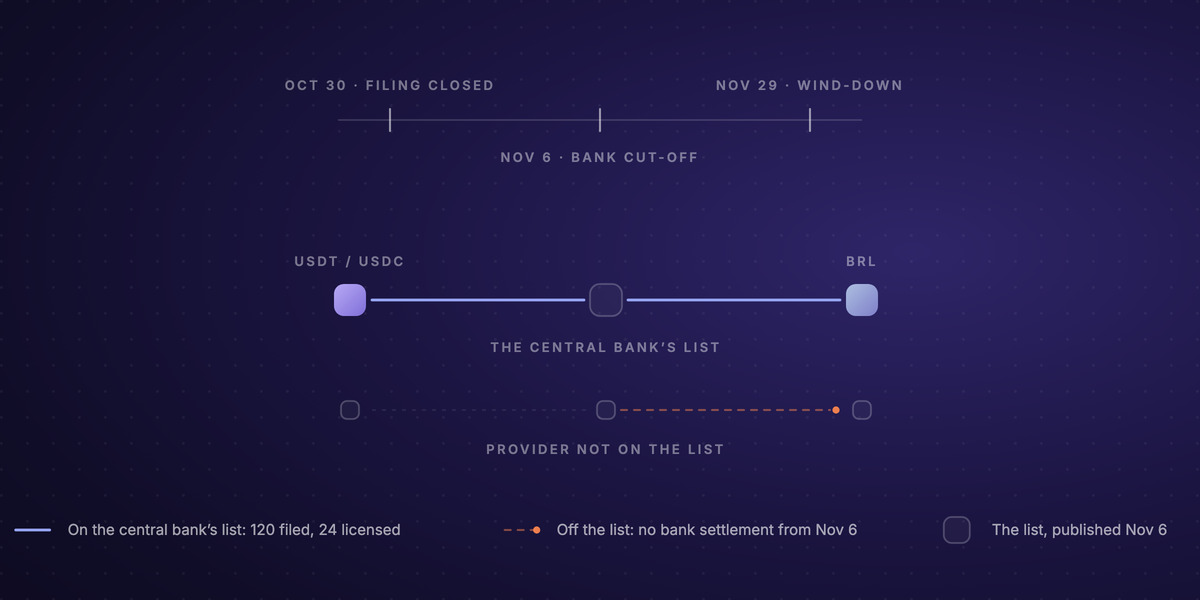
Three dates, not one
The date the market watched was October 30, the last day for a provider already operating in Brazil to file phase one of its authorization request (Resolution BCB 520, art. 88, I; Normative Instruction BCB 704, art. 9). The rulebook, though, turns on three dates, and the other two matter more to a business that uses a provider than to the provider itself.
| Date | What it does | Where it's written |
|---|---|---|
| October 30, 2026 | Last day for providers active on February 2 to file phase one of the authorization request | Res. 520 art. 88, I; IN 704 art. 9 |
| November 6, 2026 | Banks, payment institutions and other BCB-licensed firms may no longer process virtual-asset operations for providers outside the authorized or transition perimeter | Res. 520 art. 91, as amended by Res. 589 |
| November 29, 2026 | Providers that did not file must have stopped offering virtual-asset services, 30 days after the deadline | Res. 520 art. 88, §7 |
The November 6 date is new. The original article 91 set the banking cut-off on October 30, the same day as the filing deadline. On September 23 the central bank moved it back a week with Resolution 589, and the board vote behind the change says why: the extra days were for the regulator to "systematize and publish the official list" of providers in transition, so that banks and public bodies would know whom they may deal with. The regulator wanted the list out before the ban bit. The list went up on November 6.
A provider that filed in time may keep operating until its process concludes, but may not add a second modality while it waits (art. 88, §6). One that did not file had thirty days to wind down (§7).
Who filed: the central bank's list
The list lives on the Banco Central's authorization pages, under "Prestadoras de Serviços de Ativos Virtuais", and has two tables. As of its November 6 update:
- 120 companies declared they were already operating and filed: 73 as intermediaries (buying, selling and transferring on clients' behalf), 46 as brokers (intermediation plus custody) and one as a pure custodian.
- 119 are marked "under review"; one request, from a small intermediary, was refused.
- 24 already-licensed institutions, banks, FX banks, brokers and distributors, have notified that they will offer virtual-asset services under their existing license: 16 for intermediation only, 8 for custody and intermediation.
Names on the applicant table include Mercado Bitcoin, Coinbase Brasil, OKX, Bybit, KuCoin, MEXC, Gate, Foxbit, Nu Crypto, B3 Digitas, Santander Investimentos and Transfero, plus two that matter directly to stablecoin users: Circle do Brasil, the issuer of USDC, and Ripple Brasil. The licensed-institution table includes Itaú Unibanco, Bradesco, Banco do Brasil, BTG Pactual, Safra, XP, PicPay Bank, Braza Bank and Ebury.
Press counts published on deadline day ran higher, because they added up filings as they came in; the figures here are the central bank's own table as of November 6. The central bank prints two warnings above that table, and both deserve repeating. Being on the list is not authorization: it means a request was filed and is being examined. And the list is the perimeter banks now work from. A provider absent from both tables is one your bank is barred from settling for.
What else switched on October 1
Two more resolutions took effect on October 1, 2026, a month before the deadline, and both touch stablecoin flows directly.
Resolution 561: no stablecoins in the eFX pipe. eFX is Brazil's regime for small international payments and transfers handled by fintechs. Since October 1, settlement between an eFX provider and its counterparty abroad may happen only through an FX operation or a non-resident account in reais, with "the use of virtual assets forbidden" (Res. 277, art. 50, I, as amended). eFX itself is now reserved for banks, brokers, distributors, FX brokers and licensed payment institutions. A fintech outside that list may keep offering eFX only if it applies for a payment-institution license by May 31, 2027, and must stop within thirty days if it does not (art. 56-B). Licensed eFX providers had until October 30 to register the modality in the central bank's Unicad system (art. 56-A).
So the stablecoin corridor for cross-border payments runs through authorized virtual-asset providers, as we expected in September, with the eFX side now explicitly closed to crypto.
Resolution 588: self-custody transfers of US$10,000 or more are reported. Since October 1, a BCB-licensed institution must report to Coaf, Brazil's financial-intelligence unit, every transfer of virtual assets to or from a self-custody wallet worth the equivalent of US$10,000 or more (Circular 3.978, art. 49, V). Your wallet is not banned. Large movements between it and a licensed provider now generate an automatic report.
What is still open
The deadline closed the door on unlicensed operation. It did not finish the licensing.
- Reviews run into 2027. The central bank set itself up to 360 days for phase one, which checks that the firm was operating on February 2, vets controllers and confirms economic capacity, and up to 720 days for phase two, which covers everything else (Res. 549, annex; Res. 519, art. 26). A provider's adaptation period ends only when the central bank rules on phase one (Res. 520, art. 88, §1). Expect the first authorizations and refusals of filers through 2027, not this quarter.
- Reporting tightens on January 1, 2027. Resolution 589 also rewrote what providers in transition send the regulator: client balances, assets in custody, proof of reserves per asset and staking totals. It extended the duty to the banks and brokers serving the market, with the new regime starting January 1, 2027 (Res. 520, arts. 88, III, 90-A and 90-B).
- Information sharing phases in. Providers must exchange sender and beneficiary data on transfers in two stages: domestic within 365 days of February 2, 2026, international a year after that. The rule binds every authorized provider from February 2, 2028 (Res. 520, art. 89).
- eFX fintechs have until May 31, 2027 to apply for the license that lets them keep operating, as above.
What this means for a company paying or getting paid in stablecoins
- Check your provider against both tables. Open the central bank's list and search by name or CNPJ. If your exchange, broker or payment partner is on neither table, it had to stop serving Brazilian clients by November 29, and your bank has been barred from settling for it since November 6. Move before the service does.
- Treat "under review" as what it says. A listed provider may operate; it has not been approved. Keep the relationship, keep your records, and don't read the listing as a guarantee.
- Expect FX paperwork. Buying, selling or exchanging a fiat-pegged stablecoin is an FX operation under Resolution 521, so a provider that does it right will ask for the documentation a bank would. A provider that asks nothing is a warning, not a convenience.
- Don't route crypto settlement through an eFX fintech. Since October 1 that pipe is closed to virtual assets by rule, whatever the app promised earlier in the year.
- If you hold treasury in your own wallet, plan for the Coaf report on any movement of US$10,000 or more to or from a licensed provider. Nothing to do, but nothing to be surprised by either.
The same checks apply in reverse for a company abroad that pays a Brazilian supplier or contractor in stablecoins. Brazil doesn't regulate the foreign payer; it regulates the Brazilian leg, so the supplier's conversion into reais has to run through a listed provider, with the paperwork that implies.
Localbridge serves Brazilian companies. If your clients abroad pay in USDC or USDT, the account receives the coins, and conversion to reais is paid into your company's own bank account over Pix, with a record per payment that your accountant can use. A reais balance never sits inside Localbridge: converting always means settling into a real bank account. For the mechanics, see how to convert USDC to BRL and the guide to receiving payments from abroad in Brazil.
FAQ
Are stablecoins banned in Brazil after October 30, 2026? No. Holding, receiving and spending USDT or USDC stays legal. What closed on October 30 was the window for crypto providers already operating in Brazil to file for authorization. Providers that did not file had to stop by November 29; the coins themselves are untouched.
If a crypto provider appears on the central bank's applicant table, is it already authorized? Not yet. As of November 6, 119 of the 120 companies on the applicant table are marked "under review" and one was refused. The central bank states above the table that inclusion does not mean authorization. The 24 institutions on the second table already hold a license for other activities and have notified that they will also serve the virtual-asset market.
My exchange isn't on either table. What happens now? Under Resolution 520, art. 88, §7, a provider that missed the deadline had thirty days, until November 29, to stop offering virtual-asset services in Brazil. Since November 6, banks and payment institutions may not process operations for it (art. 91). Withdraw what you hold there and move to a listed provider.
Can a Brazilian company still pay a foreign supplier in USDT or USDC? Yes, through a provider on the central bank's list, documented as an FX operation under Resolution 521. The route that closed is the informal one: a platform outside the perimeter, no paper trail.
What did Resolution 589 change? Two things. It moved the start of the ban on banks dealing with unlisted providers from October 30 to November 6, 2026, giving the central bank time to publish the official list. And from January 1, 2027, it widens the data that providers in transition, and the banks serving the market, must report: client balances, custody totals, proof of reserves and staking.
What did Resolution 561 change for international payments? Since October 1, 2026, eFX providers, the fintechs handling small cross-border payments, must settle with their counterparties abroad through FX operations or non-resident accounts in reais; virtual assets are forbidden on that leg. Fintechs not among the permitted institution types must apply for a payment-institution license by May 31, 2027 to keep offering eFX.
When will Brazil grant the first crypto licenses to filers? The central bank set itself up to 360 days for phase one of the review and up to 720 days for phase two (Resolution 549). Decisions on the October filers can therefore run through 2027. The 24 licensed institutions on the second table did not need a new license to start.
Does this affect a company abroad that pays Brazilian contractors in stablecoins? Indirectly. The central bank regulates the Brazilian side: your contractor's conversion into reais must run through a listed provider and is treated as an FX operation. If the contractor's platform is off the list, the payment may arrive but the cash-out won't.