
Revolut launched a euro stablecoin on Bridge. Here's what it actually changes.
Revolut's EURR euro stablecoin is live, issued by Stripe-owned Bridge under MiCA. What EURR is, why Revolut didn't issue it itself, and what it means for the market and your money.

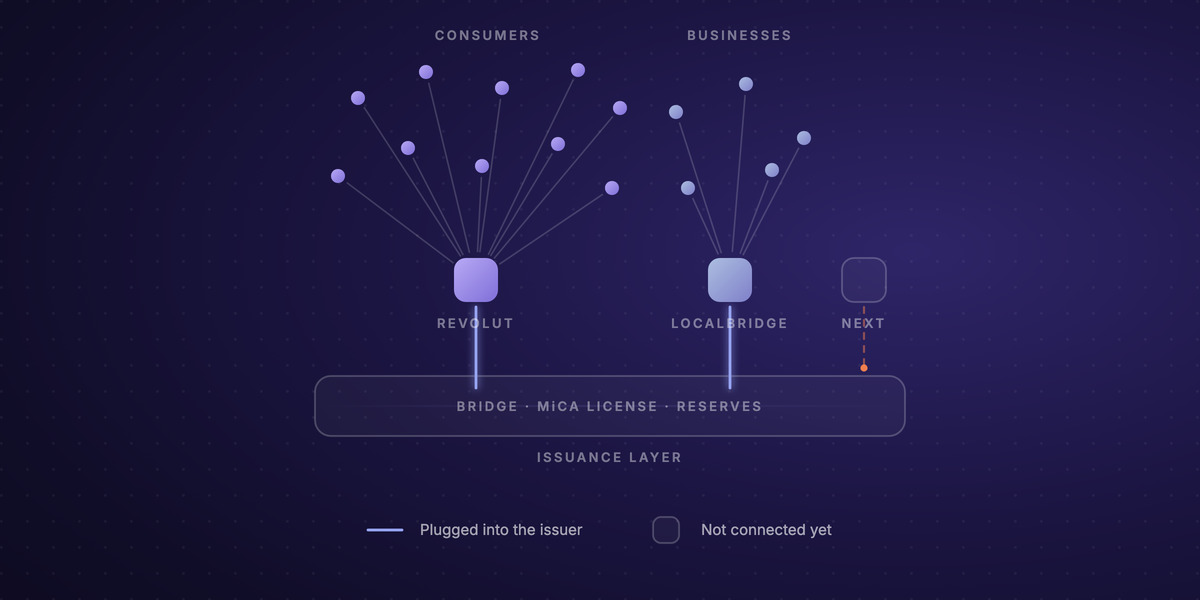
Revolut now has a stablecoin. In late August 2026 the fintech began rolling out EURR, a digital token built to always be worth exactly €1, branded "Revolut Euro" in the app, to select customers in Denmark, Poland, and Portugal. Here's the detail most headlines skipped: Revolut didn't issue it. EURR is issued by Bridge, the stablecoin infrastructure company Stripe bought for $1.1 billion, through Bridge's MiCA-licensed entity in Luxembourg.
That one detail is the story. The largest neobank in Europe, with more than 80 million customers, looked at issuing its own stablecoin and chose to rent the issuance instead. If you want to know where the stablecoin market is heading, that decision tells you more than the token itself.
This piece covers what EURR actually is, why Revolut structured it this way, what it means for the euro stablecoin market, and what to check before you hold it: how it's backed, what protections apply, and where the fine print differs from a bank account.
What is EURR?
EURR is an electronic money token under MiCA, the EU's crypto-asset regulation: a digital token designed to hold a value of €1, fully backed by euro reserves, redeemable at face value. In Revolut's app it shows up as "Revolut Euro," and eligible customers can move between euros, EURR, and external wallets directly.
The formal setup, from the regulatory filings:
- Issuer: Bridge Building S.A., a Luxembourg company regulated by the CSSF as an electronic money institution. This is the European arm of Bridge, which Stripe acquired in February 2025.
- Distributor: Revolut Digital Assets Europe Ltd, through the Revolut retail app and the Revolut X exchange.
- Availability: select customers in Denmark, Poland, and Portugal first, with a wider EEA rollout planned for later in 2026.
- Networks: Ethereum and Polygon at launch, with Solana and several more chains planned.
The public offer began on 20 August 2026, and Bridge's Luxembourg entity received its MiCA e-money license only about a month before that. Revolut is Bridge's first European client to launch a custom stablecoin on its platform, and one of the first big consumer brands anywhere to ship a white-label stablecoin this way.
One number worth savoring: as of 25 August, EURR had exactly €374 in circulation. Not million. Three hundred and seventy-four euros, matching €374 held in reserve. That's what a phased rollout looks like from the inside, and it's a useful antidote to the launch-day hype.
Why Revolut rented the issuer instead of becoming one
Revolut has publicly flirted with issuing its own stablecoin since 2024, and its US banking application from March 2026 mentions stablecoins explicitly. The ambition is real. So why launch on someone else's license?
Because being a stablecoin issuer is a heavily regulated, capital-intensive, operationally boring business. Under MiCA you need an e-money license, segregated reserves at credit institutions, monthly attestations, redemption guarantees, and a compliance function that never sleeps. None of that is where a consumer fintech makes its money.
What Revolut does have is the thing no license can buy: distribution. Over 80 million retail customers, more than 16 million of whom already use its crypto services. Bridge brings the license and the reserve plumbing; Revolut brings the users; the token ships in months instead of years. If EURR works, Revolut can still bring issuance in-house later, with product-market fit already proven.
This split, issuance as rented infrastructure below and brands competing on distribution above, is the same pattern we described when Stripe, Visa, and Mastercard started building a shared stablecoin platform. Expect more of it. Every neobank and every large merchant can now do what Revolut just did, because "launch a stablecoin" has become a vendor integration. What used to be a multi-year regulatory project is now a contract and an API.
What it means for the stablecoin market
Three things stand out.
Euro stablecoins finally get real distribution. The entire euro stablecoin market is tiny: roughly €650 million across all issuers, with Circle's EURC holding about 63% of it. Dollar stablecoins are measured in hundreds of billions. What euro tokens have always lacked isn't technology or regulation, it's reach, and 80 million app users is more consumer reach than every existing euro stablecoin combined. Whether those users actually want tokenized euros is exactly what this rollout will test. Banks are circling the same question, as we covered when nine European banks announced a joint euro stablecoin.
MiCA is working as designed. Tether never sought MiCA authorization, so USDT has been delisted for EEA retail users across the major exchanges. That created a regulatory vacuum, and licensed tokens are filling it: EURC, EURAU from Germany, and now EURR. A rulebook that was criticized as heavy-handed is quietly producing exactly what it promised, regulated tokens from household-name companies. We looked at the rulebook itself in our MiCA stablecoin regulation breakdown.
Stripe's quiet empire grows. Bridge now issues stablecoins for Revolut, a company that competes with Stripe in payments. That's the clearest sign yet that Bridge is being run as neutral infrastructure, closer to how AWS serves Amazon's retail competitors than a captive Stripe feature. For everyone building on Bridge, a marquee client like Revolut means more scrutiny, more liquidity, and a stronger issuer underneath.
What it means for you
If you're a Revolut customer in the three launch countries, you can hold euros as a token, move value to an external wallet without routing through a dollar stablecoin first, and settle any hour of any day. That last part matters more than it sounds. Bank euros stop moving on Friday evening; tokenized euros don't.
A few things to know before treating EURR as a euro that lives on-chain:
- It pays no interest, by law. MiCA prohibits e-money tokens from paying yield. Nobody's cheating you; the rule applies to every compliant euro token.
- It's not a bank deposit. Your claim is against the issuer's reserves, not covered by a deposit guarantee scheme. MiCA's reserve and redemption rules are the protection, and they're substantial, but they're a different thing.
- It's a distribution test, not a done deal. €374 in circulation means Revolut is testing carefully. Features, countries, and chains will change.
For businesses, the news is a signal rather than a product. Nothing about EURR changes how you invoice a client tomorrow. What changes is the credibility of the rails: when an 80-million-customer fintech puts its brand on a stablecoin, the "is this serious infrastructure?" conversation with your accountant gets shorter. If you're weighing those rails for getting paid, our guide to what a stablecoin actually is is the right place to start.
Where Localbridge sits in this picture
Full disclosure of our interest: Localbridge runs on Bridge, the same infrastructure that issues EURR. When a business gets paid into a Localbridge account, the balance is held as a dollar stablecoin (USDC or USDT) on rails operated by Bridge, while you see and operate in plain USD and EUR. So when Bridge lands a client like Revolut, that's the foundation under our product getting sturdier, and the bet we made on these rails looking less contrarian by the month.
We're not neutral observers here, and we won't pretend the news changes what you can do with a Localbridge account this week. It doesn't. It confirms the bet: the licensed stablecoin layer is becoming the shared plumbing of cross-border money, and the companies you already know are plugging into it one by one.
The honest part
EURR launched with €374 in circulation and three small markets. It could grow into the default way 80 million people hold euros on-chain, or it could stay a niche feature inside a crypto tab most users never open. Euro stablecoins have a history of impressive backers and unimpressive adoption, and distribution alone doesn't guarantee demand. The EEA-wide rollout is "planned," which is a word, not a date. Watch the circulation number over the next two quarters; it will tell you more than any press release.
FAQ
Is EURR safe to hold? It's as safe as its regulatory structure: a MiCA e-money token issued by a CSSF-regulated entity, backed 1:1 by euro reserves held at credit institutions, redeemable at face value. That's a strong framework, but it isn't a bank deposit and isn't covered by a deposit guarantee scheme. The counterparty is Bridge Building S.A., not Revolut.
Is EURR Revolut's own stablecoin? Branding aside, no. Revolut distributes it; Bridge (owned by Stripe) issues it and holds the reserves. Revolut has signaled it may issue its own token eventually, especially in the US, but EURR is a white-label arrangement.
Can I get EURR outside Denmark, Poland, and Portugal? Not through Revolut yet. The launch is limited to select customers in those three countries, with a broader EEA rollout planned for later in 2026. Since EURR lives on public networks like Ethereum and Polygon, it can technically move anywhere, but the in-app experience is geo-limited.
Does EURR pay interest? No, and it can't. MiCA prohibits interest on e-money tokens, so no compliant euro stablecoin pays yield on holdings. Anything offering "interest on your stablecoins" in the EU is doing something else, usually lending, with different risks.
What happened to USDT in Europe? Tether didn't seek MiCA authorization, so major exchanges delisted USDT for retail users in the European Economic Area during 2024 and 2025. That opened the regulated field to compliant tokens like USDC, EURC, and now EURR. Outside the EEA, USDT remains the largest stablecoin by far.
Do I need EURR to use stablecoins for my business? No. Most cross-border business flows today run on dollar stablecoins, which is what a Localbridge account uses under the hood while you operate in normal USD and EUR. EURR matters to you mainly as evidence that the underlying rails keep going mainstream.