
Paid in USDT by a Client? How to Cash Out to Colombian Pesos Legally
Receiving and selling USDT is legal in Colombia. What records to keep, how a USDT payment is taxed, and three ways to turn it into pesos without putting your bank account at risk.

Yes, it's legal: no Colombian rule forbids taking USDT as payment from a client or selling it for pesos. Banco de la República doesn't treat it as money or foreign currency, and the Superintendencia Financiera doesn't supervise the platforms that buy and sell it. That doesn't make it invisible. USDT a client pays you is income for your work and goes on your tax return, and crypto platforms report transactions to Colombia's anti-money-laundering unit (UIAF) and, from tax year 2026, to the tax authority (DIAN). Cashing out legally comes down to three things: being able to show where the USDT came from, declaring it, and selling it through a route where the pesos landing in your account don't come from a stranger.
This article is for people who already have USDT in a wallet because a client abroad paid them that way: developers, designers, data labelers, any freelancer whose client prefers to pay in crypto. If you want to compare exchange and P2P fees, that's covered in how to cash out USDT and how to convert USDC to COP. Here we cover what those posts don't: what the rules say, which records to keep, and which route keeps your bank account out of trouble. The rules cited are those in force as of November 2026.
Is it legal to sell USDT in Colombia?
Yes. What Colombia has is a gap: no law regulates crypto assets, and the authorities that have spoken on them mostly said what they are not.
- It isn't money or foreign currency. For Banco de la República, the peso is the only legal tender, and crypto assets aren't foreign currency. In its opinion C22-92460 of 2022, asked whether a services export can be paid in crypto, it answered that channeling through the foreign-exchange market doesn't apply to those transactions. In practice, a USDT payment sits outside the exchange regime: no exchange code (numeral), no exchange declaration. Outside the regime doesn't mean prohibited; the opinion mentions no sanctions.
- Nobody supervises the platform. The Superintendencia Financiera has said it neither oversees nor authorizes crypto platforms, and since Carta Circular 52 of 2017 it has reminded the entities it supervises that they aren't authorized to custody, invest in or intermediate crypto. If a platform shuts down or freezes you, there's no state guarantee behind it.
- Platforms report. Virtual asset service providers report to the UIAF every month transactions of US$150 or more, and those adding up to US$450 or more in a month (UIAF Resolution 314 of 2021). From tax year 2026, crypto-asset service providers also report user and transaction data to the DIAN under the OECD's CARF standard (DIAN Resolution 000240 of 2025).
- There's no specific law yet. Several bills to register platforms have moved through Congress, but none has been passed.
For the person receiving the payment, "legal" means something concrete: the income is real and documented, you declare it, and the sale doesn't mix you up with someone else's money. The next three sections take those in order.
Before you move the USDT: what to keep
Your bank has to know where the money entering your account comes from (that's its anti-money-laundering system, SARLAFT), and it can ask for supporting documents when something arrives that doesn't fit your profile. With these four records you can answer in a single email:
- Your agreement with the client and the invoice (cuenta de cobro) for the work, with the amount in dollars or USDT. That's what shows the USDT is payment for a service.
- The transaction hash, the network and the address the client paid from. A screenshot of your wallet isn't enough; with the hash anyone can verify the payment on-chain.
- The peso value on the day you received it. For the DIAN, that's the value of your income (more below). Note the TRM for that day or the USDT/COP price on the platform where you'll sell.
- What happens next: the sell order, the receipt and the transfer that reached your bank. That way the trail runs from your client to your account without gaps.
One technical detail that keeps you from losing the payment: USDT lives on several networks, and they aren't interchangeable. Tron (TRC-20) is the most used for payments, but not every platform accepts every network. Before the next payment, check which network the platform you'll sell on accepts, and send that network to your client. A transfer on the wrong network can be lost for good. More in what is USDT.
Three ways to turn USDT into Colombian pesos
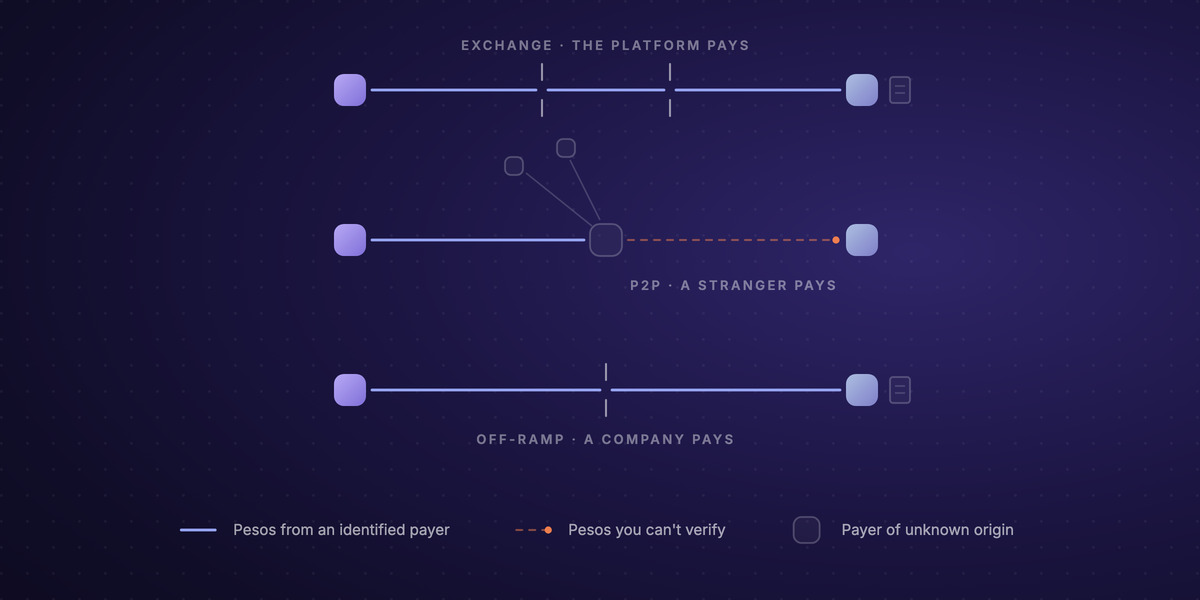
All three are legal. What changes is who pays you the pesos and what trail is left.
| Route | Who pays you the pesos | What you keep as a record | Main risk |
|---|---|---|---|
| Exchange with a COP market | The platform, from its own account | Order and withdrawal history | Platform checks or freezes; which network it accepts |
| P2P (Binance P2P and similar) | A person you don't know, from their account | The order chat and the buyer's payment proof | The buyer's money comes from a fraud and your account goes under review |
| Off-ramp straight to your bank | A company, by local transfer | Receipt with amount, rate and date | Your USDT's network isn't one it accepts |
An exchange with a peso market
You deposit the USDT, sell it on the platform's USDT/COP market and withdraw pesos to your account. The platform pays you the pesos, and it has already verified the identity of everyone buying. You're left with a tidy history your accountant can use. Check two things before depositing: that the platform accepts the network you were paid on, and that it withdraws pesos straight to your bank without routing through a card or an intermediate balance.
P2P: legal, but you carry the risk
In P2P you sell your USDT to another person. The platform holds the USDT while the buyer transfers pesos from their account, and releases it once you confirm the money arrived. Using P2P isn't illegal. The problem is on the peso side: you don't know where that money came from.
The scheme Colombians worry about is well known: someone thinks they're paying for a product through PSE, but the money goes to an account holder on a crypto platform, and the scammer walks away with USDT. Portafolio described it in September 2026. If yours is the account that received that payment, the transfer points to you when the victim files a complaint, and the bank can put the account under review while it checks. You did everything right and you're still in the middle.
If P2P is your only option: sell only to buyers paying from an account in their own name that matches the verified name on the platform; don't accept third-party payments or cash deposits; and keep the chat and payment proof for every order.
An off-ramp straight to your bank
An off-ramp converts the USDT and sends pesos to your account as a local transfer. The pesos come from a company, not a private individual, and the receipt states what you sold, at what rate and when. It's the route with the cleanest trail. How it works with us is below.
How a USDT payment is taxed
This is the part most people leave for later, and the one that matters most if the DIAN asks. Everything here comes from the DIAN's unified opinion on crypto assets (Concepto 18075 of 2023) and the Tax Code (Estatuto Tributario).
- The payment is income in kind. The DIAN treats a crypto payment under a services contract as payment in kind. If you're an individual who doesn't keep formal accounts, the income is realized when you receive it, at the commercial value of what you received at that moment (articles 27 and 29 of the Tax Code). If a client pays you 1,000 USDT, that day you have income equal to what 1,000 USDT is worth in pesos, even if you haven't sold it yet.
- Selling it is a separate event. For tax purposes USDT is an intangible asset. If its peso price moved between the day you received it and the day you sell (USDT tracks the dollar, and the dollar moves against the peso), that difference is a separate result: ordinary income, or an occasional gain if you held it as a fixed asset for more than two years. For someone who sells within days, it's usually a small number.
- What you hold on December 31 goes on the return. Crypto assets you hold at year end are included in your net worth, at their tax cost.
- The filing threshold doesn't change. Using the 2026 UVT, you must file an income tax return if your gross income for the year exceeds 1,400 UVT (COP 73,323,600), among other thresholds. USDT payments count toward that total.
- The 4x1000 is charged on the way out. Receiving pesos doesn't trigger the GMF; moving them afterwards does, except from the account you've marked as exempt (up to 350 UVT a month, COP 18,330,900 in 2026). Have the pesos land in that account.
How to cash out USDT to pesos with Localbridge
This is the only section of the article about us. Localbridge has an individual account built for income from companies abroad: the client paying for your work, a platform, an employer. The account includes a stablecoin wallet, and your client's USDT payment can land there. Check the network before your client pays: the wallet works on Solana, Base and Ethereum, and Tron isn't on that list today. If your client usually pays over Tron, ask them to use Solana or Ethereum.
When you want pesos, you convert the amount you choose, see the exchange rate before you confirm, and the pesos arrive in your Colombian bank account via Bre-B or bank transfer. You get a receipt with the amount, the rate applied and the date, which is the record your bank or accountant would ask for. There's no fixed fee per incoming payment: you pay a percentage of what you convert, published on the pricing page.
Next time you can skip the USDT. The same account gives you US dollar payment details, and your client pays you by ACH like any US vendor. The payment converts to USDC or USDT on arrival and the rest works the same way. Your client doesn't need to know anything about crypto, and the payment is on record in the banking system from the first step.
Localbridge never holds your funds: accounts and conversion run on partners' regulated infrastructure, the balance isn't a bank deposit, and pesos always go to an external bank account.
Two honest limits. The individual account receives payments from companies and platforms, not from other people: if the person paying you USDT is a private individual, this isn't the tool. And it isn't for invoicing as a business; that's what the business account is for. The full loop to local currency is live today for Colombia, Mexico and Brazil.
FAQ
Is it legal to sell USDT in Colombia? Yes. No law prohibits or specifically regulates buying and selling crypto assets. Banco de la República doesn't treat them as money or foreign currency, so a sale isn't a foreign-exchange transaction, and the Superintendencia Financiera doesn't supervise the platforms. Tax law does apply: what you earn in USDT gets declared.
How do I convert USDT to Colombian pesos? Three ways: sell it on an exchange with a COP market and withdraw to your bank, sell it P2P to someone who transfers you the pesos, or use an off-ramp that converts the USDT and sends pesos to your account by local transfer. All three are legal; the difference is who pays you the pesos and what record you keep.
How much is 1 USDT in Colombian pesos? About one dollar at the day's TRM, minus the margin of the platform you sell on. Because USDT tracks the dollar, its peso price rises and falls with the dollar. Compare the quote with the TRM before you confirm the sale.
Do I have to declare USDT a client paid me? Yes. For the DIAN it's income in kind for your services, at the peso value of the USDT on the day you received it. If you later sell at a different price, that difference is treated separately, and if you still hold it on December 31 it goes into your net worth.
Can my bank freeze my account for selling USDT? Selling USDT isn't prohibited, but your bank has to know where your incoming money comes from and can put the account under review while it checks. That happens mostly when pesos come from strangers, as in P2P. With the contract, the payment hash and the sale receipt you can answer quickly.
Is Binance P2P legal in Colombia? Using a P2P platform isn't illegal. The risk is practical: the pesos come from a private individual whose money you can't verify. If you use it, sell only to buyers paying from an account in their own name and keep the chat and payment proof for every order.
Which network should I receive USDT on? The one supported by the platform where you'll sell. Tron (TRC-20) is the most used and cheap for payments; Solana is cheap too; Ethereum is the most expensive. Confirm the network with your client before they send: a payment on the wrong network can be lost.
Can my client pay me in dollars instead of USDT? Yes, if you have US dollar payment details. With a Localbridge individual account your client pays you by ACH like a US vendor, the payment converts to stablecoins on arrival, and you move to pesos in your Colombian account whenever you decide.