
USDC Payments: How They Work and How to Accept Them
How USDC payments work: networks and fees, why they can't be reversed, how they compare with cards and wires, and three ways a business can accept USDC and turn it into money in the bank.

A USDC payment is a transfer of USD Coin, a dollar-pegged stablecoin, from one wallet to another over a blockchain. The money moves directly from the payer to you, settles in seconds, and is final the moment it lands. No card network, no correspondent bank, no five-day wait. With about $73 billion of USDC in circulation as of mid-2026 and checkout support arriving at millions of online stores, USDC has quietly become a normal way for clients to pay invoices and for shoppers to pay merchants.
This post explains the mechanics: how a payment actually moves, what it costs on each network, why finality cuts both ways, and the three practical routes for accepting USDC as a freelancer or business.
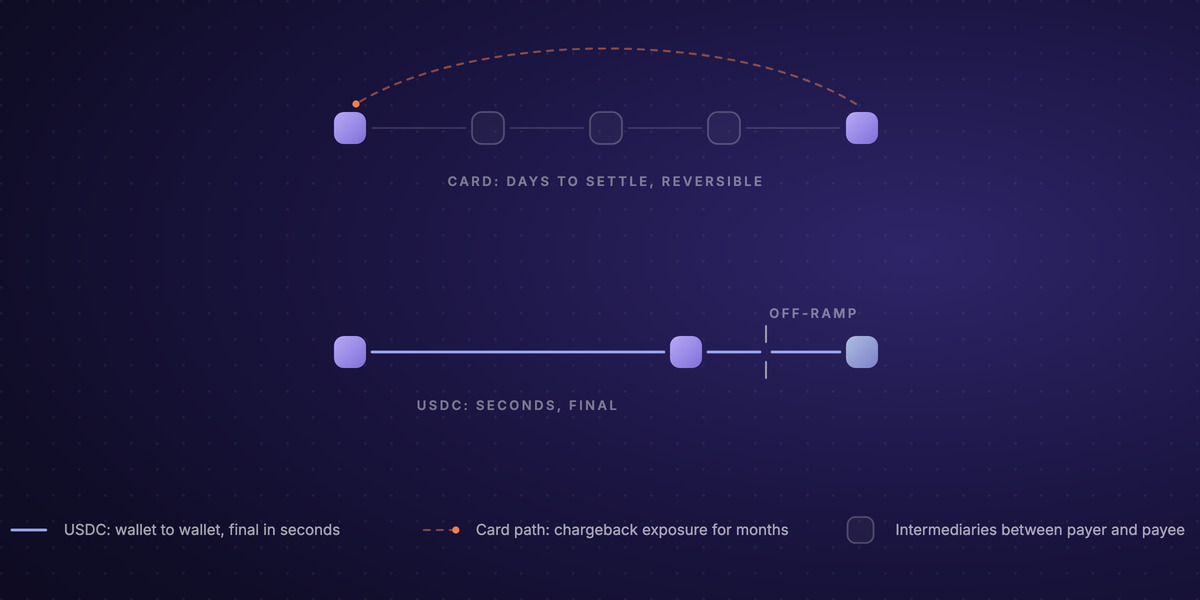
How a USDC payment actually works
A card payment is a pull: you hand over your card details, and the merchant's processor reaches into your account through a chain of intermediaries. A USDC payment is a push. The payer opens their wallet, enters your address, and sends. The blockchain confirms the transfer, usually in seconds, and the tokens are yours.
Three practical consequences follow from that design:
- You share an address, not your banking details. A payment request is a wallet address (or a payment link that wraps one) plus the network it lives on.
- The network matters. USDC exists on many chains, and the payer must send on one you can receive on. Base, Solana, and Ethereum carry most payment traffic; sending on the wrong network is the classic way money gets lost.
- Settlement is the payment. There's no "pending" state that a bank later reverses. Once confirmed on-chain, the transfer is done, nights, weekends, and holidays included.
Payment finality cuts both ways
There are no chargebacks in USDC. For anyone selling across borders, that's the headline feature: a client's bank can't claw a payment back three months later, and "the wire got recalled" stops being a thing. Exporters and agencies that eat chargeback fraud on cards tend to notice the difference in their margins first.
The same property puts the risk on the payer. If you send USDC to the wrong address, no one can retrieve it. A refund isn't a reversal; it's a new payment the recipient chooses to send. So businesses double-check addresses, use payment links instead of hand-typed addresses where possible, and test large first-time transfers with a small amount. Boring habits, real money saved.
What a USDC payment costs
The transfer itself is close to free on modern networks. The real costs sit at the edges, where dollars become USDC and where USDC becomes bank money again; that second edge is the off-ramp.
| Method | Typical cost to move $1,000 | Settlement |
|---|---|---|
| USDC on Base | Under a cent | Seconds |
| USDC on Solana | Fractions of a cent | Seconds |
| USDC on Ethereum | A few dollars, more when the network is busy | Minutes |
| Card payment | ~2.9% + $0.30 (about $29) | Days to settle, months of chargeback exposure |
| International wire | $15–50 plus FX spread | 2–5 business days |
Compare the whole journey, though, not just the transfer. If your client pays $1,000 in USDC and you convert it to your local currency, your true cost is the network fee plus whatever the conversion takes. That total is usually still far below a wire plus a retail bank's FX rate, but a "free" transfer followed by a bad conversion rate can quietly give the advantage back.
Where you can already pay with USDC
Paying is the easy half. Anyone with a wallet and a USDC balance can pay anyone with an address, and mainstream checkout is catching up fast: Shopify Payments now lets merchants in 34 countries accept USDC on Base, built with Coinbase and Stripe, with hundreds of wallets supported at checkout. On the B2B side, growth is steeper still. Research from Artemis put business-to-business stablecoin payments past $3 billion a month in 2025, growing more than 700% year over year, and most of that is ordinary companies paying ordinary invoices.
The US regulatory question has also settled. Since the GENIUS Act became law in July 2025, dollar stablecoins operate under an explicit federal framework, and USDC's issuer Circle positioned for the regime early. Accepting USDC in 2026 doesn't require a view on crypto; it requires a view on payment costs.
How to accept USDC payments
Three routes, matched to three situations.
1. A wallet you run yourself. Install a wallet, share the address, receive USDC. This is the zero-permission route and it genuinely works for small volumes. You also take on everything: securing keys, checking networks, converting to spendable money through some separate service, and building records your accountant can use. Fine for a first payment; creaky as a monthly income routine.
2. A checkout processor. If you sell products online, Shopify-style USDC checkout is the low-friction option: the buyer pays from their wallet, and you receive local currency by default through the payments stack you already use. It's built for cart-sized retail transactions, not for a $20,000 invoice from a client abroad.
3. A business account with the conversion built in. For invoice-shaped income, the missing piece isn't the receiving address; it's everything after. With Localbridge, a business or freelancer gets a wallet for USDC (and USDT) where client payments arrive on-chain, plus the off-ramp in the same account: convert at a rate shown before you confirm, and send real money out over local rails to any external bank account. Dollars by ACH, euros by SEPA, pesos by SPEI, reais by Pix, yours or a supplier's. On-chain transactions cost 0.5%, verification is proper KYB, not a consumer app's selfie check, and every conversion leaves a record with a rate and a timestamp. We wrote up the business case separately in stablecoin off-ramps for business.
The honest test for choosing: look at what your USDC needs to become. If the answer is "local currency in a bank account, every month", pick the route where that step is native rather than bolted on.
FAQ
Are USDC payments reversible? No. Once confirmed on-chain, a USDC transfer is final. A refund is a new payment sent back by the recipient. That's why payers verify addresses carefully and why sellers like the format: there is no chargeback mechanism at all.
Which network should I use for USDC payments? Whichever both sides support, with cost as the tiebreaker. Base and Solana settle in seconds for under a cent; Ethereum is more expensive but universally supported. The non-negotiable rule: the sending and receiving network must match.
Can I accept USDC without handling crypto myself? Yes. Checkout processors like Shopify Payments convert to local currency by default, and a business account like Localbridge holds the USDC and converts it when you choose, so you work in balances and payments, never in keys and gas fees.
Is getting paid in USDC taxable? Payment in USDC is income at its dollar value when received, like being paid in any currency. Converting it to fiat later is usually a separate reportable event with near-zero gain, since USDC tracks the dollar. Rules vary by country; this isn't tax advice.
Do USDC payments work on weekends? Yes, around the clock. Blockchains don't have banking hours, which is precisely why a client can settle an invoice on Saturday and you can convert it to pesos or euros on Sunday.
What about USDT instead of USDC? Both are dollar stablecoins and the payment mechanics are identical. They differ on reserves, regulation, and where each is licensed; USDT vs USDC covers when the difference matters.